

occurring pesticide for nonresistant species, such as Vitis vinifera L., the most
widely cultivated grape species in winemaking.
Furthermore, stilbenes have been reported to possess health promoting
compounds with cardioprotective, neuroprotective, and anticancer properties
[4, 5 ]. Trans-resveratrol seems to be one of the most promising compounds due to
its bioactivity. Other stilbenes, such as piceatannol and viniferins, are usually found
in grapes and wine at a lower concentration than resveratrol. Although their bioactivity has received less attention as a consequence, some of their health-promoting
properties are currently being investigated [6]. To sum up, stilbenes are of great
interest thanks to their health-promoting properties.
However, dietary sources of stilbenes are rather scarce, resveratrol, for example,
being found in small quantities in peanuts, berries, grapes, and wines. Grapes and
wine are considered to be the most important sources of stilbenes in the human diet.
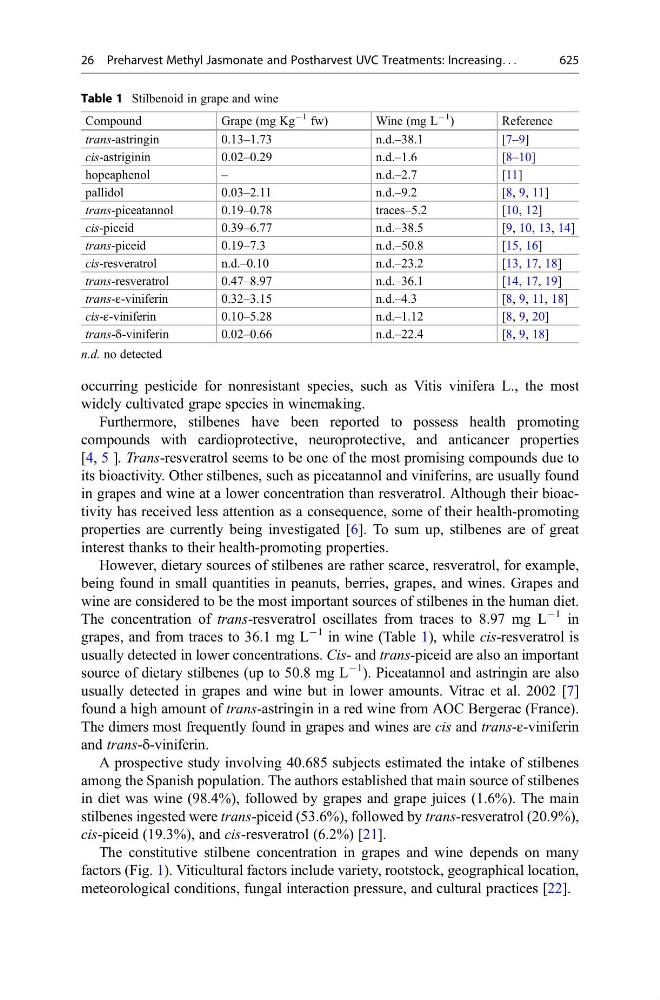
The concentration of trans-resveratrol oscillates from traces to 8.97 mg L
À1 in
grapes, and from traces to 36.1 mg L
À1 in wine (Table 1), while cis-resveratrol is
usually detected in lower concentrations. Cis- and trans-piceid are also an important
source of dietary stilbenes (up to 50.8 mg L
À1 ). Piceatannol and astringin are also
usually detected in grapes and wine but in lower amounts. Vitrac et al. 2002 [7]
found a high amount of trans-astringin in a red wine from AOC Bergerac (France).
The dimers most frequently found in grapes and wines are cis and trans-ε-viniferin
and trans-δ-viniferin.
A prospective study involving 40.685 subjects estimated the intake of stilbenes
among the Spanish population. The authors established that main source of stilbenes
in diet was wine (98.4%), followed by grapes and grape juices (1.6%). The main
stilbenes ingested were trans-piceid (53.6%), followed by trans-resveratrol (20.9%),
cis-piceid (19.3%), and cis-resveratrol (6.2%) [21].
The constitutive stilbene concentration in grapes and wine depends on many
factors (Fig. 1). Viticultural factors include variety, rootstock, geographical location,
meteorological conditions, fungal interaction pressure, and cultural practices [22].
Table 1 Stilbenoid in grape and wine
Compound
Grape (mg Kg
À1 fw)
Wine (mg L
À1
)
Reference
trans-astringin
0.13–1.73
n.d.–38.1
[7–9]
cis-astriginin
0.02–0.29
n.d.–1.6
[8–10]
hopeaphenol
–
n.d.–2.7
[11]
pallidol
0.03–2.11
n.d.–9.2
[8, 9, 11]
trans-piceatannol
0.19–0.78
traces–5.2
[10, 12]
cis-piceid
0.39–6.77
n.d.–38.5
[9, 10, 13, 14]
trans-piceid
0.19–7.3
n.d.–50.8
[15, 16]
cis-resveratrol
n.d.–0.10
n.d.–23.2
[13, 17, 18]
trans-resveratrol
0.47–8.97
n.d.–36.1
[14, 17, 19]
trans-ε-viniferin
0.32–3.15
n.d.–4.3
[8, 9, 11, 18]
cis-ε-viniferin
0.10–5.28
n.d.–1.12
[8, 9, 20]
trans-δ-viniferin
0.02–0.66
n.d.–22.4
[8, 9, 18]
n.d. no detected
26 Preharvest Methyl Jasmonate and Postharvest UVC Treatments: Increasing. . .
625