

increasing amount of information obtained at the various scales in accurate models,
and to predict the macroscopic response of the system to control interventions.
Such mechanistic models can provide real insights into critical traits that regulate
invasion success, coexistence, and diversity in eco-evolutionary systems. They can
also guide the design of new assays by indicating relevant processes for further
investigation and prevent excessive experimentation needed to develop effective
control strategies.
In particular, the future of multiscale modeling in biology seems to be promising in an age, the era of “omics,” in which unprecedented views of organisms at
work are being produced. Integrating all the facets of ecology and evolution
beginning at the level of genes cannot rely on intuition alone. Theoretical multiscale approaches might be essential tools to quantitatively describe the complexity
of biological communities and to predict its response to endogenous or exogenous
imbalances. Clearly, computer simulations will be essential for the extensive
investigation of detailed and realistic multiscale models. But, at least in the near
future, in silico ecology will not be able to replace entirely field observations and
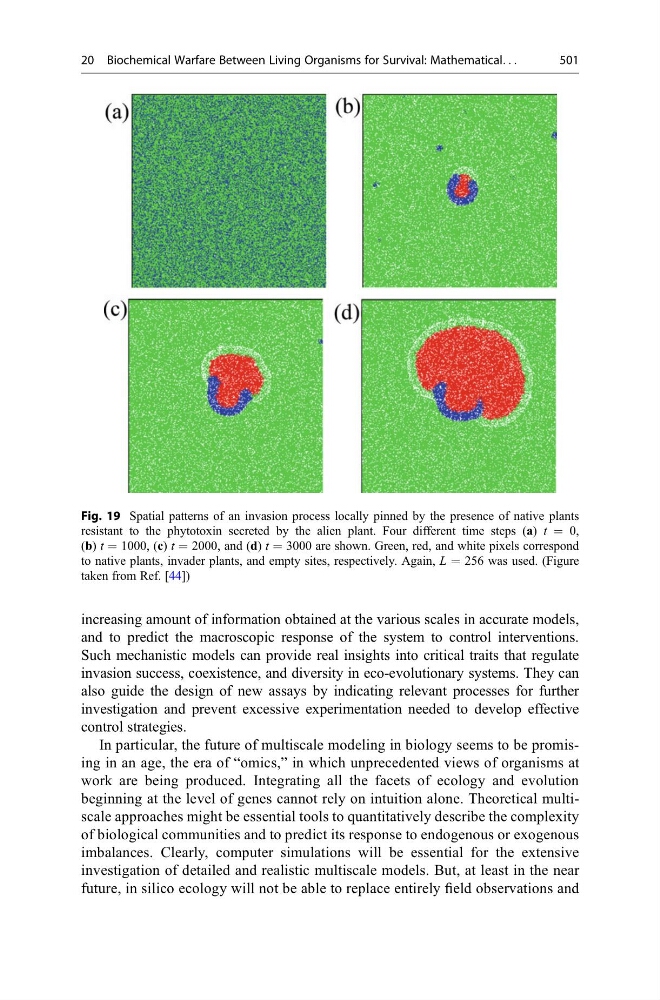
Fig. 19 Spatial patterns of an invasion process locally pinned by the presence of native plants
resistant to the phytotoxin secreted by the alien plant. Four different time steps (a) t = 0,
(b) t = 1000, (c) t = 2000, and (d) t = 3000 are shown. Green, red, and white pixels correspond
to native plants, invader plants, and empty sites, respectively. Again, L = 256 was used. (Figure
taken from Ref. [44])
20 Biochemical Warfare Between Living Organisms for Survival: Mathematical. . .
501
and to predict the macroscopic response of the system to control interventions.
Such mechanistic models can provide real insights into critical traits that regulate
invasion success, coexistence, and diversity in eco-evolutionary systems. They can
also guide the design of new assays by indicating relevant processes for further
investigation and prevent excessive experimentation needed to develop effective
control strategies.
In particular, the future of multiscale modeling in biology seems to be promising in an age, the era of “omics,” in which unprecedented views of organisms at
work are being produced. Integrating all the facets of ecology and evolution
beginning at the level of genes cannot rely on intuition alone. Theoretical multiscale approaches might be essential tools to quantitatively describe the complexity
of biological communities and to predict its response to endogenous or exogenous
imbalances. Clearly, computer simulations will be essential for the extensive
investigation of detailed and realistic multiscale models. But, at least in the near
future, in silico ecology will not be able to replace entirely field observations and
Fig. 19 Spatial patterns of an invasion process locally pinned by the presence of native plants
resistant to the phytotoxin secreted by the alien plant. Four different time steps (a) t = 0,
(b) t = 1000, (c) t = 2000, and (d) t = 3000 are shown. Green, red, and white pixels correspond
to native plants, invader plants, and empty sites, respectively. Again, L = 256 was used. (Figure
taken from Ref. [44])
20 Biochemical Warfare Between Living Organisms for Survival: Mathematical. . .
501