

the ecological factors that possibly determine the pinning-depinning threshold.
Interfering in such factors in order to pinning the invasion front might act as an
effective control strategy of biological invasions.
5
The Future of Theoretical Allelopathy
The complexity and diversity of phenomena underlying species competition, coexistence, and invasions; the range of spatial and temporal scales over which they
act, extending from the molecular to the ecological levels; and the intricate way in
which they are interwoven make practically unfeasible the understanding of the
biochemical warfare between living organisms through intuition alone. The development of quantitative theoretical models for these phenomena, such as the one
presented here, might be a very useful approach to deduce how distinct mechanisms
interact to generate community stability and biodiversity, to integrate the rapidly
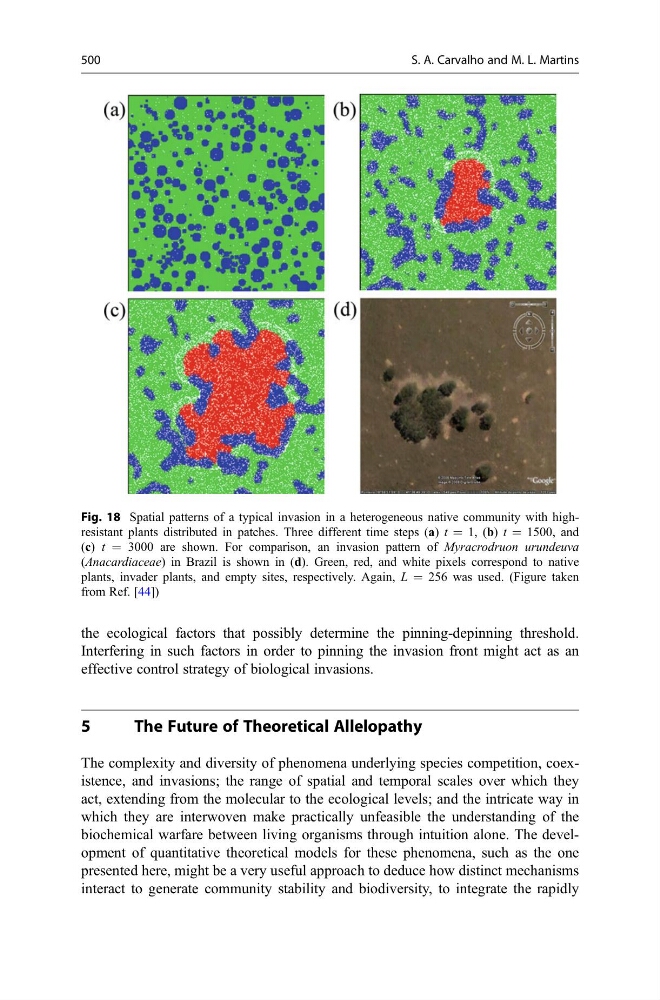
Fig. 18 Spatial patterns of a typical invasion in a heterogeneous native community with highresistant plants distributed in patches. Three different time steps (a) t = 1, (b) t = 1500, and
(c) t = 3000 are shown. For comparison, an invasion pattern of Myracrodruon urundeuva
(Anacardiaceae) in Brazil is shown in (d). Green, red, and white pixels correspond to native
plants, invader plants, and empty sites, respectively. Again, L = 256 was used. (Figure taken
from Ref. [44])
500
S. A. Carvalho and M. L. Martins
Interfering in such factors in order to pinning the invasion front might act as an
effective control strategy of biological invasions.
5
The Future of Theoretical Allelopathy
The complexity and diversity of phenomena underlying species competition, coexistence, and invasions; the range of spatial and temporal scales over which they
act, extending from the molecular to the ecological levels; and the intricate way in
which they are interwoven make practically unfeasible the understanding of the
biochemical warfare between living organisms through intuition alone. The development of quantitative theoretical models for these phenomena, such as the one
presented here, might be a very useful approach to deduce how distinct mechanisms
interact to generate community stability and biodiversity, to integrate the rapidly
Fig. 18 Spatial patterns of a typical invasion in a heterogeneous native community with highresistant plants distributed in patches. Three different time steps (a) t = 1, (b) t = 1500, and
(c) t = 3000 are shown. For comparison, an invasion pattern of Myracrodruon urundeuva
(Anacardiaceae) in Brazil is shown in (d). Green, red, and white pixels correspond to native
plants, invader plants, and empty sites, respectively. Again, L = 256 was used. (Figure taken
from Ref. [44])
500
S. A. Carvalho and M. L. Martins