

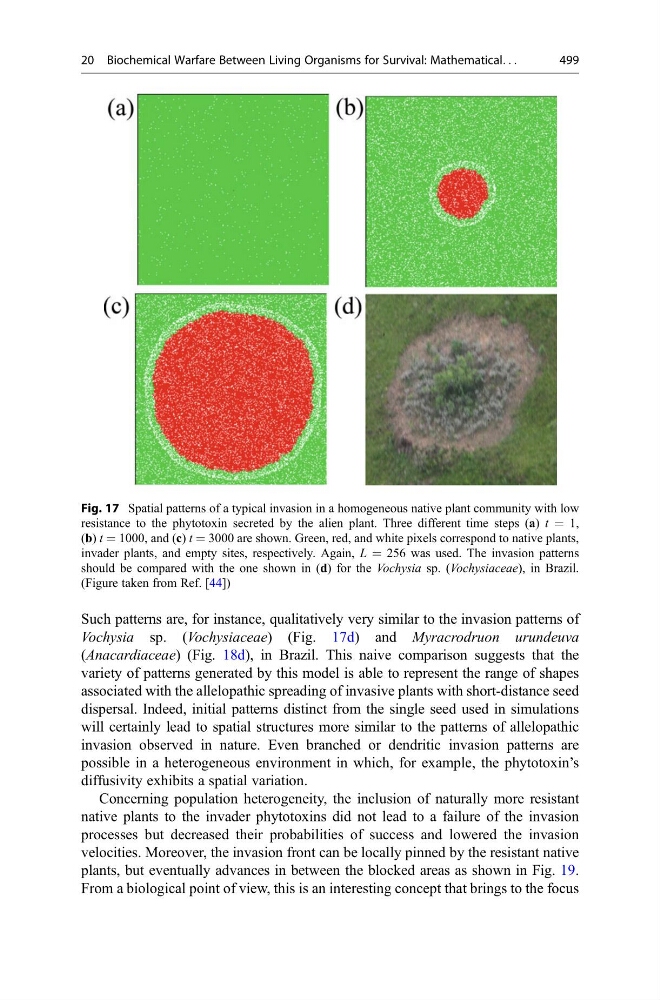
Such patterns are, for instance, qualitatively very similar to the invasion patterns of
Vochysia sp. (Vochysiaceae) (Fig. 17d) and Myracrodruon urundeuva
(Anacardiaceae) (Fig. 18d), in Brazil. This naive comparison suggests that the
variety of patterns generated by this model is able to represent the range of shapes
associated with the allelopathic spreading of invasive plants with short-distance seed
dispersal. Indeed, initial patterns distinct from the single seed used in simulations
will certainly lead to spatial structures more similar to the patterns of allelopathic
invasion observed in nature. Even branched or dendritic invasion patterns are
possible in a heterogeneous environment in which, for example, the phytotoxin’s
diffusivity exhibits a spatial variation.
Concerning population heterogeneity, the inclusion of naturally more resistant
native plants to the invader phytotoxins did not lead to a failure of the invasion
processes but decreased their probabilities of success and lowered the invasion
velocities. Moreover, the invasion front can be locally pinned by the resistant native
plants, but eventually advances in between the blocked areas as shown in Fig. 19.
From a biological point of view, this is an interesting concept that brings to the focus
Fig. 17 Spatial patterns of a typical invasion in a homogeneous native plant community with low
resistance to the phytotoxin secreted by the alien plant. Three different time steps (a) t = 1,
(b) t = 1000, and (c) t = 3000 are shown. Green, red, and white pixels correspond to native plants,
invader plants, and empty sites, respectively. Again, L = 256 was used. The invasion patterns
should be compared with the one shown in (d) for the Vochysia sp. (Vochysiaceae), in Brazil.
(Figure taken from Ref. [44])
20 Biochemical Warfare Between Living Organisms for Survival: Mathematical. . .
499
Vochysia sp. (Vochysiaceae) (Fig. 17d) and Myracrodruon urundeuva
(Anacardiaceae) (Fig. 18d), in Brazil. This naive comparison suggests that the
variety of patterns generated by this model is able to represent the range of shapes
associated with the allelopathic spreading of invasive plants with short-distance seed
dispersal. Indeed, initial patterns distinct from the single seed used in simulations
will certainly lead to spatial structures more similar to the patterns of allelopathic
invasion observed in nature. Even branched or dendritic invasion patterns are
possible in a heterogeneous environment in which, for example, the phytotoxin’s
diffusivity exhibits a spatial variation.
Concerning population heterogeneity, the inclusion of naturally more resistant
native plants to the invader phytotoxins did not lead to a failure of the invasion
processes but decreased their probabilities of success and lowered the invasion
velocities. Moreover, the invasion front can be locally pinned by the resistant native
plants, but eventually advances in between the blocked areas as shown in Fig. 19.
From a biological point of view, this is an interesting concept that brings to the focus
Fig. 17 Spatial patterns of a typical invasion in a homogeneous native plant community with low
resistance to the phytotoxin secreted by the alien plant. Three different time steps (a) t = 1,
(b) t = 1000, and (c) t = 3000 are shown. Green, red, and white pixels correspond to native plants,
invader plants, and empty sites, respectively. Again, L = 256 was used. The invasion patterns
should be compared with the one shown in (d) for the Vochysia sp. (Vochysiaceae), in Brazil.
(Figure taken from Ref. [44])
20 Biochemical Warfare Between Living Organisms for Survival: Mathematical. . .
499