

This equation includes the simplest diffusive dynamics, the synthesis of the
phytotoxin by the alien plants and its natural degradation in time as the only
mechanisms involved in the spatiotemporal variation of the phytotoxin concentration. On the right hand side of this equation, the Laplacian term represents the Fick’s
diffusion which tends to equalize in space the phytotoxin concentration through its
flux from regions of high concentrations to regions of low concentrations. In turn,
the term containing a sum over Dirac delta functions δ x
! À x
!
i t
ð Þ
models the
synthesis of phytotoxins by spatially localized sources (invader plants) at sites x
!
i in
time t. At last, the third term on the right hand side of the equation represents the
degradation of the phytotoxin in proportion to its local, instantaneous concentration.
In Eq. (8), D is the diffusion constant of the phytotoxin, and β and γ are its rates of
synthesis and degradation, respectively. Thus, the γ term in this equation sets up a
characteristic interaction distance between plants.
Dirichlet boundary conditions are imposed to the phytotoxin concentration field.
The diffusion constant D and production and degradation rates, β and γ, respectively,
are model parameters controlling phytotoxin dynamics. All of them are assumed
constant in the model. Eq. (8) is numerically solved through relaxational methods on
a square lattice with a lattice unit equals to the radius of the plant rhizosphere.
4.2.2 The Mesoscopic Scale: Plant-Fitotoxins Interactions
Initially, all patches in the landscape are occupied by the native species, except the
center of the lattice invaded by an alien plant. Each plant is a cellular automaton
(CA) [45, 46] or simply an individual agent. The initial ages of plants are drawn
stochastically with uniform probability in the range 1 to t max , the maximum longevity permitted, a parameter model. The effects of competition operate primarily on the
individual, eventually affecting its reproduction, survival, and dispersal. The following interaction rules define the CA evolution.
Plant reproduction. The plants can begin to disperse seeds at the age t m
corresponding to the onset of reproductive maturity. Mature plants produce seeds
with a probability p s = (t max À t m )
À1 , meaning that in average each one produces
a seed crop along their life cycle. Every invader plant produces n 0 seeds, whereas
native ones have their seed production affected by the local phytotoxin concentration
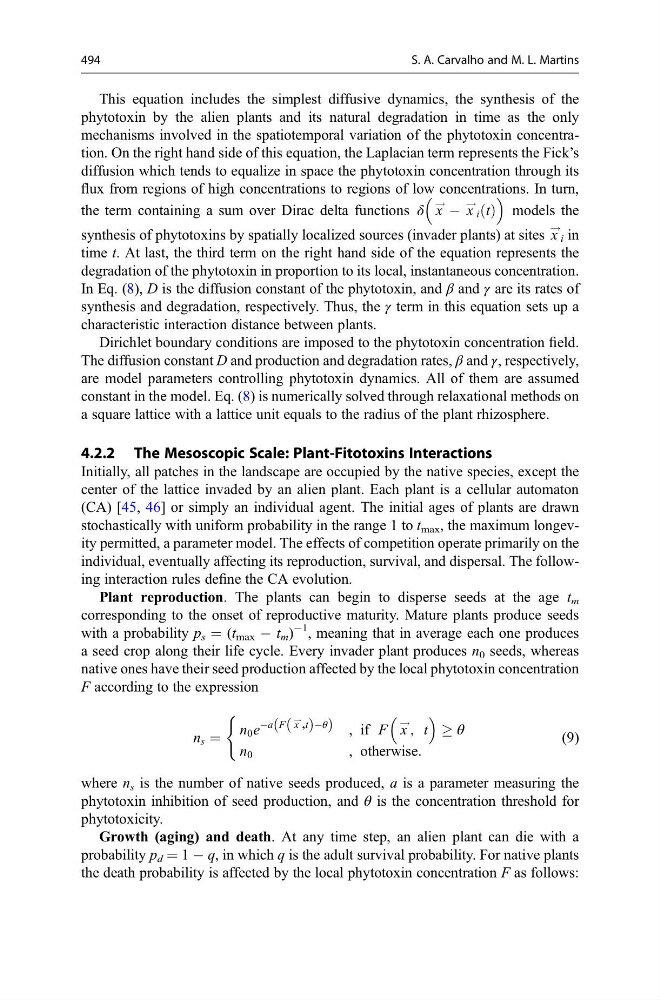
F according to the expression
n s ¼
n 0 e
Àa F x
!
,t
ð ÞÀθ
ð
Þ , if F x
!
, t
! θ
n 0
, otherwise:
(
(9)
where n s is the number of native seeds produced, a is a parameter measuring the
phytotoxin inhibition of seed production, and θ is the concentration threshold for
phytotoxicity.
Growth (aging) and death. At any time step, an alien plant can die with a
probability p d = 1 À q, in which q is the adult survival probability. For native plants
the death probability is affected by the local phytotoxin concentration F as follows:
494
S. A. Carvalho and M. L. Martins
phytotoxin by the alien plants and its natural degradation in time as the only
mechanisms involved in the spatiotemporal variation of the phytotoxin concentration. On the right hand side of this equation, the Laplacian term represents the Fick’s
diffusion which tends to equalize in space the phytotoxin concentration through its
flux from regions of high concentrations to regions of low concentrations. In turn,
the term containing a sum over Dirac delta functions δ x
! À x
!
i t
ð Þ
models the
synthesis of phytotoxins by spatially localized sources (invader plants) at sites x
!
i in
time t. At last, the third term on the right hand side of the equation represents the
degradation of the phytotoxin in proportion to its local, instantaneous concentration.
In Eq. (8), D is the diffusion constant of the phytotoxin, and β and γ are its rates of
synthesis and degradation, respectively. Thus, the γ term in this equation sets up a
characteristic interaction distance between plants.
Dirichlet boundary conditions are imposed to the phytotoxin concentration field.
The diffusion constant D and production and degradation rates, β and γ, respectively,
are model parameters controlling phytotoxin dynamics. All of them are assumed
constant in the model. Eq. (8) is numerically solved through relaxational methods on
a square lattice with a lattice unit equals to the radius of the plant rhizosphere.
4.2.2 The Mesoscopic Scale: Plant-Fitotoxins Interactions
Initially, all patches in the landscape are occupied by the native species, except the
center of the lattice invaded by an alien plant. Each plant is a cellular automaton
(CA) [45, 46] or simply an individual agent. The initial ages of plants are drawn
stochastically with uniform probability in the range 1 to t max , the maximum longevity permitted, a parameter model. The effects of competition operate primarily on the
individual, eventually affecting its reproduction, survival, and dispersal. The following interaction rules define the CA evolution.
Plant reproduction. The plants can begin to disperse seeds at the age t m
corresponding to the onset of reproductive maturity. Mature plants produce seeds
with a probability p s = (t max À t m )
À1 , meaning that in average each one produces
a seed crop along their life cycle. Every invader plant produces n 0 seeds, whereas
native ones have their seed production affected by the local phytotoxin concentration
F according to the expression
n s ¼
n 0 e
Àa F x
!
,t
ð ÞÀθ
ð
Þ , if F x
!
, t
! θ
n 0
, otherwise:
(
(9)
where n s is the number of native seeds produced, a is a parameter measuring the
phytotoxin inhibition of seed production, and θ is the concentration threshold for
phytotoxicity.
Growth (aging) and death. At any time step, an alien plant can die with a
probability p d = 1 À q, in which q is the adult survival probability. For native plants
the death probability is affected by the local phytotoxin concentration F as follows:
494
S. A. Carvalho and M. L. Martins