

vice versa, because plant interactions can also alter cell states and consequently the
nature and timing of the subcellular processes at the microscopic scale. In turn, plant
replication and death and the external introduction of new plants, events associated
with the mesoscopic level, lead to new distributions of source/sink of chemical
factors and nutrients as well as generate moving boundary conditions that specify
the boundary-value problem for these continuous fields at the macroscopic level.
Again, in counterpart, the distribution of nutrients and chemical factors in the
landscape, components of the macroscopic physical state of the system, clearly
affect both the microscopic and mesoscopic scales.
Mathematically, the link between the macroscopic, mesoscopic, and microscopic
scales has to be referred to the parameters (growth, death, uptake or absorption, and
degradation rates, threshold densities, diffusion coefficients, etc.) characterizing the
model. Each parameter refers to a given phenomenon and has a particular effect on
a specific plant population, or a chemical substance, or a subcellular process
occurring in a plant species. Some of the parameters can be evaluated from biological essays, obtained from generic databases or derived from mathematical models.
So, plant invasion, sometimes called the green cancer, is neatly a
multiscale, nonlinear dynamical problem as it is tumor growth in multicellular
organisms [42, 43]. The fundamental evolution of these problems cannot be quantitatively described without the help of mathematical models.
4.2
A Multiscale Model for Allelopathic Suppression
The best way to illustrate how multiscale modeling works is to discuss a typical
example. Here, an agent-based model for allelochemical suppression in plants,
proposed by our group [44], is considered. This model integrates the plant (mesoscopic) and landscape (macroscopic) scales in plant invasion mediated by allelopathy. Specifically, it introduces an effective stochastic kinetics controlled by local
probabilities as a strategy to connect the macroscopic diffusion equations for
fitotoxins to plant response and interactions at the mesoscopic scale, a central
challenge in developing multiscale models.
4.2.1 The Macroscopic Scale: Fitotoxins’ Diffusion on the Landscape
The homogeneous environment is represented by a square lattice of L Â L identical
patches. Each patch or site has a size scale comparable to those of the plants’
rhizosphere. Fixed, null boundary conditions simulating a closed system are used.
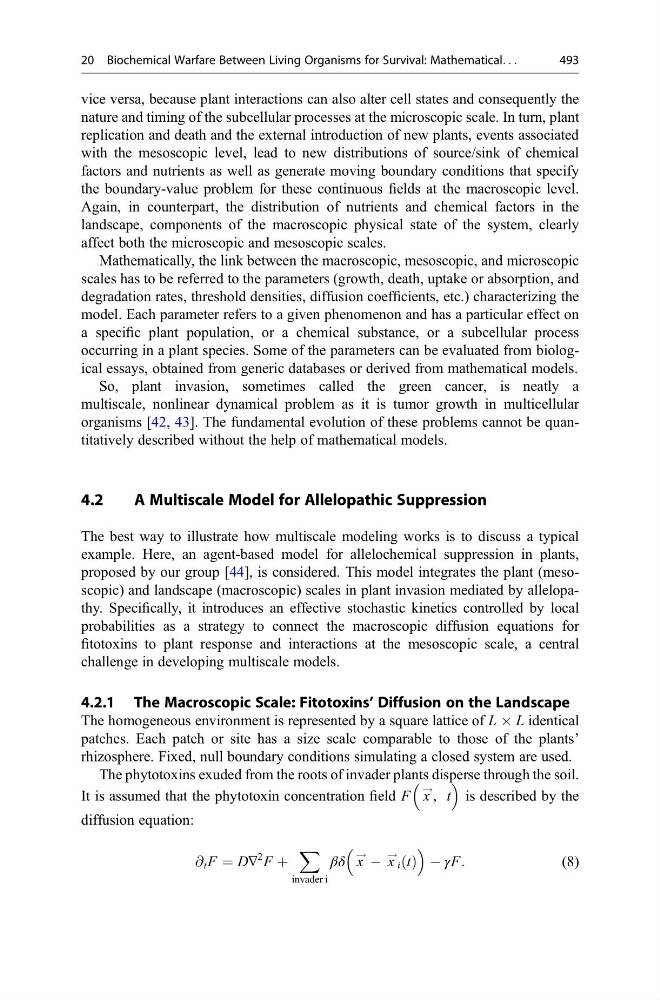
The phytotoxins exuded from the roots of invader plants disperse through the soil.
It is assumed that the phytotoxin concentration field F x
! , t
is described by the
diffusion equation:
@ t F ¼ D∇
2 F þ
X
invader i
βδ x
! À x
!
i t
ð Þ
À γF:
(8)
20 Biochemical Warfare Between Living Organisms for Survival: Mathematical. . .
493
nature and timing of the subcellular processes at the microscopic scale. In turn, plant
replication and death and the external introduction of new plants, events associated
with the mesoscopic level, lead to new distributions of source/sink of chemical
factors and nutrients as well as generate moving boundary conditions that specify
the boundary-value problem for these continuous fields at the macroscopic level.
Again, in counterpart, the distribution of nutrients and chemical factors in the
landscape, components of the macroscopic physical state of the system, clearly
affect both the microscopic and mesoscopic scales.
Mathematically, the link between the macroscopic, mesoscopic, and microscopic
scales has to be referred to the parameters (growth, death, uptake or absorption, and
degradation rates, threshold densities, diffusion coefficients, etc.) characterizing the
model. Each parameter refers to a given phenomenon and has a particular effect on
a specific plant population, or a chemical substance, or a subcellular process
occurring in a plant species. Some of the parameters can be evaluated from biological essays, obtained from generic databases or derived from mathematical models.
So, plant invasion, sometimes called the green cancer, is neatly a
multiscale, nonlinear dynamical problem as it is tumor growth in multicellular
organisms [42, 43]. The fundamental evolution of these problems cannot be quantitatively described without the help of mathematical models.
4.2
A Multiscale Model for Allelopathic Suppression
The best way to illustrate how multiscale modeling works is to discuss a typical
example. Here, an agent-based model for allelochemical suppression in plants,
proposed by our group [44], is considered. This model integrates the plant (mesoscopic) and landscape (macroscopic) scales in plant invasion mediated by allelopathy. Specifically, it introduces an effective stochastic kinetics controlled by local
probabilities as a strategy to connect the macroscopic diffusion equations for
fitotoxins to plant response and interactions at the mesoscopic scale, a central
challenge in developing multiscale models.
4.2.1 The Macroscopic Scale: Fitotoxins’ Diffusion on the Landscape
The homogeneous environment is represented by a square lattice of L Â L identical
patches. Each patch or site has a size scale comparable to those of the plants’
rhizosphere. Fixed, null boundary conditions simulating a closed system are used.
The phytotoxins exuded from the roots of invader plants disperse through the soil.
It is assumed that the phytotoxin concentration field F x
! , t
is described by the
diffusion equation:
@ t F ¼ D∇
2 F þ
X
invader i
βδ x
! À x
!
i t
ð Þ
À γF:
(8)
20 Biochemical Warfare Between Living Organisms for Survival: Mathematical. . .
493