

ions, protein secretion, and exudation of micro- and macromolecular metabolites
by root border and epidermal cells, etc.
• The mesoscopic scale refers to physiological processes occurring in the rhizosphere or at plant level such as root-root and root-microbe communications, root
colonization and growth, seed germination, waves of cell death along the roots,
seedling mortality, reduced shoot differentiation, and inhibition of plant growth
elicited by phytotoxins, etc.
• The macroscopic scale concerns with processes occurring at the ecosystem
level such as invasion fronts, convection and diffusion of nutrients and chemical
compounds, seed dispersion, community integration and coevolution, chemical
patterning of the soil, etc.
In a multiscale approach, each scale of interest is described in terms of distinct
physical models, and all of them are coupled in a single model [40, 41]. Such
interwoven levels of description is the main feature typifying multiscale models,
neatly evidenced in the general framework expressed through model Eqs. (8, 9, 10,
11, 12, 13, and 14), introduced in the next subsection. Indeed, phenomena at the
cellular level (microscopic scale) affect the plant dynamics (mesoscopic scale) and
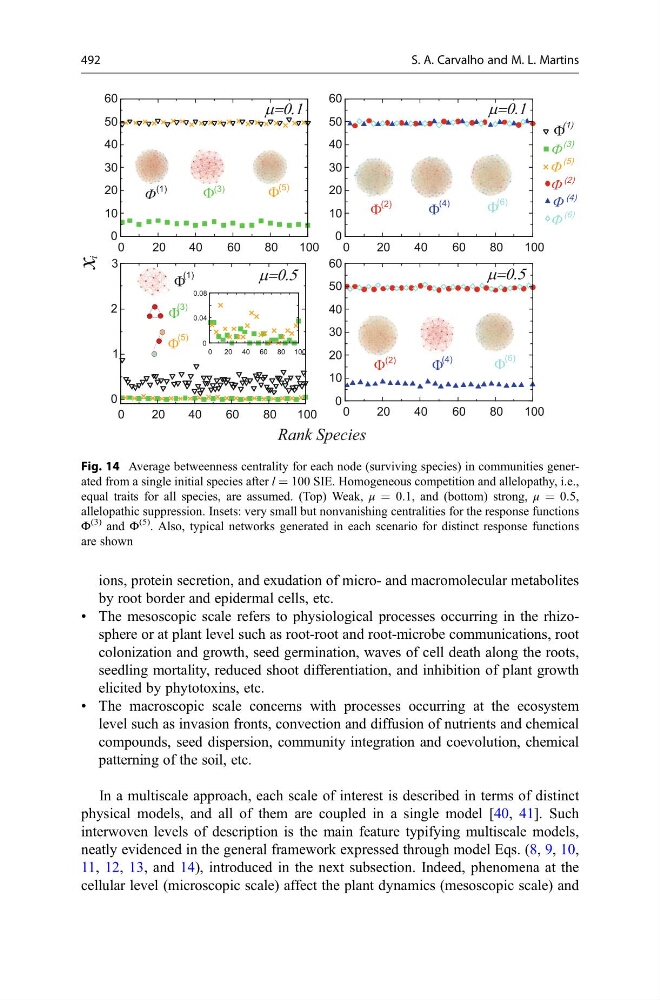
Fig. 14 Average betweenness centrality for each node (surviving species) in communities generated from a single initial species after l = 100 SIE. Homogeneous competition and allelopathy, i.e.,
equal traits for all species, are assumed. (Top) Weak, μ = 0.1, and (bottom) strong, μ = 0.5,
allelopathic suppression. Insets: very small but nonvanishing centralities for the response functions
Φ
(3) and Φ
(5)
. Also, typical networks generated in each scenario for distinct response functions
are shown
492
S. A. Carvalho and M. L. Martins
by root border and epidermal cells, etc.
• The mesoscopic scale refers to physiological processes occurring in the rhizosphere or at plant level such as root-root and root-microbe communications, root
colonization and growth, seed germination, waves of cell death along the roots,
seedling mortality, reduced shoot differentiation, and inhibition of plant growth
elicited by phytotoxins, etc.
• The macroscopic scale concerns with processes occurring at the ecosystem
level such as invasion fronts, convection and diffusion of nutrients and chemical
compounds, seed dispersion, community integration and coevolution, chemical
patterning of the soil, etc.
In a multiscale approach, each scale of interest is described in terms of distinct
physical models, and all of them are coupled in a single model [40, 41]. Such
interwoven levels of description is the main feature typifying multiscale models,
neatly evidenced in the general framework expressed through model Eqs. (8, 9, 10,
11, 12, 13, and 14), introduced in the next subsection. Indeed, phenomena at the
cellular level (microscopic scale) affect the plant dynamics (mesoscopic scale) and
Fig. 14 Average betweenness centrality for each node (surviving species) in communities generated from a single initial species after l = 100 SIE. Homogeneous competition and allelopathy, i.e.,
equal traits for all species, are assumed. (Top) Weak, μ = 0.1, and (bottom) strong, μ = 0.5,
allelopathic suppression. Insets: very small but nonvanishing centralities for the response functions
Φ
(3) and Φ
(5)
. Also, typical networks generated in each scenario for distinct response functions
are shown
492
S. A. Carvalho and M. L. Martins