

p d ¼
1 À qe
Àb F x
!
,t
ð ÞÀθ
½
, if plant
’ s age
t e and F x
! , t
! θ
1 À q
, otherwise:
(
(10)
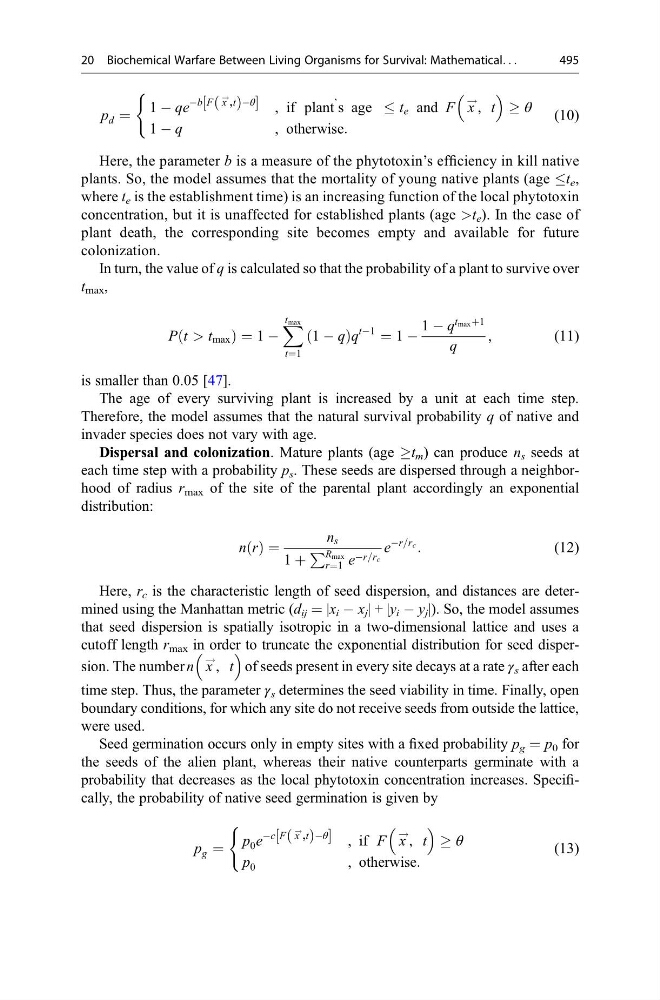
Here, the parameter b is a measure of the phytotoxin’s efficiency in kill native
plants. So, the model assumes that the mortality of young native plants (age t e ,
where t e is the establishment time) is an increasing function of the local phytotoxin
concentration, but it is unaffected for established plants (age >t e ). In the case of
plant death, the corresponding site becomes empty and available for future
colonization.
In turn, the value of q is calculated so that the probability of a plant to survive over
t max ,
P t > t max
ð
Þ¼1 À
X t max
t¼1
1 À q
ð
Þq
tÀ1
¼ 1 À
1 À q
t max þ1
q
,
(11)
is smaller than 0.05 [47].
The age of every surviving plant is increased by a unit at each time step.
Therefore, the model assumes that the natural survival probability q of native and
invader species does not vary with age.
Dispersal and colonization. Mature plants (age !t m ) can produce n s seeds at
each time step with a probability p s . These seeds are dispersed through a neighborhood of radius r max of the site of the parental plant accordingly an exponential
distribution:
n r
ð Þ ¼
n s
1 þ
P R max
r¼1 e Àr=r c
e
Àr=r c :
(12)
Here, r c is the characteristic length of seed dispersion, and distances are determined using the Manhattan metric (d ij = |x i À x j | + |y i À y j |). So, the model assumes
that seed dispersion is spatially isotropic in a two-dimensional lattice and uses a
cutoff length r max in order to truncate the exponential distribution for seed dispersion. The number n x
!
, t
of seeds present in every site decays at a rate γ s after each
time step. Thus, the parameter γ s determines the seed viability in time. Finally, open
boundary conditions, for which any site do not receive seeds from outside the lattice,
were used.
Seed germination occurs only in empty sites with a fixed probability p g = p 0 for
the seeds of the alien plant, whereas their native counterparts germinate with a
probability that decreases as the local phytotoxin concentration increases. Specifically, the probability of native seed germination is given by
p g ¼
p 0 e
Àc F x
!
,t
ð ÞÀθ
½
, if F x
!
, t
! θ
p 0
, otherwise:
(
(13)
20 Biochemical Warfare Between Living Organisms for Survival: Mathematical. . .
495
1 À qe
Àb F x
!
,t
ð ÞÀθ
½
, if plant
’ s age
t e and F x
! , t
! θ
1 À q
, otherwise:
(
(10)
Here, the parameter b is a measure of the phytotoxin’s efficiency in kill native
plants. So, the model assumes that the mortality of young native plants (age t e ,
where t e is the establishment time) is an increasing function of the local phytotoxin
concentration, but it is unaffected for established plants (age >t e ). In the case of
plant death, the corresponding site becomes empty and available for future
colonization.
In turn, the value of q is calculated so that the probability of a plant to survive over
t max ,
P t > t max
ð
Þ¼1 À
X t max
t¼1
1 À q
ð
Þq
tÀ1
¼ 1 À
1 À q
t max þ1
q
,
(11)
is smaller than 0.05 [47].
The age of every surviving plant is increased by a unit at each time step.
Therefore, the model assumes that the natural survival probability q of native and
invader species does not vary with age.
Dispersal and colonization. Mature plants (age !t m ) can produce n s seeds at
each time step with a probability p s . These seeds are dispersed through a neighborhood of radius r max of the site of the parental plant accordingly an exponential
distribution:
n r
ð Þ ¼
n s
1 þ
P R max
r¼1 e Àr=r c
e
Àr=r c :
(12)
Here, r c is the characteristic length of seed dispersion, and distances are determined using the Manhattan metric (d ij = |x i À x j | + |y i À y j |). So, the model assumes
that seed dispersion is spatially isotropic in a two-dimensional lattice and uses a
cutoff length r max in order to truncate the exponential distribution for seed dispersion. The number n x
!
, t
of seeds present in every site decays at a rate γ s after each
time step. Thus, the parameter γ s determines the seed viability in time. Finally, open
boundary conditions, for which any site do not receive seeds from outside the lattice,
were used.
Seed germination occurs only in empty sites with a fixed probability p g = p 0 for
the seeds of the alien plant, whereas their native counterparts germinate with a
probability that decreases as the local phytotoxin concentration increases. Specifically, the probability of native seed germination is given by
p g ¼
p 0 e
Àc F x
!
,t
ð ÞÀθ
½
, if F x
!
, t
! θ
p 0
, otherwise:
(
(13)
20 Biochemical Warfare Between Living Organisms for Survival: Mathematical. . .
495