

their diffusivities and degradation rates. Only within this area allelopathic suppression can be relevant. So, in the case of an invasion focus, the mutual allelopathic
suppressions effectively occur into a rim around the focus. Again, interfacial or
peripheral interactions are established, but without socialized behavior. These interfacial interactions emerge from the combination of allelopathy and patchy population distributions in space. It is just this combination that is lost in the regime of pure
competition in which allelopathy is absent. Accordingly, the tristability is impossible
in classical pure competition. Therefore, our model provides a distinct mechanism
for an emergent tristability independent of social behaviors as those discussed in
reference [30].
2.3
Spatial Patterns for More Species
It is straightforward to generalize system (3) to take into account any number of
species engaged in a biochemical warfare. Such an extension is of paramount
relevance for real ecosystems often involving interactions among more than three
x
-4 -2 0 2 4
y
-4
-2
0
2
4
x
y
0.8
0.6
0
0.2
0.4
1.0
0.8
0.6
0.2
0.4
x
-4 -2 0 2 4
y
-4
-2
0
2
4
y
-4
-2
0
2
4
x
-4 -2 0 2 4
0.9
0.8
0.5
0.6
0.7
y
x
y
-4
-2
0
2
4
x
-4 -2 0 2 4
0.9999999999999
0.9999999999998
0.9999999999997
0.9999999999996
0.9999999999995
0.9999999999994
y
x
y
x
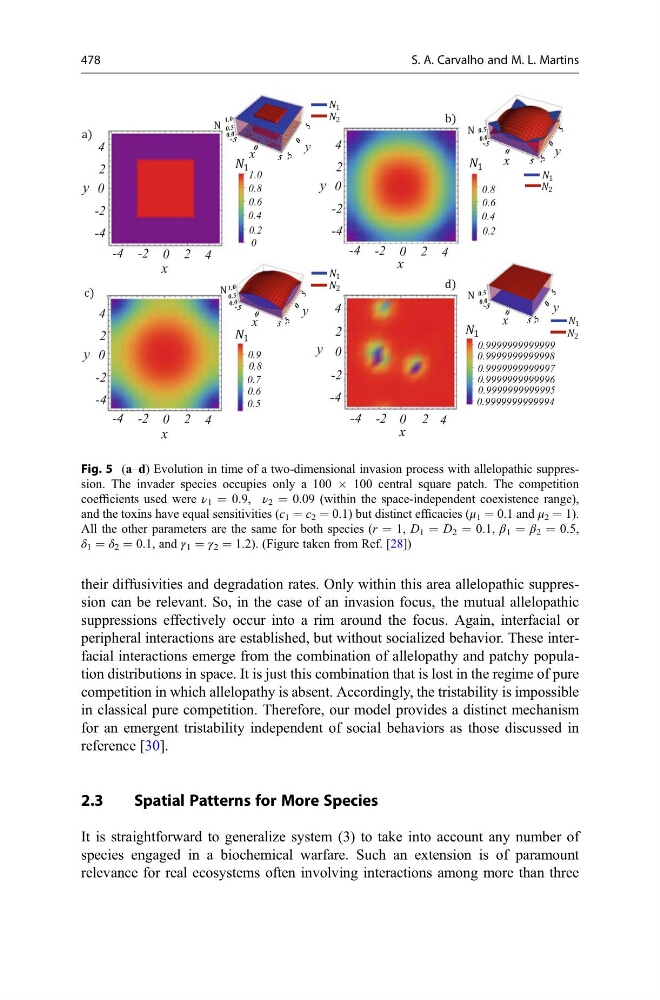
Fig. 5 (a–d) Evolution in time of a two-dimensional invasion process with allelopathic suppression. The invader species occupies only a 100 Â 100 central square patch. The competition
coefficients used were ν 1 = 0.9, ν 2 = 0.09 (within the space-independent coexistence range),
and the toxins have equal sensitivities (c 1 = c 2 = 0.1) but distinct efficacies (μ 1 = 0.1 and μ 2 = 1).
All the other parameters are the same for both species (r = 1, D 1 = D 2 = 0.1, β 1 = β 2 = 0.5,
δ 1 = δ 2 = 0.1, and γ 1 = γ 2 = 1.2). (Figure taken from Ref. [28])
478
S. A. Carvalho and M. L. Martins
suppressions effectively occur into a rim around the focus. Again, interfacial or
peripheral interactions are established, but without socialized behavior. These interfacial interactions emerge from the combination of allelopathy and patchy population distributions in space. It is just this combination that is lost in the regime of pure
competition in which allelopathy is absent. Accordingly, the tristability is impossible
in classical pure competition. Therefore, our model provides a distinct mechanism
for an emergent tristability independent of social behaviors as those discussed in
reference [30].
2.3
Spatial Patterns for More Species
It is straightforward to generalize system (3) to take into account any number of
species engaged in a biochemical warfare. Such an extension is of paramount
relevance for real ecosystems often involving interactions among more than three
x
-4 -2 0 2 4
y
-4
-2
0
2
4
x
y
0.8
0.6
0
0.2
0.4
1.0
0.8
0.6
0.2
0.4
x
-4 -2 0 2 4
y
-4
-2
0
2
4
y
-4
-2
0
2
4
x
-4 -2 0 2 4
0.9
0.8
0.5
0.6
0.7
y
x
y
-4
-2
0
2
4
x
-4 -2 0 2 4
0.9999999999999
0.9999999999998
0.9999999999997
0.9999999999996
0.9999999999995
0.9999999999994
y
x
y
x
Fig. 5 (a–d) Evolution in time of a two-dimensional invasion process with allelopathic suppression. The invader species occupies only a 100 Â 100 central square patch. The competition
coefficients used were ν 1 = 0.9, ν 2 = 0.09 (within the space-independent coexistence range),
and the toxins have equal sensitivities (c 1 = c 2 = 0.1) but distinct efficacies (μ 1 = 0.1 and μ 2 = 1).
All the other parameters are the same for both species (r = 1, D 1 = D 2 = 0.1, β 1 = β 2 = 0.5,
δ 1 = δ 2 = 0.1, and γ 1 = γ 2 = 1.2). (Figure taken from Ref. [28])
478
S. A. Carvalho and M. L. Martins