

species. The aim is to understand the self-organized pattern formation processes
leading to species coexistence, a fundamental problem in ecology and evolutionary
biology [31].
Recently, the paradigm to address the role of population mobility in coexistence
and biodiversity is the three-species cyclic game model rock-paper-scissor (RPS)
[32]. This model and its whole class of variants are based on individual agents and
their rules for dispersion, predation, replication, etc. (the “microscopic” interactions). A hallmark result is that coexistence emerges at small mobilities from the
interactions of entangled rotational spiral waves in the landscape. Since then the
spiral wave patterns are thought to be the basic dynamical structure supporting
coexistence.
In Fig. 7 are shown the spatial patterns and the evolution in time of populations for five species competing for resources and allelopathically suppressing
each other. The five species are linked through cyclic suppressions as
shown in Fig. 7A1. Our results are qualitatively similar to those obtained for the
x
-4 -2 0 2 4
y
-4
-2
0
2
4
0
0.2
0.4
0.6
0.8
1.0
x
-4 -2 0 2 4
y
-4
-2
0
2
4
0
0.2
0.6
1.0
0.4
0.8
y
x
y
x
x
-4 -2 0 2 4
y
-4
-2
0
2
4
0
0.2
0.4
0.8
1.0
0.6
x
y
x
-4 -2 0 2 4
y
-4
-2
0
2
4
0.7142857142856900
1
0.7142857142856800
0.7142857142856700
0.7142857142856500
0.7142857142856601
y
x
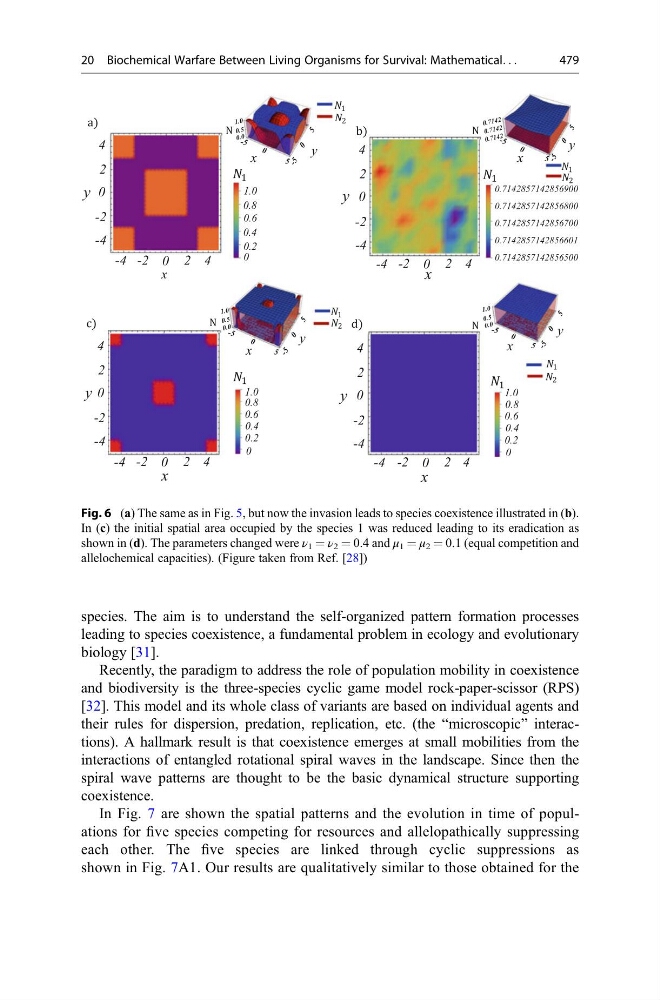
Fig. 6 (a) The same as in Fig. 5, but now the invasion leads to species coexistence illustrated in (b).
In (c) the initial spatial area occupied by the species 1 was reduced leading to its eradication as
shown in (d). The parameters changed were ν 1 = ν 2 = 0.4 and μ 1 = μ 2 = 0.1 (equal competition and
allelochemical capacities). (Figure taken from Ref. [28])
20 Biochemical Warfare Between Living Organisms for Survival: Mathematical. . .
479
leading to species coexistence, a fundamental problem in ecology and evolutionary
biology [31].
Recently, the paradigm to address the role of population mobility in coexistence
and biodiversity is the three-species cyclic game model rock-paper-scissor (RPS)
[32]. This model and its whole class of variants are based on individual agents and
their rules for dispersion, predation, replication, etc. (the “microscopic” interactions). A hallmark result is that coexistence emerges at small mobilities from the
interactions of entangled rotational spiral waves in the landscape. Since then the
spiral wave patterns are thought to be the basic dynamical structure supporting
coexistence.
In Fig. 7 are shown the spatial patterns and the evolution in time of populations for five species competing for resources and allelopathically suppressing
each other. The five species are linked through cyclic suppressions as
shown in Fig. 7A1. Our results are qualitatively similar to those obtained for the
x
-4 -2 0 2 4
y
-4
-2
0
2
4
0
0.2
0.4
0.6
0.8
1.0
x
-4 -2 0 2 4
y
-4
-2
0
2
4
0
0.2
0.6
1.0
0.4
0.8
y
x
y
x
x
-4 -2 0 2 4
y
-4
-2
0
2
4
0
0.2
0.4
0.8
1.0
0.6
x
y
x
-4 -2 0 2 4
y
-4
-2
0
2
4
0.7142857142856900
1
0.7142857142856800
0.7142857142856700
0.7142857142856500
0.7142857142856601
y
x
Fig. 6 (a) The same as in Fig. 5, but now the invasion leads to species coexistence illustrated in (b).
In (c) the initial spatial area occupied by the species 1 was reduced leading to its eradication as
shown in (d). The parameters changed were ν 1 = ν 2 = 0.4 and μ 1 = μ 2 = 0.1 (equal competition and
allelochemical capacities). (Figure taken from Ref. [28])
20 Biochemical Warfare Between Living Organisms for Survival: Mathematical. . .
479