

addition to competition, allelochemical suppression and spatial heterogeneity are in
action. So, our numerical analysis reveals that the present model may exhibit
tristability – eradication of either species 1 or 2 and coexistence – ruled by the
spatial population distributions.
Thus, depending on the initial population distributions in space, the invasion
process can lead to three outcomes, namely, the eradication of the invader organism,
the extinction of the native species, and the coexistence of both invader and native
organisms. Such unexpected tristability was observed even for two species sharing
the same competition coefficients and allelochemical traits. Such major finding is
supported by recently studied ecosystems in which interactions involve the coordinate social behavior of the species as, for instance, gather and hunt in herds [30], i.e.,
nonclassical 1-1 interactions among competing individuals. Instead, since it is
assumed that the individuals in both populations stick together, the interactions
occur mainly via those individuals living at the perimeter of the territory occupied
by the herds.
In system (3) there is no social behavior. Instead, the toxins released by each
individual effectively diffuse throughout an area with a characteristic radius fixed by
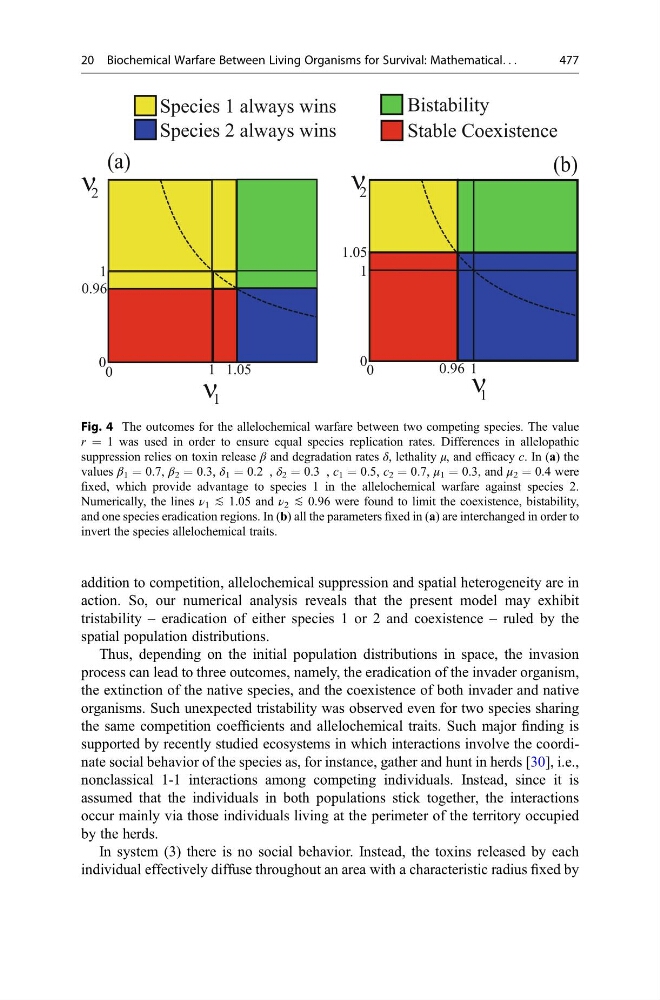
Fig. 4 The outcomes for the allelochemical warfare between two competing species. The value
r = 1 was used in order to ensure equal species replication rates. Differences in allelopathic
suppression relies on toxin release β and degradation rates δ, lethality μ, and efficacy c. In (a) the
values β 1 = 0.7, β 2 = 0.3, δ 1 = 0.2 , δ 2 = 0.3 , c 1 = 0.5, c 2 = 0.7, μ 1 = 0.3, and μ 2 = 0.4 were
fixed, which provide advantage to species 1 in the allelochemical warfare against species 2.
Numerically, the lines ν 1 ≲ 1.05 and ν 2 ≲ 0.96 were found to limit the coexistence, bistability,
and one species eradication regions. In (b) all the parameters fixed in (a) are interchanged in order to
invert the species allelochemical traits.
20 Biochemical Warfare Between Living Organisms for Survival: Mathematical. . .
477
action. So, our numerical analysis reveals that the present model may exhibit
tristability – eradication of either species 1 or 2 and coexistence – ruled by the
spatial population distributions.
Thus, depending on the initial population distributions in space, the invasion
process can lead to three outcomes, namely, the eradication of the invader organism,
the extinction of the native species, and the coexistence of both invader and native
organisms. Such unexpected tristability was observed even for two species sharing
the same competition coefficients and allelochemical traits. Such major finding is
supported by recently studied ecosystems in which interactions involve the coordinate social behavior of the species as, for instance, gather and hunt in herds [30], i.e.,
nonclassical 1-1 interactions among competing individuals. Instead, since it is
assumed that the individuals in both populations stick together, the interactions
occur mainly via those individuals living at the perimeter of the territory occupied
by the herds.
In system (3) there is no social behavior. Instead, the toxins released by each
individual effectively diffuse throughout an area with a characteristic radius fixed by
Fig. 4 The outcomes for the allelochemical warfare between two competing species. The value
r = 1 was used in order to ensure equal species replication rates. Differences in allelopathic
suppression relies on toxin release β and degradation rates δ, lethality μ, and efficacy c. In (a) the
values β 1 = 0.7, β 2 = 0.3, δ 1 = 0.2 , δ 2 = 0.3 , c 1 = 0.5, c 2 = 0.7, μ 1 = 0.3, and μ 2 = 0.4 were
fixed, which provide advantage to species 1 in the allelochemical warfare against species 2.
Numerically, the lines ν 1 ≲ 1.05 and ν 2 ≲ 0.96 were found to limit the coexistence, bistability,
and one species eradication regions. In (b) all the parameters fixed in (a) are interchanged in order to
invert the species allelochemical traits.
20 Biochemical Warfare Between Living Organisms for Survival: Mathematical. . .
477