

competition coefficients are in the range of values that ensure species coexistence in
the homogeneous (space-independent) regime. Figure 5 shows the possibility of a
weaker competitor to invade and eradicate a stronger competitor since it is provided
with more effective allelochemical weapons. In this example, the wave fronts exhibit
constant and isotropic speeds. In turn, Fig. 6 shows an unexpected and very
interesting finding for the interaction between two species having equal competition
and allelochemical traits. In Fig. 6a an invasion process occurs without species
eradication, the predicted outcome at the coexistence regime. However, Fig. 6b, in
which only the initial spatial distributions of the interacting species were altered,
shows an invasion process with one species eradication. Surprisingly, despite equal
competition and allelochemical capacities, the coexistence outcome is replaced by
one species eradication. This outcome is impossible in classical competition, whatever the case may be: space-independent or dependent. But it is possible if, in
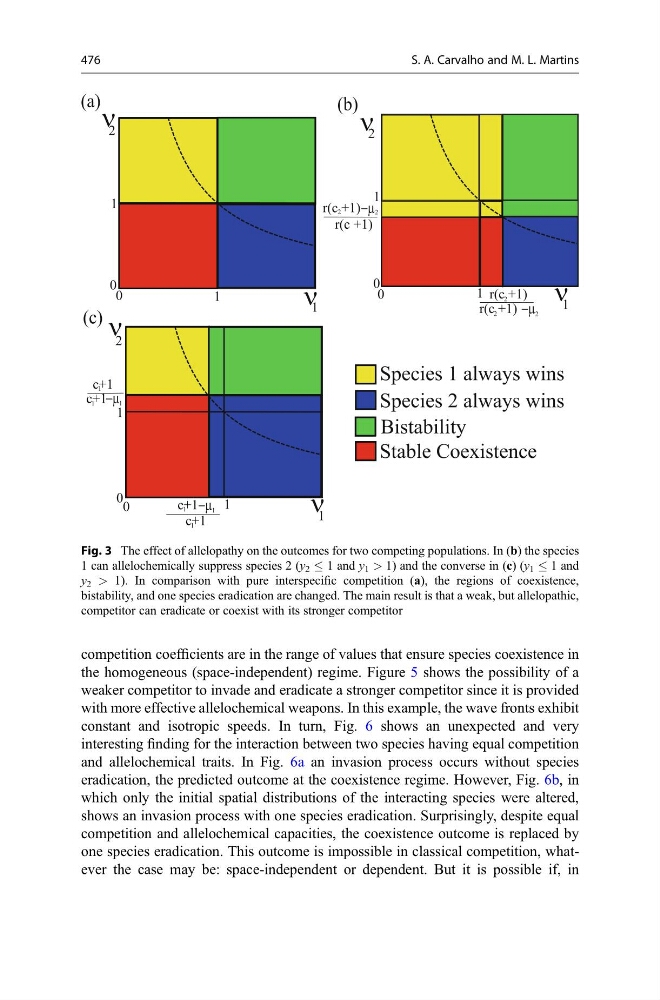
Fig. 3 The effect of allelopathy on the outcomes for two competing populations. In (b) the species
1 can allelochemically suppress species 2 (y 2 1 and y 1 > 1) and the converse in (c) (y 1 1 and
y 2 > 1). In comparison with pure interspecific competition (a), the regions of coexistence,
bistability, and one species eradication are changed. The main result is that a weak, but allelopathic,
competitor can eradicate or coexist with its stronger competitor
476
S. A. Carvalho and M. L. Martins
the homogeneous (space-independent) regime. Figure 5 shows the possibility of a
weaker competitor to invade and eradicate a stronger competitor since it is provided
with more effective allelochemical weapons. In this example, the wave fronts exhibit
constant and isotropic speeds. In turn, Fig. 6 shows an unexpected and very
interesting finding for the interaction between two species having equal competition
and allelochemical traits. In Fig. 6a an invasion process occurs without species
eradication, the predicted outcome at the coexistence regime. However, Fig. 6b, in
which only the initial spatial distributions of the interacting species were altered,
shows an invasion process with one species eradication. Surprisingly, despite equal
competition and allelochemical capacities, the coexistence outcome is replaced by
one species eradication. This outcome is impossible in classical competition, whatever the case may be: space-independent or dependent. But it is possible if, in
Fig. 3 The effect of allelopathy on the outcomes for two competing populations. In (b) the species
1 can allelochemically suppress species 2 (y 2 1 and y 1 > 1) and the converse in (c) (y 1 1 and
y 2 > 1). In comparison with pure interspecific competition (a), the regions of coexistence,
bistability, and one species eradication are changed. The main result is that a weak, but allelopathic,
competitor can eradicate or coexist with its stronger competitor
476
S. A. Carvalho and M. L. Martins