

@ t N 1 ¼
∇
2 N 1 þ 1 À N 1 À ν 1 N 2
ð
Þ N 1 À μ 1 Φ 1 y 2
ð ÞN 1
@ t N 2 ¼
D 1 ∇
2 N 2 þ r 1 À N 2 À ν 2 N 1
ð
Þ N 2 À μ 2 Φ 2 y 1
ð ÞN 2
@ t B 1 ¼
D 2 ∇
2 B 1 þ β 1 N 1 À δ 1 B 1 À y 1
@ t B 2 ¼
D 3 ∇
2 B 2 þ β 2 N 2 À δ 2 B 2 À y 2 ,
8
> > <
> > :
(3)
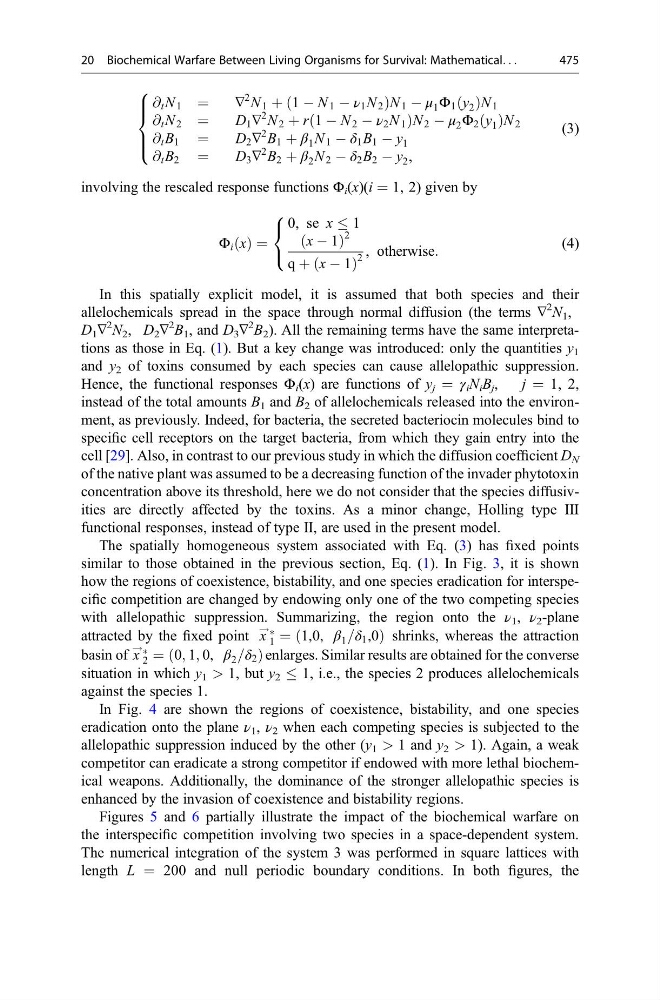
involving the rescaled response functions Φ i (x)(i = 1, 2) given by
Φ i x
ð Þ ¼
0, se x 1
x À 1
ð
Þ
2
q þ x À 1
ð
Þ
2
, otherwise:
8
<
:
(4)
In this spatially explicit model, it is assumed that both species and their
allelochemicals spread in the space through normal diffusion (the terms ∇
2 N 1 ,
D 1 ∇
2 N 2 , D 2 ∇
2 B 1 , and D 3 ∇
2 B 2 ). All the remaining terms have the same interpretations as those in Eq. (1). But a key change was introduced: only the quantities y 1
and y 2 of toxins consumed by each species can cause allelopathic suppression.
Hence, the functional responses Φ i (x) are functions of y j = γ i N i B j ,
j = 1, 2,
instead of the total amounts B 1 and B 2 of allelochemicals released into the environment, as previously. Indeed, for bacteria, the secreted bacteriocin molecules bind to
specific cell receptors on the target bacteria, from which they gain entry into the
cell [29]. Also, in contrast to our previous study in which the diffusion coefficient D N
of the native plant was assumed to be a decreasing function of the invader phytotoxin
concentration above its threshold, here we do not consider that the species diffusivities are directly affected by the toxins. As a minor change, Holling type III
functional responses, instead of type II, are used in the present model.
The spatially homogeneous system associated with Eq. (3) has fixed points
similar to those obtained in the previous section, Eq. (1). In Fig. 3, it is shown
how the regions of coexistence, bistability, and one species eradication for interspecific competition are changed by endowing only one of the two competing species
with allelopathic suppression. Summarizing, the region onto the ν 1 , ν 2 -plane
attracted by the fixed point x
! Ã
1 ¼ 1,0, β 1 =δ 1 ,0
ð
Þshrinks, whereas the attraction
basin of x
! Ã
2 ¼ 0; 1; 0, β 2 =δ 2
ð
Þ enlarges. Similar results are obtained for the converse
situation in which y 1 > 1, but y 2 1, i.e., the species 2 produces allelochemicals
against the species 1.
In Fig. 4 are shown the regions of coexistence, bistability, and one species
eradication onto the plane ν 1 , ν 2 when each competing species is subjected to the
allelopathic suppression induced by the other (y 1 > 1 and y 2 > 1). Again, a weak
competitor can eradicate a strong competitor if endowed with more lethal biochemical weapons. Additionally, the dominance of the stronger allelopathic species is
enhanced by the invasion of coexistence and bistability regions.
Figures 5 and 6 partially illustrate the impact of the biochemical warfare on
the interspecific competition involving two species in a space-dependent system.
The numerical integration of the system 3 was performed in square lattices with
length L = 200 and null periodic boundary conditions. In both figures, the
20 Biochemical Warfare Between Living Organisms for Survival: Mathematical. . .
475
∇
2 N 1 þ 1 À N 1 À ν 1 N 2
ð
Þ N 1 À μ 1 Φ 1 y 2
ð ÞN 1
@ t N 2 ¼
D 1 ∇
2 N 2 þ r 1 À N 2 À ν 2 N 1
ð
Þ N 2 À μ 2 Φ 2 y 1
ð ÞN 2
@ t B 1 ¼
D 2 ∇
2 B 1 þ β 1 N 1 À δ 1 B 1 À y 1
@ t B 2 ¼
D 3 ∇
2 B 2 þ β 2 N 2 À δ 2 B 2 À y 2 ,
8
> > <
> > :
(3)
involving the rescaled response functions Φ i (x)(i = 1, 2) given by
Φ i x
ð Þ ¼
0, se x 1
x À 1
ð
Þ
2
q þ x À 1
ð
Þ
2
, otherwise:
8
<
:
(4)
In this spatially explicit model, it is assumed that both species and their
allelochemicals spread in the space through normal diffusion (the terms ∇
2 N 1 ,
D 1 ∇
2 N 2 , D 2 ∇
2 B 1 , and D 3 ∇
2 B 2 ). All the remaining terms have the same interpretations as those in Eq. (1). But a key change was introduced: only the quantities y 1
and y 2 of toxins consumed by each species can cause allelopathic suppression.
Hence, the functional responses Φ i (x) are functions of y j = γ i N i B j ,
j = 1, 2,
instead of the total amounts B 1 and B 2 of allelochemicals released into the environment, as previously. Indeed, for bacteria, the secreted bacteriocin molecules bind to
specific cell receptors on the target bacteria, from which they gain entry into the
cell [29]. Also, in contrast to our previous study in which the diffusion coefficient D N
of the native plant was assumed to be a decreasing function of the invader phytotoxin
concentration above its threshold, here we do not consider that the species diffusivities are directly affected by the toxins. As a minor change, Holling type III
functional responses, instead of type II, are used in the present model.
The spatially homogeneous system associated with Eq. (3) has fixed points
similar to those obtained in the previous section, Eq. (1). In Fig. 3, it is shown
how the regions of coexistence, bistability, and one species eradication for interspecific competition are changed by endowing only one of the two competing species
with allelopathic suppression. Summarizing, the region onto the ν 1 , ν 2 -plane
attracted by the fixed point x
! Ã
1 ¼ 1,0, β 1 =δ 1 ,0
ð
Þshrinks, whereas the attraction
basin of x
! Ã
2 ¼ 0; 1; 0, β 2 =δ 2
ð
Þ enlarges. Similar results are obtained for the converse
situation in which y 1 > 1, but y 2 1, i.e., the species 2 produces allelochemicals
against the species 1.
In Fig. 4 are shown the regions of coexistence, bistability, and one species
eradication onto the plane ν 1 , ν 2 when each competing species is subjected to the
allelopathic suppression induced by the other (y 1 > 1 and y 2 > 1). Again, a weak
competitor can eradicate a strong competitor if endowed with more lethal biochemical weapons. Additionally, the dominance of the stronger allelopathic species is
enhanced by the invasion of coexistence and bistability regions.
Figures 5 and 6 partially illustrate the impact of the biochemical warfare on
the interspecific competition involving two species in a space-dependent system.
The numerical integration of the system 3 was performed in square lattices with
length L = 200 and null periodic boundary conditions. In both figures, the
20 Biochemical Warfare Between Living Organisms for Survival: Mathematical. . .
475