

sesqui-, and diterpenoids in plants. These plants have different volatile terpenoids
with allelopathic activity [55].
Other examples are 1,4-cineole and 1,8-cineole [46]. p-Menth-2-en-1-ols thymol,
carvacrol, 1,8-cineole, α-pinene, and β-pinene were isolated as allelopathic monoterpenes from Eucalyptus species. Other allelopathic terpenes (sesquiterpenes) present in Eucalyptus are spathulenol and α-, β-, and γ-eudesmols [29]. Monoterpenes
such as R-(+)-limonene show allelopathic activities on the germination and seedling
growth of Amaranthus tricolor L. through a synergistic interaction with xanthoxylin
[56]. Research study indicated that limonene, from Juniperus ashei, together with
camphor and bornyl acetate, shows allelopathic effect on the germination and
growth of Bouteloua curtipendula [57].
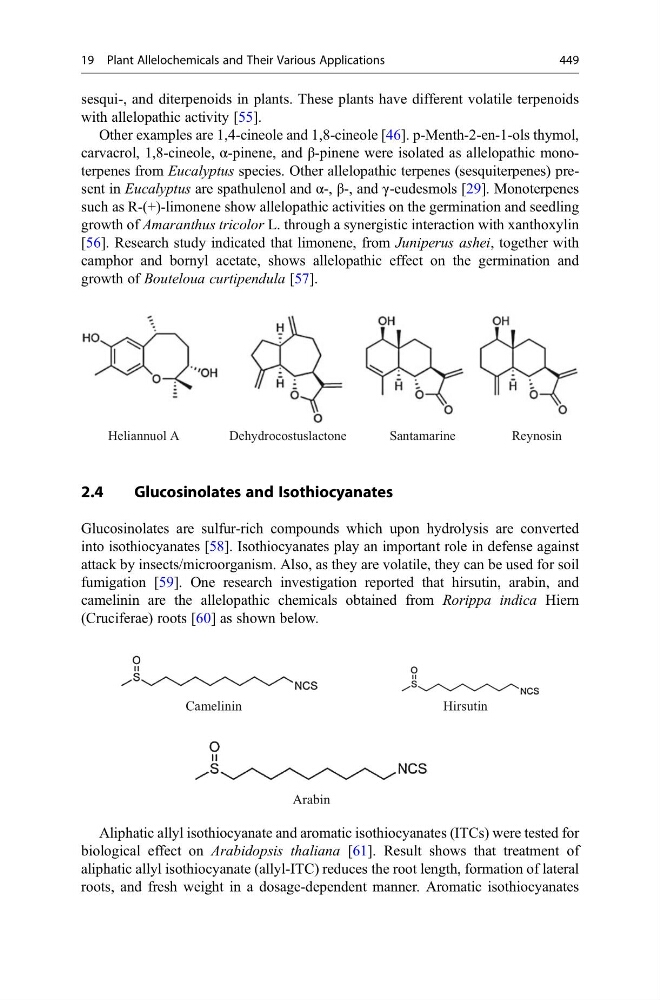
Heliannuol A
Dehydrocostuslactone
Santamarine
Reynosin
2.4
Glucosinolates and Isothiocyanates
Glucosinolates are sulfur-rich compounds which upon hydrolysis are converted
into isothiocyanates [58]. Isothiocyanates play an important role in defense against
attack by insects/microorganism. Also, as they are volatile, they can be used for soil
fumigation [59]. One research investigation reported that hirsutin, arabin, and
camelinin are the allelopathic chemicals obtained from Rorippa indica Hiern
(Cruciferae) roots [60] as shown below.
Camelinin
Hirsutin
Arabin
Aliphatic allyl isothiocyanate and aromatic isothiocyanates (ITCs) were tested for
biological effect on Arabidopsis thaliana [61]. Result shows that treatment of
aliphatic allyl isothiocyanate (allyl-ITC) reduces the root length, formation of lateral
roots, and fresh weight in a dosage-dependent manner. Aromatic isothiocyanates
19 Plant Allelochemicals and Their Various Applications
449
with allelopathic activity [55].
Other examples are 1,4-cineole and 1,8-cineole [46]. p-Menth-2-en-1-ols thymol,
carvacrol, 1,8-cineole, α-pinene, and β-pinene were isolated as allelopathic monoterpenes from Eucalyptus species. Other allelopathic terpenes (sesquiterpenes) present in Eucalyptus are spathulenol and α-, β-, and γ-eudesmols [29]. Monoterpenes
such as R-(+)-limonene show allelopathic activities on the germination and seedling
growth of Amaranthus tricolor L. through a synergistic interaction with xanthoxylin
[56]. Research study indicated that limonene, from Juniperus ashei, together with
camphor and bornyl acetate, shows allelopathic effect on the germination and
growth of Bouteloua curtipendula [57].
Heliannuol A
Dehydrocostuslactone
Santamarine
Reynosin
2.4
Glucosinolates and Isothiocyanates
Glucosinolates are sulfur-rich compounds which upon hydrolysis are converted
into isothiocyanates [58]. Isothiocyanates play an important role in defense against
attack by insects/microorganism. Also, as they are volatile, they can be used for soil
fumigation [59]. One research investigation reported that hirsutin, arabin, and
camelinin are the allelopathic chemicals obtained from Rorippa indica Hiern
(Cruciferae) roots [60] as shown below.
Camelinin
Hirsutin
Arabin
Aliphatic allyl isothiocyanate and aromatic isothiocyanates (ITCs) were tested for
biological effect on Arabidopsis thaliana [61]. Result shows that treatment of
aliphatic allyl isothiocyanate (allyl-ITC) reduces the root length, formation of lateral
roots, and fresh weight in a dosage-dependent manner. Aromatic isothiocyanates
19 Plant Allelochemicals and Their Various Applications
449