

of pathogenic fungi Fusarium oxysporum, Pyricularia grisea, Gloeosporium
musarum, and Phytophthora capsici. The allelopathic effects of essential oil
are due to presence of terpenoid (alloocimene 43.22%, α-pinene 13.63%, γ-terpinene
5.49%) [52]. Terpenes obtained from Eupatorium adenophorum and their allelopathic effects on seed germination of Arabidopsis were performed [53].
Eleven terpenes were isolated and identified from Eupatorium adenophorum. The
structure of these isolated compounds was established by NMR (1D, 2D) and mass
spectrometry. Isolated compounds were (À)-(1RÃ,2S,Ã4RÃ,5SÃ)-3,3-dimethyl-5hydroxybicyclo [2,2,1]hept-2-ylmethanol (1); two new cadinane sesquiterpenes,
(À)-(5SÃ,6SÃ,7SÃ,9RÃ,10SÃ)-7-hydroxy-5,7-epidioxycadinan-3-ene-2-one (2) and
(+)-(5SÃ,6RÃ,9RÃ,10SÃ)-5,6-dihydroxycadinan-3-ene-2,7-dione (3); and eight
known terpene compounds (4, 6–12). Results suggest that out of all other terpenoids,
cadinene-type sesquiterpenes are only part of the allelochemicals in Eupatorium
adenophorum.
Allelopathic activity and phytotoxic activities of Atriplex cana essential oil
were studied [54]. Seedling growth of Amaranthus retroflexus and Poa annua
was inhibited by volatile organic compounds released by Atriplex cana. Experiment
was performed in an airtight container in fresh leaves and stems of Atriplex
cana. Previous studies reported a number of allelochemicals among the mono-,
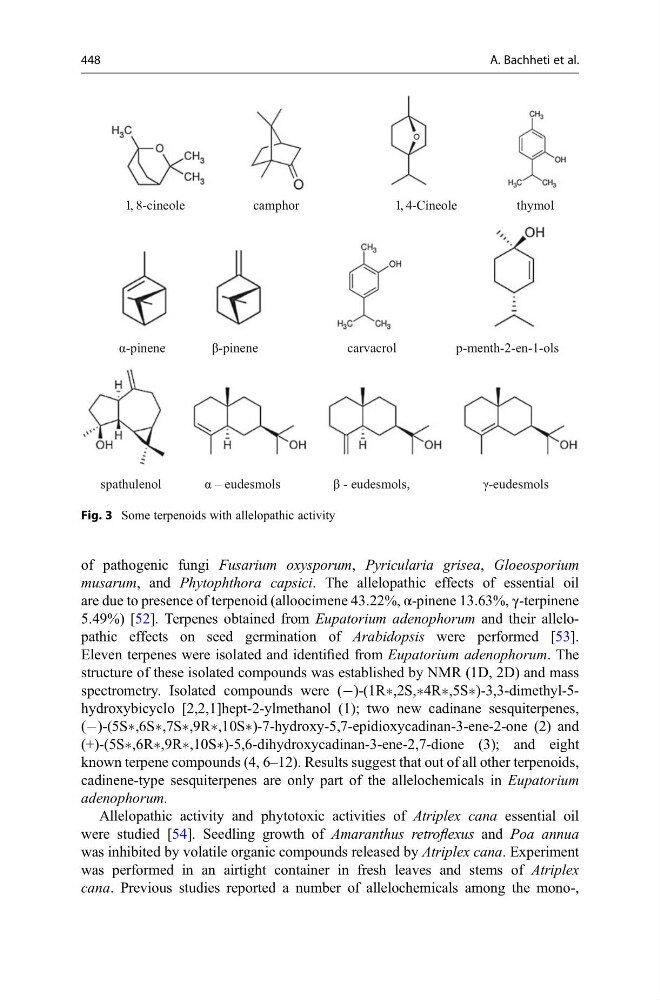
1, 8-cineole
camphor
1, 4-Cineole
thymol
α-pinene
β-pinene
carvacrol
p-menth-2-en-1-ols
spathulenol
α – eudesmols
β - eudesmols,
γ-eudesmols
Fig. 3 Some terpenoids with allelopathic activity
448
A. Bachheti et al.
musarum, and Phytophthora capsici. The allelopathic effects of essential oil
are due to presence of terpenoid (alloocimene 43.22%, α-pinene 13.63%, γ-terpinene
5.49%) [52]. Terpenes obtained from Eupatorium adenophorum and their allelopathic effects on seed germination of Arabidopsis were performed [53].
Eleven terpenes were isolated and identified from Eupatorium adenophorum. The
structure of these isolated compounds was established by NMR (1D, 2D) and mass
spectrometry. Isolated compounds were (À)-(1RÃ,2S,Ã4RÃ,5SÃ)-3,3-dimethyl-5hydroxybicyclo [2,2,1]hept-2-ylmethanol (1); two new cadinane sesquiterpenes,
(À)-(5SÃ,6SÃ,7SÃ,9RÃ,10SÃ)-7-hydroxy-5,7-epidioxycadinan-3-ene-2-one (2) and
(+)-(5SÃ,6RÃ,9RÃ,10SÃ)-5,6-dihydroxycadinan-3-ene-2,7-dione (3); and eight
known terpene compounds (4, 6–12). Results suggest that out of all other terpenoids,
cadinene-type sesquiterpenes are only part of the allelochemicals in Eupatorium
adenophorum.
Allelopathic activity and phytotoxic activities of Atriplex cana essential oil
were studied [54]. Seedling growth of Amaranthus retroflexus and Poa annua
was inhibited by volatile organic compounds released by Atriplex cana. Experiment
was performed in an airtight container in fresh leaves and stems of Atriplex
cana. Previous studies reported a number of allelochemicals among the mono-,
1, 8-cineole
camphor
1, 4-Cineole
thymol
α-pinene
β-pinene
carvacrol
p-menth-2-en-1-ols
spathulenol
α – eudesmols
β - eudesmols,
γ-eudesmols
Fig. 3 Some terpenoids with allelopathic activity
448
A. Bachheti et al.