

In Q. acutissima, the glucose contents of leaves collected at 10:30–11:00 a.m.
were slightly higher in newly expanded leaves in early May than those in other
seasons. In the evergreen Q. sessilifolia, however, such a trend was not detected, and
glucose was always much lower than in Q. acutissima [39]. In Q. acutissima, the
average glucose content was 71.7 Æ 3.9 SD (n = 5) mg g
À1 dry weight in the basal
part of a leaf (excluding the values in early May), whereas in Q. sessilifolia, the
glucose content was 24.6 Æ 3.9 SD (n = 8) mg g
À1 dry weight.
These measurements of the microscale distributions of chemicals within a single
leaf of Q. acutissima and Q. sessilifolia suggested that sugar concentration is an
important factor affecting which species the flying squirrels eat, and total phenolic
concentration affects which parts of the single leaf they eat preferably. The deciduous Q. acutissima leaves were preferred for the flying squirrels to eat from spring to
summer, despite the evergreen Q. sessilifolia leave were always available. In winter,
however, Q. acutissima had no leaves and they ate the leaves of Q. sessilifolia. Sugar
contents were homogeneously distributed within the single leaf both in Q.
acutissima and Q. sessilifolia, but the former included three times more sugar than
the latter. Thus, the flying squirrels may choose the sweeter Q. acutissima leaves
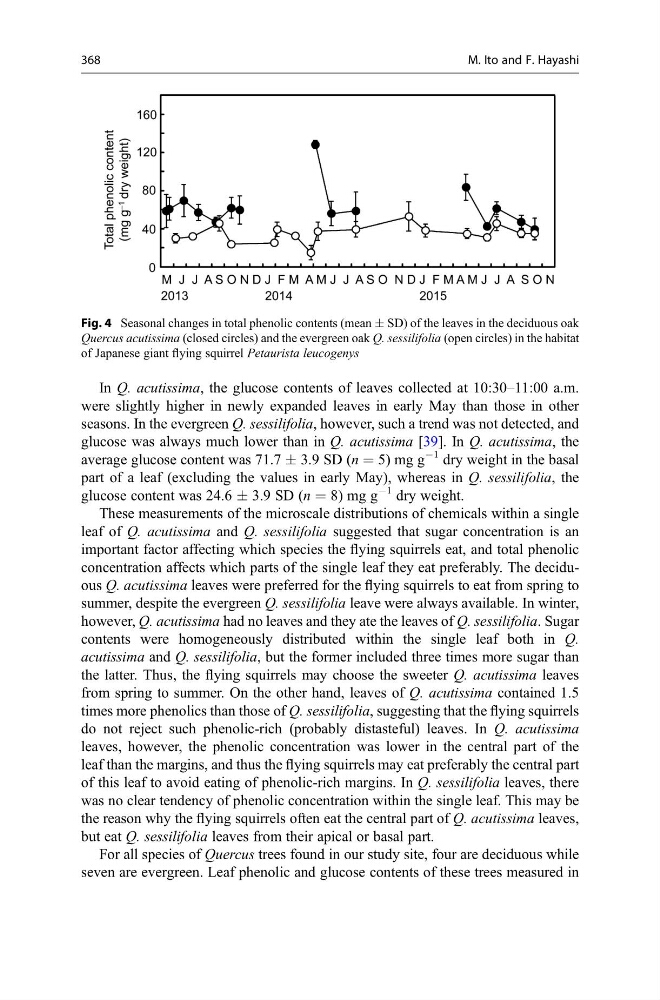
from spring to summer. On the other hand, leaves of Q. acutissima contained 1.5
times more phenolics than those of Q. sessilifolia, suggesting that the flying squirrels
do not reject such phenolic-rich (probably distasteful) leaves. In Q. acutissima
leaves, however, the phenolic concentration was lower in the central part of the
leaf than the margins, and thus the flying squirrels may eat preferably the central part
of this leaf to avoid eating of phenolic-rich margins. In Q. sessilifolia leaves, there
was no clear tendency of phenolic concentration within the single leaf. This may be
the reason why the flying squirrels often eat the central part of Q. acutissima leaves,
but eat Q. sessilifolia leaves from their apical or basal part.
For all species of Quercus trees found in our study site, four are deciduous while
seven are evergreen. Leaf phenolic and glucose contents of these trees measured in
Fig. 4 Seasonal changes in total phenolic contents (mean Æ SD) of the leaves in the deciduous oak
Quercus acutissima (closed circles) and the evergreen oak Q. sessilifolia (open circles) in the habitat
of Japanese giant flying squirrel Petaurista leucogenys
368
M. Ito and F. Hayashi
were slightly higher in newly expanded leaves in early May than those in other
seasons. In the evergreen Q. sessilifolia, however, such a trend was not detected, and
glucose was always much lower than in Q. acutissima [39]. In Q. acutissima, the
average glucose content was 71.7 Æ 3.9 SD (n = 5) mg g
À1 dry weight in the basal
part of a leaf (excluding the values in early May), whereas in Q. sessilifolia, the
glucose content was 24.6 Æ 3.9 SD (n = 8) mg g
À1 dry weight.
These measurements of the microscale distributions of chemicals within a single
leaf of Q. acutissima and Q. sessilifolia suggested that sugar concentration is an
important factor affecting which species the flying squirrels eat, and total phenolic
concentration affects which parts of the single leaf they eat preferably. The deciduous Q. acutissima leaves were preferred for the flying squirrels to eat from spring to
summer, despite the evergreen Q. sessilifolia leave were always available. In winter,
however, Q. acutissima had no leaves and they ate the leaves of Q. sessilifolia. Sugar
contents were homogeneously distributed within the single leaf both in Q.
acutissima and Q. sessilifolia, but the former included three times more sugar than
the latter. Thus, the flying squirrels may choose the sweeter Q. acutissima leaves
from spring to summer. On the other hand, leaves of Q. acutissima contained 1.5
times more phenolics than those of Q. sessilifolia, suggesting that the flying squirrels
do not reject such phenolic-rich (probably distasteful) leaves. In Q. acutissima
leaves, however, the phenolic concentration was lower in the central part of the
leaf than the margins, and thus the flying squirrels may eat preferably the central part
of this leaf to avoid eating of phenolic-rich margins. In Q. sessilifolia leaves, there
was no clear tendency of phenolic concentration within the single leaf. This may be
the reason why the flying squirrels often eat the central part of Q. acutissima leaves,
but eat Q. sessilifolia leaves from their apical or basal part.
For all species of Quercus trees found in our study site, four are deciduous while
seven are evergreen. Leaf phenolic and glucose contents of these trees measured in
Fig. 4 Seasonal changes in total phenolic contents (mean Æ SD) of the leaves in the deciduous oak
Quercus acutissima (closed circles) and the evergreen oak Q. sessilifolia (open circles) in the habitat
of Japanese giant flying squirrel Petaurista leucogenys
368
M. Ito and F. Hayashi