

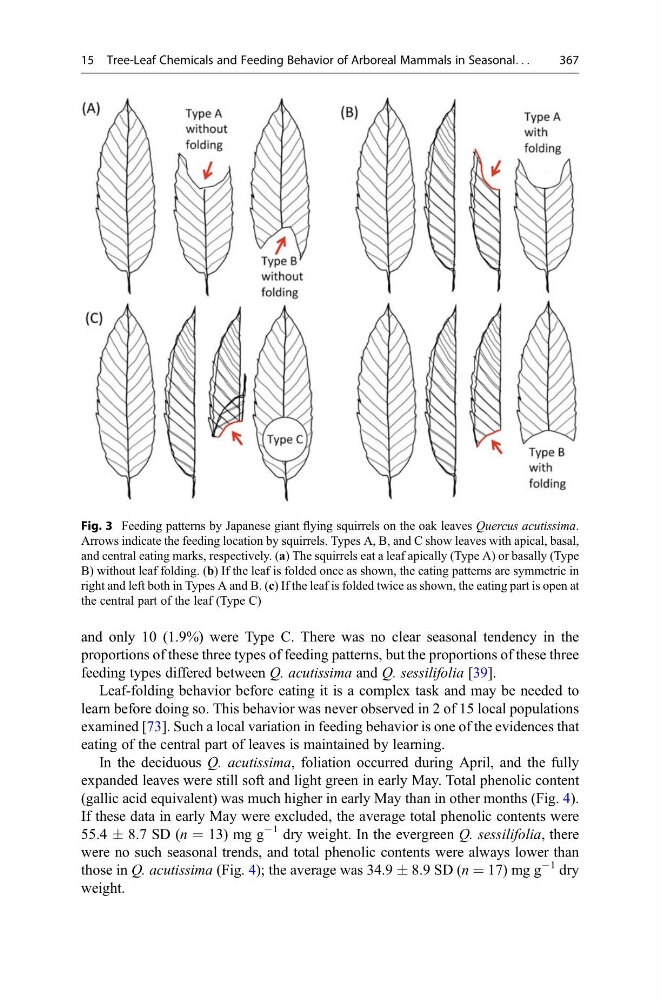
and only 10 (1.9%) were Type C. There was no clear seasonal tendency in the
proportions of these three types of feeding patterns, but the proportions of these three
feeding types differed between Q. acutissima and Q. sessilifolia [39].
Leaf-folding behavior before eating it is a complex task and may be needed to
learn before doing so. This behavior was never observed in 2 of 15 local populations
examined [73]. Such a local variation in feeding behavior is one of the evidences that
eating of the central part of leaves is maintained by learning.
In the deciduous Q. acutissima, foliation occurred during April, and the fully
expanded leaves were still soft and light green in early May. Total phenolic content
(gallic acid equivalent) was much higher in early May than in other months (Fig. 4).
If these data in early May were excluded, the average total phenolic contents were
55.4 Æ 8.7 SD (n = 13) mg g
À1 dry weight. In the evergreen Q. sessilifolia, there
were no such seasonal trends, and total phenolic contents were always lower than
those in Q. acutissima (Fig. 4); the average was 34.9 Æ 8.9 SD (n = 17) mg g
À1 dry
weight.
Fig. 3 Feeding patterns by Japanese giant flying squirrels on the oak leaves Quercus acutissima.
Arrows indicate the feeding location by squirrels. Types A, B, and C show leaves with apical, basal,
and central eating marks, respectively. (a) The squirrels eat a leaf apically (Type A) or basally (Type
B) without leaf folding. (b) If the leaf is folded once as shown, the eating patterns are symmetric in
right and left both in Types A and B. (c) If the leaf is folded twice as shown, the eating part is open at
the central part of the leaf (Type C)
15 Tree-Leaf Chemicals and Feeding Behavior of Arboreal Mammals in Seasonal. . .
367
proportions of these three types of feeding patterns, but the proportions of these three
feeding types differed between Q. acutissima and Q. sessilifolia [39].
Leaf-folding behavior before eating it is a complex task and may be needed to
learn before doing so. This behavior was never observed in 2 of 15 local populations
examined [73]. Such a local variation in feeding behavior is one of the evidences that
eating of the central part of leaves is maintained by learning.
In the deciduous Q. acutissima, foliation occurred during April, and the fully
expanded leaves were still soft and light green in early May. Total phenolic content
(gallic acid equivalent) was much higher in early May than in other months (Fig. 4).
If these data in early May were excluded, the average total phenolic contents were
55.4 Æ 8.7 SD (n = 13) mg g
À1 dry weight. In the evergreen Q. sessilifolia, there
were no such seasonal trends, and total phenolic contents were always lower than
those in Q. acutissima (Fig. 4); the average was 34.9 Æ 8.9 SD (n = 17) mg g
À1 dry
weight.
Fig. 3 Feeding patterns by Japanese giant flying squirrels on the oak leaves Quercus acutissima.
Arrows indicate the feeding location by squirrels. Types A, B, and C show leaves with apical, basal,
and central eating marks, respectively. (a) The squirrels eat a leaf apically (Type A) or basally (Type
B) without leaf folding. (b) If the leaf is folded once as shown, the eating patterns are symmetric in
right and left both in Types A and B. (c) If the leaf is folded twice as shown, the eating part is open at
the central part of the leaf (Type C)
15 Tree-Leaf Chemicals and Feeding Behavior of Arboreal Mammals in Seasonal. . .
367