

The study site was 50 ha in an isolated section of woods in Hachioji, Tokyo,
Japan. The vegetation was mixed temperate broadleaf and coniferous trees [116].
One to five morning censuses were conducted every month along a fixed 2-km
transect. The census was continued from April 2013 to November 2015 for a total of
87 times and a total of 2761 food items were identified, consisting of 1559 (56.47%)
leaves, 734 (26.58%) seeds/fruits, 264 (9.56%) buds, and 204 (7.39%) flowers. The
leaves were most important foods for them and almost all (97.95%) leaves were from
Quercus trees: Q. acutissima (63.72%), Q. sessilifolia (33.73%), Q. crispula
(1.24%), Q. glauca (1.11%), Q. myrsinifolia (0.13%), and Q. variabilis (0.07%).
Quercus trees include deciduous and evergreen species, which enables us to compare
food availability and selectivity in the seasonal environment. Most dominant food in
our study site, Q. acutissima, is a deciduous tree, and leaf debris was found from
May to October. Feeding was intensive from May to July. Leaf debris of justexpanded leaves in early May of this tree was never found. Another dominant
food, Q. sessilifolia, is evergreen and leaf debris was found from October to the
next June when the deciduous Q. acutissima leaves were fallen.
Interestingly, there were three types of feeding debris. Type A, eaten at apical part
of a leaf, included both asymmetric cutting without leaf folding (Fig. 3A) and
symmetric cutting after folding the leaf once (Fig. 3B). Type B, eaten at basal part
of a leaf, also included both of these patterns (Fig. 3A, B). Type C, which occurred
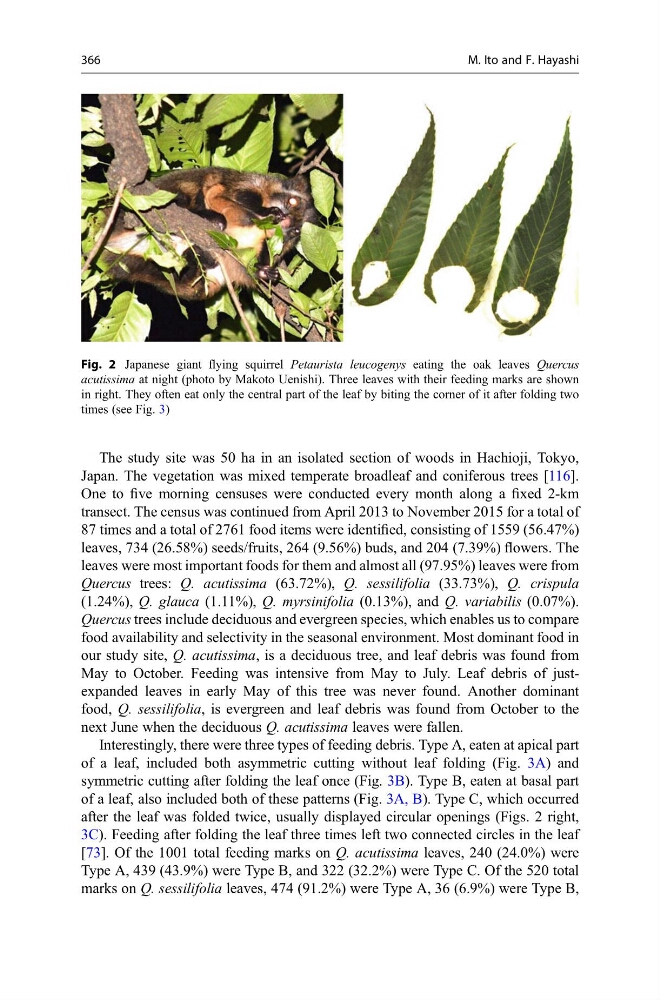
after the leaf was folded twice, usually displayed circular openings (Figs. 2 right,
3C). Feeding after folding the leaf three times left two connected circles in the leaf
[73]. Of the 1001 total feeding marks on Q. acutissima leaves, 240 (24.0%) were
Type A, 439 (43.9%) were Type B, and 322 (32.2%) were Type C. Of the 520 total
marks on Q. sessilifolia leaves, 474 (91.2%) were Type A, 36 (6.9%) were Type B,
Fig. 2 Japanese giant flying squirrel Petaurista leucogenys eating the oak leaves Quercus
acutissima at night (photo by Makoto Uenishi). Three leaves with their feeding marks are shown
in right. They often eat only the central part of the leaf by biting the corner of it after folding two
times (see Fig. 3)
366
M. Ito and F. Hayashi
Japan. The vegetation was mixed temperate broadleaf and coniferous trees [116].
One to five morning censuses were conducted every month along a fixed 2-km
transect. The census was continued from April 2013 to November 2015 for a total of
87 times and a total of 2761 food items were identified, consisting of 1559 (56.47%)
leaves, 734 (26.58%) seeds/fruits, 264 (9.56%) buds, and 204 (7.39%) flowers. The
leaves were most important foods for them and almost all (97.95%) leaves were from
Quercus trees: Q. acutissima (63.72%), Q. sessilifolia (33.73%), Q. crispula
(1.24%), Q. glauca (1.11%), Q. myrsinifolia (0.13%), and Q. variabilis (0.07%).
Quercus trees include deciduous and evergreen species, which enables us to compare
food availability and selectivity in the seasonal environment. Most dominant food in
our study site, Q. acutissima, is a deciduous tree, and leaf debris was found from
May to October. Feeding was intensive from May to July. Leaf debris of justexpanded leaves in early May of this tree was never found. Another dominant
food, Q. sessilifolia, is evergreen and leaf debris was found from October to the
next June when the deciduous Q. acutissima leaves were fallen.
Interestingly, there were three types of feeding debris. Type A, eaten at apical part
of a leaf, included both asymmetric cutting without leaf folding (Fig. 3A) and
symmetric cutting after folding the leaf once (Fig. 3B). Type B, eaten at basal part
of a leaf, also included both of these patterns (Fig. 3A, B). Type C, which occurred
after the leaf was folded twice, usually displayed circular openings (Figs. 2 right,
3C). Feeding after folding the leaf three times left two connected circles in the leaf
[73]. Of the 1001 total feeding marks on Q. acutissima leaves, 240 (24.0%) were
Type A, 439 (43.9%) were Type B, and 322 (32.2%) were Type C. Of the 520 total
marks on Q. sessilifolia leaves, 474 (91.2%) were Type A, 36 (6.9%) were Type B,
Fig. 2 Japanese giant flying squirrel Petaurista leucogenys eating the oak leaves Quercus
acutissima at night (photo by Makoto Uenishi). Three leaves with their feeding marks are shown
in right. They often eat only the central part of the leaf by biting the corner of it after folding two
times (see Fig. 3)
366
M. Ito and F. Hayashi