

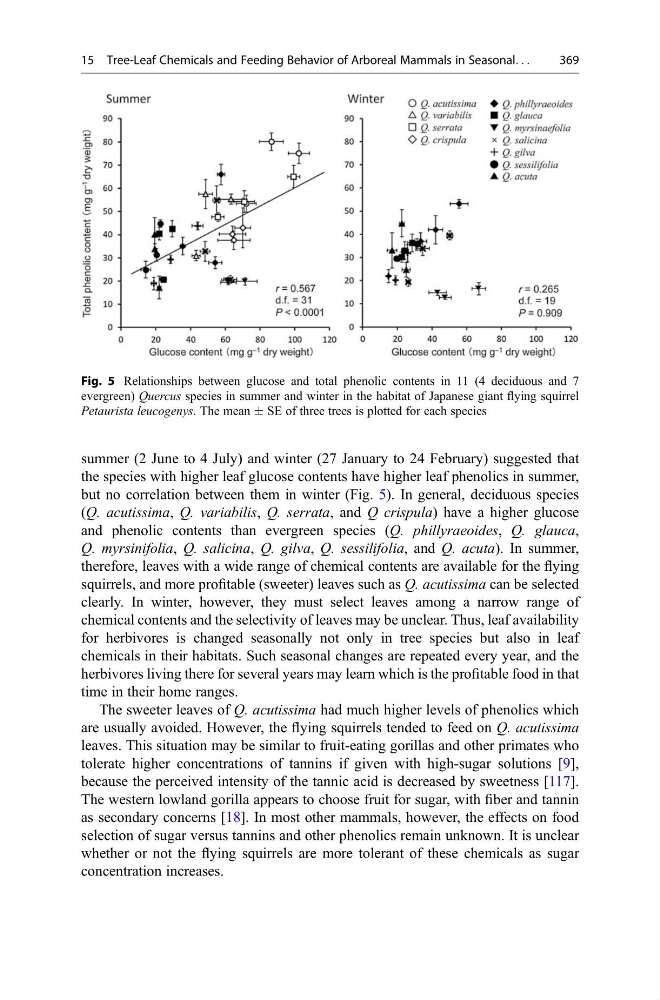
summer (2 June to 4 July) and winter (27 January to 24 February) suggested that
the species with higher leaf glucose contents have higher leaf phenolics in summer,
but no correlation between them in winter (Fig. 5). In general, deciduous species
(Q. acutissima, Q. variabilis, Q. serrata, and Q crispula) have a higher glucose
and phenolic contents than evergreen species (Q. phillyraeoides, Q. glauca,
Q. myrsinifolia, Q. salicina, Q. gilva, Q. sessilifolia, and Q. acuta). In summer,
therefore, leaves with a wide range of chemical contents are available for the flying
squirrels, and more profitable (sweeter) leaves such as Q. acutissima can be selected
clearly. In winter, however, they must select leaves among a narrow range of
chemical contents and the selectivity of leaves may be unclear. Thus, leaf availability
for herbivores is changed seasonally not only in tree species but also in leaf
chemicals in their habitats. Such seasonal changes are repeated every year, and the
herbivores living there for several years may learn which is the profitable food in that
time in their home ranges.
The sweeter leaves of Q. acutissima had much higher levels of phenolics which
are usually avoided. However, the flying squirrels tended to feed on Q. acutissima
leaves. This situation may be similar to fruit-eating gorillas and other primates who
tolerate higher concentrations of tannins if given with high-sugar solutions [9],
because the perceived intensity of the tannic acid is decreased by sweetness [117].
The western lowland gorilla appears to choose fruit for sugar, with fiber and tannin
as secondary concerns [18]. In most other mammals, however, the effects on food
selection of sugar versus tannins and other phenolics remain unknown. It is unclear
whether or not the flying squirrels are more tolerant of these chemicals as sugar
concentration increases.
Fig. 5 Relationships between glucose and total phenolic contents in 11 (4 deciduous and 7
evergreen) Quercus species in summer and winter in the habitat of Japanese giant flying squirrel
Petaurista leucogenys. The mean Æ SE of three trees is plotted for each species
15 Tree-Leaf Chemicals and Feeding Behavior of Arboreal Mammals in Seasonal. . .
369
the species with higher leaf glucose contents have higher leaf phenolics in summer,
but no correlation between them in winter (Fig. 5). In general, deciduous species
(Q. acutissima, Q. variabilis, Q. serrata, and Q crispula) have a higher glucose
and phenolic contents than evergreen species (Q. phillyraeoides, Q. glauca,
Q. myrsinifolia, Q. salicina, Q. gilva, Q. sessilifolia, and Q. acuta). In summer,
therefore, leaves with a wide range of chemical contents are available for the flying
squirrels, and more profitable (sweeter) leaves such as Q. acutissima can be selected
clearly. In winter, however, they must select leaves among a narrow range of
chemical contents and the selectivity of leaves may be unclear. Thus, leaf availability
for herbivores is changed seasonally not only in tree species but also in leaf
chemicals in their habitats. Such seasonal changes are repeated every year, and the
herbivores living there for several years may learn which is the profitable food in that
time in their home ranges.
The sweeter leaves of Q. acutissima had much higher levels of phenolics which
are usually avoided. However, the flying squirrels tended to feed on Q. acutissima
leaves. This situation may be similar to fruit-eating gorillas and other primates who
tolerate higher concentrations of tannins if given with high-sugar solutions [9],
because the perceived intensity of the tannic acid is decreased by sweetness [117].
The western lowland gorilla appears to choose fruit for sugar, with fiber and tannin
as secondary concerns [18]. In most other mammals, however, the effects on food
selection of sugar versus tannins and other phenolics remain unknown. It is unclear
whether or not the flying squirrels are more tolerant of these chemicals as sugar
concentration increases.
Fig. 5 Relationships between glucose and total phenolic contents in 11 (4 deciduous and 7
evergreen) Quercus species in summer and winter in the habitat of Japanese giant flying squirrel
Petaurista leucogenys. The mean Æ SE of three trees is plotted for each species
15 Tree-Leaf Chemicals and Feeding Behavior of Arboreal Mammals in Seasonal. . .
369