

5.3.2 Equisetin
Equisetin has been isolated for the first time from F. equiseti which gave rise to its
name. This mycotoxin with antimicrobial properties inhibits the development
of Gram-positive bacteria [206]. So far, equisetin was also found in cultures of
F. solani and F. heterosporum. Equisetin is a phytotoxin causing seed deterioration,
which simultaneously has an important pharmacological importance for human
[207]. The interest in this compound increased dramatically because of its ability
to inhibit the enzyme responsible for human DNA infection by human immunodeficiency virus type 1 (HIV-1) [208, 209].
Equisetin is a tetramic acid composed of octaketide linked with serine moiety.
In 2005, Sims and colleagues described eqx gene cluster responsible for equisetin
biosynthesis [210]. Eight units of malonyl-CoA are condensed and transformed
by the eqxC-encoded enoylreductase and PKS-NRPS hybrid, encoded by eqxS
gene. Heptaketide formed in these reactions undergoes a Diels-Alder cyclization
carried out by eqx3-expressed protein. Further conversions are accomplished by
PKS-NRPS and lead to the formation of trichosetin, which after N-methylation
becomes equisetin [210–212]. Ten years after the results of Sims et al. were
published [210], Kato et al. reported equisetin as an intermediate substrate in
fusarisetin production and proposed new genes’ designations [213]. As in other
examples of PKS-NRPS-dependent biosynthetic pathways, also in this case, PKSNRPS hybrid plays a key role for equisetin production, as ΔeqxS mutants completely
lose their ability to produce equisetin [210, 212]. Unfortunately, there are no reports
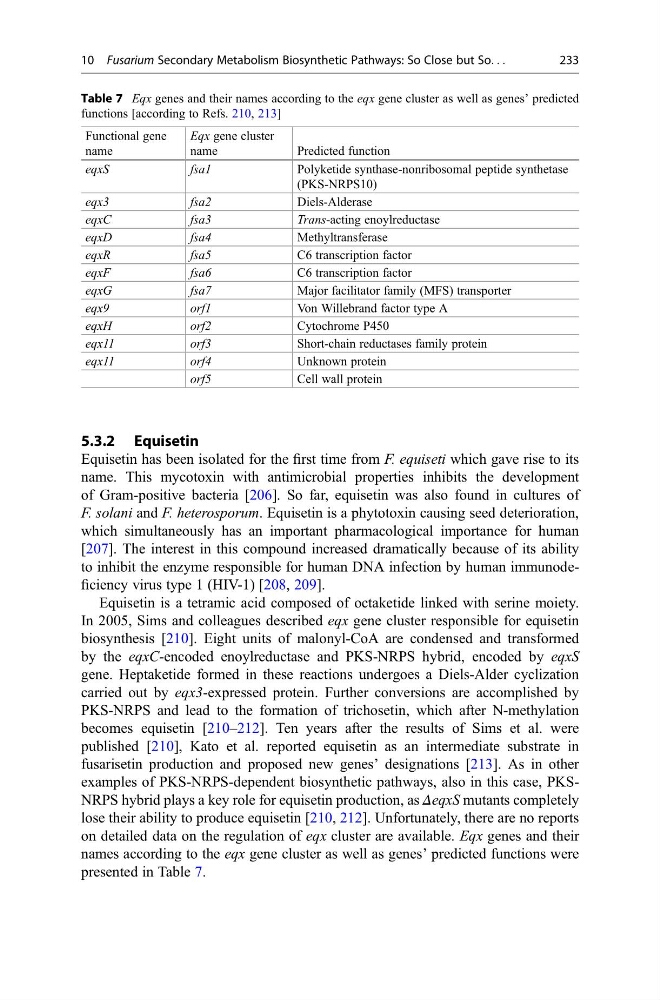
on detailed data on the regulation of eqx cluster are available. Eqx genes and their
names according to the eqx gene cluster as well as genes’ predicted functions were
presented in Table 7.
Table 7 Eqx genes and their names according to the eqx gene cluster as well as genes’ predicted
functions [according to Refs. 210, 213]
Functional gene
name
Eqx gene cluster
name
Predicted function
eqxS
fsa1
Polyketide synthase-nonribosomal peptide synthetase
(PKS-NRPS10)
eqx3
fsa2
Diels-Alderase
eqxC
fsa3
Trans-acting enoylreductase
eqxD
fsa4
Methyltransferase
eqxR
fsa5
C6 transcription factor
eqxF
fsa6
C6 transcription factor
eqxG
fsa7
Major facilitator family (MFS) transporter
eqx9
orf1
Von Willebrand factor type A
eqxH
orf2
Cytochrome P450
eqx11
orf3
Short-chain reductases family protein
eqx11
orf4
Unknown protein
orf5
Cell wall protein
10 Fusarium Secondary Metabolism Biosynthetic Pathways: So Close but So. . .
233
Equisetin has been isolated for the first time from F. equiseti which gave rise to its
name. This mycotoxin with antimicrobial properties inhibits the development
of Gram-positive bacteria [206]. So far, equisetin was also found in cultures of
F. solani and F. heterosporum. Equisetin is a phytotoxin causing seed deterioration,
which simultaneously has an important pharmacological importance for human
[207]. The interest in this compound increased dramatically because of its ability
to inhibit the enzyme responsible for human DNA infection by human immunodeficiency virus type 1 (HIV-1) [208, 209].
Equisetin is a tetramic acid composed of octaketide linked with serine moiety.
In 2005, Sims and colleagues described eqx gene cluster responsible for equisetin
biosynthesis [210]. Eight units of malonyl-CoA are condensed and transformed
by the eqxC-encoded enoylreductase and PKS-NRPS hybrid, encoded by eqxS
gene. Heptaketide formed in these reactions undergoes a Diels-Alder cyclization
carried out by eqx3-expressed protein. Further conversions are accomplished by
PKS-NRPS and lead to the formation of trichosetin, which after N-methylation
becomes equisetin [210–212]. Ten years after the results of Sims et al. were
published [210], Kato et al. reported equisetin as an intermediate substrate in
fusarisetin production and proposed new genes’ designations [213]. As in other
examples of PKS-NRPS-dependent biosynthetic pathways, also in this case, PKSNRPS hybrid plays a key role for equisetin production, as ΔeqxS mutants completely
lose their ability to produce equisetin [210, 212]. Unfortunately, there are no reports
on detailed data on the regulation of eqx cluster are available. Eqx genes and their
names according to the eqx gene cluster as well as genes’ predicted functions were
presented in Table 7.
Table 7 Eqx genes and their names according to the eqx gene cluster as well as genes’ predicted
functions [according to Refs. 210, 213]
Functional gene
name
Eqx gene cluster
name
Predicted function
eqxS
fsa1
Polyketide synthase-nonribosomal peptide synthetase
(PKS-NRPS10)
eqx3
fsa2
Diels-Alderase
eqxC
fsa3
Trans-acting enoylreductase
eqxD
fsa4
Methyltransferase
eqxR
fsa5
C6 transcription factor
eqxF
fsa6
C6 transcription factor
eqxG
fsa7
Major facilitator family (MFS) transporter
eqx9
orf1
Von Willebrand factor type A
eqxH
orf2
Cytochrome P450
eqx11
orf3
Short-chain reductases family protein
eqx11
orf4
Unknown protein
orf5
Cell wall protein
10 Fusarium Secondary Metabolism Biosynthetic Pathways: So Close but So. . .
233