

5.3.3 Gibberellins
Gibberellins (GAs) are a group of well-known growth-promoting phytohormones,
which are also secondary metabolites produced by some bacteria and filamentous
fungi including Fusarium. GAs are tetracyclic diterpene acids containing 20 or 19
carbons in the cases where lactone bridge is present. Despite the fact that gibberellins
are essentially plant hormones, for the first time, they were identified in Gibberella
fujikuroi (F. fujikuroi), and this is where their name came from. Other Fusarium
species have also the capacity to synthesize GAs, for instance, F. circinatum,
F. mangiferae, and F. oxysporum produce abundant amounts of GAs. From the
economical point of view, the most important gibberellins are GA 1 , GA 3 , GA 7 ,
and GA 14 , all produced by F. fujikuroi – the strain used most frequently in biotechnological production of GAs [62, 73, 214].
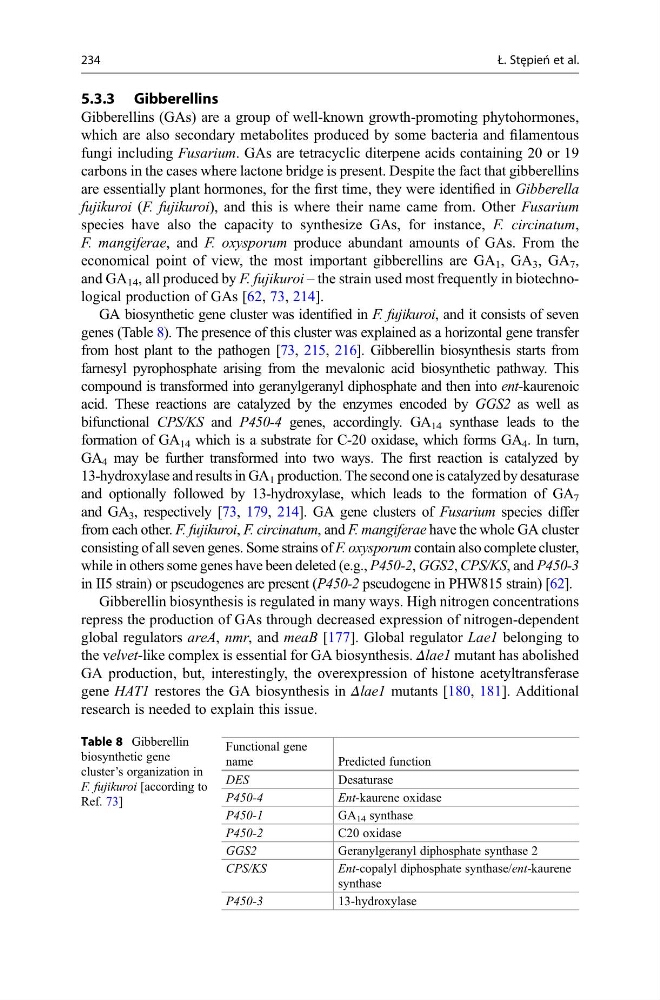
GA biosynthetic gene cluster was identified in F. fujikuroi, and it consists of seven
genes (Table 8). The presence of this cluster was explained as a horizontal gene transfer
from host plant to the pathogen [73, 215, 216]. Gibberellin biosynthesis starts from
farnesyl pyrophosphate arising from the mevalonic acid biosynthetic pathway. This
compound is transformed into geranylgeranyl diphosphate and then into ent-kaurenoic
acid. These reactions are catalyzed by the enzymes encoded by GGS2 as well as
bifunctional CPS/KS and P450-4 genes, accordingly. GA 14 synthase leads to the
formation of GA 14 which is a substrate for C-20 oxidase, which forms GA 4 . In turn,
GA 4 may be further transformed into two ways. The first reaction is catalyzed by
13-hydroxylase and results in GA 1 production. The second one is catalyzed by desaturase
and optionally followed by 13-hydroxylase, which leads to the formation of GA 7
and GA 3 , respectively [73, 179, 214]. GA gene clusters of Fusarium species differ
from each other. F. fujikuroi, F. circinatum, and F. mangiferae have the whole GA cluster
consisting of all seven genes. Some strains of F. oxysporum contain also complete cluster,
while in others some genes have been deleted (e.g., P450-2, GGS2, CPS/KS, and P450-3
in II5 strain) or pseudogenes are present (P450-2 pseudogene in PHW815 strain) [62].
Gibberellin biosynthesis is regulated in many ways. High nitrogen concentrations
repress the production of GAs through decreased expression of nitrogen-dependent
global regulators areA, nmr, and meaB [177]. Global regulator Lae1 belonging to
the velvet-like complex is essential for GA biosynthesis. Δlae1 mutant has abolished
GA production, but, interestingly, the overexpression of histone acetyltransferase
gene HAT1 restores the GA biosynthesis in Δlae1 mutants [180, 181]. Additional
research is needed to explain this issue.
Table 8 Gibberellin
biosynthetic gene
cluster’s organization in
F. fujikuroi [according to
Ref. 73]
Functional gene
name
Predicted function
DES
Desaturase
P450-4
Ent-kaurene oxidase
P450-1
GA 14 synthase
P450-2
C20 oxidase
GGS2
Geranylgeranyl diphosphate synthase 2
CPS/KS
Ent-copalyl diphosphate synthase/ent-kaurene
synthase
P450-3
13-hydroxylase
234
Ł. Stępień et al.
Gibberellins (GAs) are a group of well-known growth-promoting phytohormones,
which are also secondary metabolites produced by some bacteria and filamentous
fungi including Fusarium. GAs are tetracyclic diterpene acids containing 20 or 19
carbons in the cases where lactone bridge is present. Despite the fact that gibberellins
are essentially plant hormones, for the first time, they were identified in Gibberella
fujikuroi (F. fujikuroi), and this is where their name came from. Other Fusarium
species have also the capacity to synthesize GAs, for instance, F. circinatum,
F. mangiferae, and F. oxysporum produce abundant amounts of GAs. From the
economical point of view, the most important gibberellins are GA 1 , GA 3 , GA 7 ,
and GA 14 , all produced by F. fujikuroi – the strain used most frequently in biotechnological production of GAs [62, 73, 214].
GA biosynthetic gene cluster was identified in F. fujikuroi, and it consists of seven
genes (Table 8). The presence of this cluster was explained as a horizontal gene transfer
from host plant to the pathogen [73, 215, 216]. Gibberellin biosynthesis starts from
farnesyl pyrophosphate arising from the mevalonic acid biosynthetic pathway. This
compound is transformed into geranylgeranyl diphosphate and then into ent-kaurenoic
acid. These reactions are catalyzed by the enzymes encoded by GGS2 as well as
bifunctional CPS/KS and P450-4 genes, accordingly. GA 14 synthase leads to the
formation of GA 14 which is a substrate for C-20 oxidase, which forms GA 4 . In turn,
GA 4 may be further transformed into two ways. The first reaction is catalyzed by
13-hydroxylase and results in GA 1 production. The second one is catalyzed by desaturase
and optionally followed by 13-hydroxylase, which leads to the formation of GA 7
and GA 3 , respectively [73, 179, 214]. GA gene clusters of Fusarium species differ
from each other. F. fujikuroi, F. circinatum, and F. mangiferae have the whole GA cluster
consisting of all seven genes. Some strains of F. oxysporum contain also complete cluster,
while in others some genes have been deleted (e.g., P450-2, GGS2, CPS/KS, and P450-3
in II5 strain) or pseudogenes are present (P450-2 pseudogene in PHW815 strain) [62].
Gibberellin biosynthesis is regulated in many ways. High nitrogen concentrations
repress the production of GAs through decreased expression of nitrogen-dependent
global regulators areA, nmr, and meaB [177]. Global regulator Lae1 belonging to
the velvet-like complex is essential for GA biosynthesis. Δlae1 mutant has abolished
GA production, but, interestingly, the overexpression of histone acetyltransferase
gene HAT1 restores the GA biosynthesis in Δlae1 mutants [180, 181]. Additional
research is needed to explain this issue.
Table 8 Gibberellin
biosynthetic gene
cluster’s organization in
F. fujikuroi [according to
Ref. 73]
Functional gene
name
Predicted function
DES
Desaturase
P450-4
Ent-kaurene oxidase
P450-1
GA 14 synthase
P450-2
C20 oxidase
GGS2
Geranylgeranyl diphosphate synthase 2
CPS/KS
Ent-copalyl diphosphate synthase/ent-kaurene
synthase
P450-3
13-hydroxylase
234
Ł. Stępień et al.