

to 8-O-methylfusarubin by FAD-dependent monooxygenase. Unfortunately, molecular mechanisms of fusarubin biosynthesis regulation remain unrevealed. It is only
known that this process is stimulated under alkaline pH and nitrogen limitation
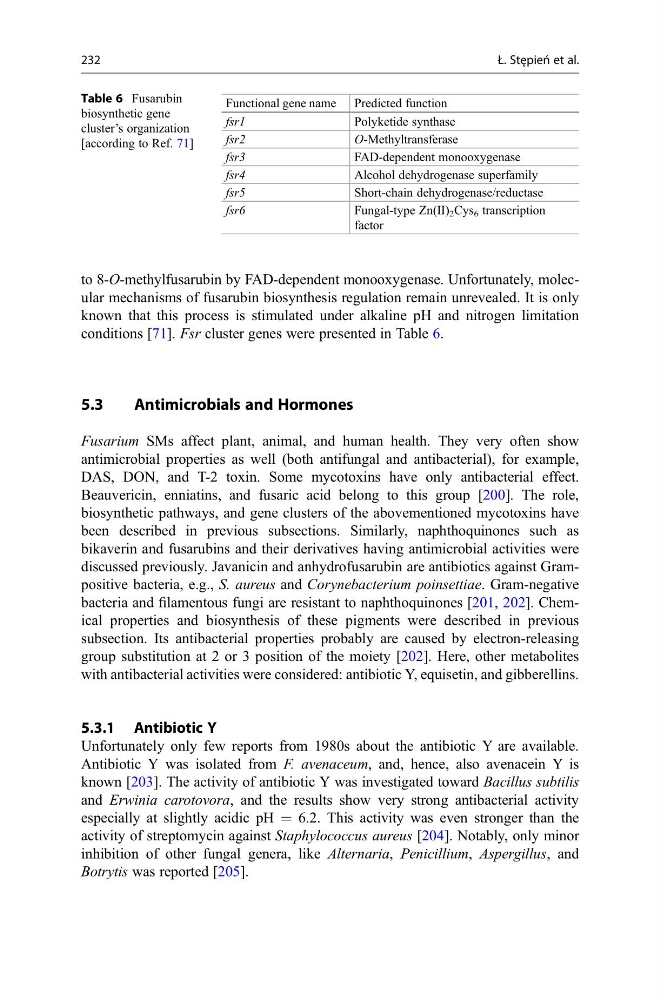
conditions [71]. Fsr cluster genes were presented in Table 6.
5.3
Antimicrobials and Hormones
Fusarium SMs affect plant, animal, and human health. They very often show
antimicrobial properties as well (both antifungal and antibacterial), for example,
DAS, DON, and T-2 toxin. Some mycotoxins have only antibacterial effect.
Beauvericin, enniatins, and fusaric acid belong to this group [200]. The role,
biosynthetic pathways, and gene clusters of the abovementioned mycotoxins have
been described in previous subsections. Similarly, naphthoquinones such as
bikaverin and fusarubins and their derivatives having antimicrobial activities were
discussed previously. Javanicin and anhydrofusarubin are antibiotics against Grampositive bacteria, e.g., S. aureus and Corynebacterium poinsettiae. Gram-negative
bacteria and filamentous fungi are resistant to naphthoquinones [201, 202]. Chemical properties and biosynthesis of these pigments were described in previous
subsection. Its antibacterial properties probably are caused by electron-releasing
group substitution at 2 or 3 position of the moiety [202]. Here, other metabolites
with antibacterial activities were considered: antibiotic Y, equisetin, and gibberellins.
5.3.1 Antibiotic Y
Unfortunately only few reports from 1980s about the antibiotic Y are available.
Antibiotic Y was isolated from F. avenaceum, and, hence, also avenacein Y is
known [203]. The activity of antibiotic Y was investigated toward Bacillus subtilis
and Erwinia carotovora, and the results show very strong antibacterial activity
especially at slightly acidic pH = 6.2. This activity was even stronger than the
activity of streptomycin against Staphylococcus aureus [204]. Notably, only minor
inhibition of other fungal genera, like Alternaria, Penicillium, Aspergillus, and
Botrytis was reported [205].
Table 6 Fusarubin
biosynthetic gene
cluster’s organization
[according to Ref. 71]
Functional gene name Predicted function
fsr1
Polyketide synthase
fsr2
O-Methyltransferase
fsr3
FAD-dependent monooxygenase
fsr4
Alcohol dehydrogenase superfamily
fsr5
Short-chain dehydrogenase/reductase
fsr6
Fungal-type Zn(II) 2 Cys 6 transcription
factor
232
Ł. Stępień et al.
known that this process is stimulated under alkaline pH and nitrogen limitation
conditions [71]. Fsr cluster genes were presented in Table 6.
5.3
Antimicrobials and Hormones
Fusarium SMs affect plant, animal, and human health. They very often show
antimicrobial properties as well (both antifungal and antibacterial), for example,
DAS, DON, and T-2 toxin. Some mycotoxins have only antibacterial effect.
Beauvericin, enniatins, and fusaric acid belong to this group [200]. The role,
biosynthetic pathways, and gene clusters of the abovementioned mycotoxins have
been described in previous subsections. Similarly, naphthoquinones such as
bikaverin and fusarubins and their derivatives having antimicrobial activities were
discussed previously. Javanicin and anhydrofusarubin are antibiotics against Grampositive bacteria, e.g., S. aureus and Corynebacterium poinsettiae. Gram-negative
bacteria and filamentous fungi are resistant to naphthoquinones [201, 202]. Chemical properties and biosynthesis of these pigments were described in previous
subsection. Its antibacterial properties probably are caused by electron-releasing
group substitution at 2 or 3 position of the moiety [202]. Here, other metabolites
with antibacterial activities were considered: antibiotic Y, equisetin, and gibberellins.
5.3.1 Antibiotic Y
Unfortunately only few reports from 1980s about the antibiotic Y are available.
Antibiotic Y was isolated from F. avenaceum, and, hence, also avenacein Y is
known [203]. The activity of antibiotic Y was investigated toward Bacillus subtilis
and Erwinia carotovora, and the results show very strong antibacterial activity
especially at slightly acidic pH = 6.2. This activity was even stronger than the
activity of streptomycin against Staphylococcus aureus [204]. Notably, only minor
inhibition of other fungal genera, like Alternaria, Penicillium, Aspergillus, and
Botrytis was reported [205].
Table 6 Fusarubin
biosynthetic gene
cluster’s organization
[according to Ref. 71]
Functional gene name Predicted function
fsr1
Polyketide synthase
fsr2
O-Methyltransferase
fsr3
FAD-dependent monooxygenase
fsr4
Alcohol dehydrogenase superfamily
fsr5
Short-chain dehydrogenase/reductase
fsr6
Fungal-type Zn(II) 2 Cys 6 transcription
factor
232
Ł. Stępień et al.