

5.2.2 Bikaverin
Bikaverin is a red pigment of polyketide structure produced by a number
of Fusarium species (F. oxysporum, F. solani, F. fujikuroi, F. proliferatum, and
F. verticillioides), and F. oxysporum was the first species from which bikaverin was
isolated. As with most pigments, it acts as a stress protection, for example, against
UV light. Bikaverin gene cluster has been found and characterized for F. fujikuroi
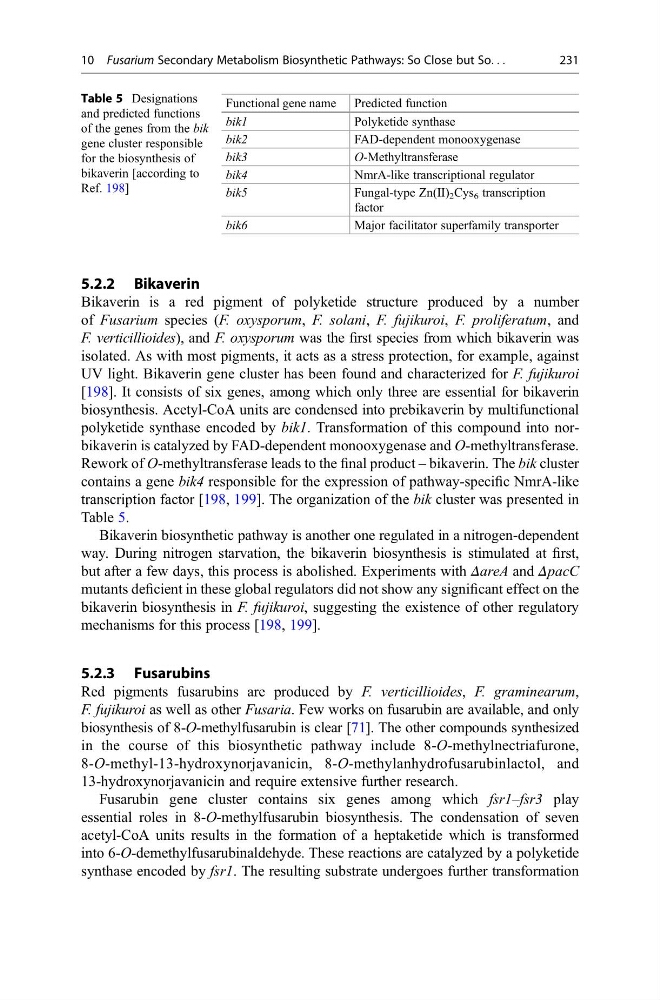
[198]. It consists of six genes, among which only three are essential for bikaverin
biosynthesis. Acetyl-CoA units are condensed into prebikaverin by multifunctional
polyketide synthase encoded by bik1. Transformation of this compound into norbikaverin is catalyzed by FAD-dependent monooxygenase and O-methyltransferase.
Rework of O-methyltransferase leads to the final product – bikaverin. The bik cluster
contains a gene bik4 responsible for the expression of pathway-specific NmrA-like
transcription factor [198, 199]. The organization of the bik cluster was presented in
Table 5.
Bikaverin biosynthetic pathway is another one regulated in a nitrogen-dependent
way. During nitrogen starvation, the bikaverin biosynthesis is stimulated at first,
but after a few days, this process is abolished. Experiments with ΔareA and ΔpacC
mutants deficient in these global regulators did not show any significant effect on the
bikaverin biosynthesis in F. fujikuroi, suggesting the existence of other regulatory
mechanisms for this process [198, 199].
5.2.3 Fusarubins
Red pigments fusarubins are produced by F. verticillioides, F. graminearum,
F. fujikuroi as well as other Fusaria. Few works on fusarubin are available, and only
biosynthesis of 8-O-methylfusarubin is clear [71]. The other compounds synthesized
in the course of this biosynthetic pathway include 8-O-methylnectriafurone,
8-O-methyl-13-hydroxynorjavanicin, 8-O-methylanhydrofusarubinlactol, and
13-hydroxynorjavanicin and require extensive further research.
Fusarubin gene cluster contains six genes among which fsr1–fsr3 play
essential roles in 8-O-methylfusarubin biosynthesis. The condensation of seven
acetyl-CoA units results in the formation of a heptaketide which is transformed
into 6-O-demethylfusarubinaldehyde. These reactions are catalyzed by a polyketide
synthase encoded by fsr1. The resulting substrate undergoes further transformation
Table 5 Designations
and predicted functions
of the genes from the bik
gene cluster responsible
for the biosynthesis of
bikaverin [according to
Ref. 198]
Functional gene name Predicted function
bik1
Polyketide synthase
bik2
FAD-dependent monooxygenase
bik3
O-Methyltransferase
bik4
NmrA-like transcriptional regulator
bik5
Fungal-type Zn(II) 2 Cys 6 transcription
factor
bik6
Major facilitator superfamily transporter
10 Fusarium Secondary Metabolism Biosynthetic Pathways: So Close but So. . .
231
Bikaverin is a red pigment of polyketide structure produced by a number
of Fusarium species (F. oxysporum, F. solani, F. fujikuroi, F. proliferatum, and
F. verticillioides), and F. oxysporum was the first species from which bikaverin was
isolated. As with most pigments, it acts as a stress protection, for example, against
UV light. Bikaverin gene cluster has been found and characterized for F. fujikuroi
[198]. It consists of six genes, among which only three are essential for bikaverin
biosynthesis. Acetyl-CoA units are condensed into prebikaverin by multifunctional
polyketide synthase encoded by bik1. Transformation of this compound into norbikaverin is catalyzed by FAD-dependent monooxygenase and O-methyltransferase.
Rework of O-methyltransferase leads to the final product – bikaverin. The bik cluster
contains a gene bik4 responsible for the expression of pathway-specific NmrA-like
transcription factor [198, 199]. The organization of the bik cluster was presented in
Table 5.
Bikaverin biosynthetic pathway is another one regulated in a nitrogen-dependent
way. During nitrogen starvation, the bikaverin biosynthesis is stimulated at first,
but after a few days, this process is abolished. Experiments with ΔareA and ΔpacC
mutants deficient in these global regulators did not show any significant effect on the
bikaverin biosynthesis in F. fujikuroi, suggesting the existence of other regulatory
mechanisms for this process [198, 199].
5.2.3 Fusarubins
Red pigments fusarubins are produced by F. verticillioides, F. graminearum,
F. fujikuroi as well as other Fusaria. Few works on fusarubin are available, and only
biosynthesis of 8-O-methylfusarubin is clear [71]. The other compounds synthesized
in the course of this biosynthetic pathway include 8-O-methylnectriafurone,
8-O-methyl-13-hydroxynorjavanicin, 8-O-methylanhydrofusarubinlactol, and
13-hydroxynorjavanicin and require extensive further research.
Fusarubin gene cluster contains six genes among which fsr1–fsr3 play
essential roles in 8-O-methylfusarubin biosynthesis. The condensation of seven
acetyl-CoA units results in the formation of a heptaketide which is transformed
into 6-O-demethylfusarubinaldehyde. These reactions are catalyzed by a polyketide
synthase encoded by fsr1. The resulting substrate undergoes further transformation
Table 5 Designations
and predicted functions
of the genes from the bik
gene cluster responsible
for the biosynthesis of
bikaverin [according to
Ref. 198]
Functional gene name Predicted function
bik1
Polyketide synthase
bik2
FAD-dependent monooxygenase
bik3
O-Methyltransferase
bik4
NmrA-like transcriptional regulator
bik5
Fungal-type Zn(II) 2 Cys 6 transcription
factor
bik6
Major facilitator superfamily transporter
10 Fusarium Secondary Metabolism Biosynthetic Pathways: So Close but So. . .
231