

and play a role in photosynthesis, photoprotection, and plant signaling, but no other
significant function besides pigmentation has been found in fungi. Carotenoids were
identified for the first time in cultures of F. aquaeductum but later also in F. fujikuroi
and F. oxysporum. Fusarium species are able to produce β-carotene, lycopene, and
neurosporaxanthin thanks to the car gene cluster encoding enzymes involved in
carotenoid biosynthesis [196, 197].
Carotenoid biosynthesis is basically a continuation of the mevalonic acid biosynthesis because of the use of geranylgeranyl pyrophosphate (GGPP) as a first substrate. carRA and carB were the first genes involved in carotenoid biosynthesis
that were discovered [196]. The cyclase encoded by carRA catalyzes the transformation of two GGPP units into 15-cis-phytoene which is converted into
neurosporene by desaturase encoded by carB. Then, this compound serves as
a substrate for the γ-carotene formation. Two intermediate products of this reaction
are possible, and the outcome depends on which enzyme (cyclase or desaturase) acts
first. If desaturase is the first acting enzyme, the intermediate product will be
lycopene, and β-zeacarotene is a product of the cyclase. Carotenoidogenesis may
diverge into two ways at this point. Using the first, cyclase converts γ-carotene into
β-carotene which can be transformed by oxygenase (encoded by carX) into two
retinol units. Using the second route, γ-carotene is desaturated into torulene by the
first oxygenase (encoded by carT) into β-apo-4
0 -carotenol which is finally converted
into neurosporaxanthine thanks to the oxygenase action (encoded by carD) [196,
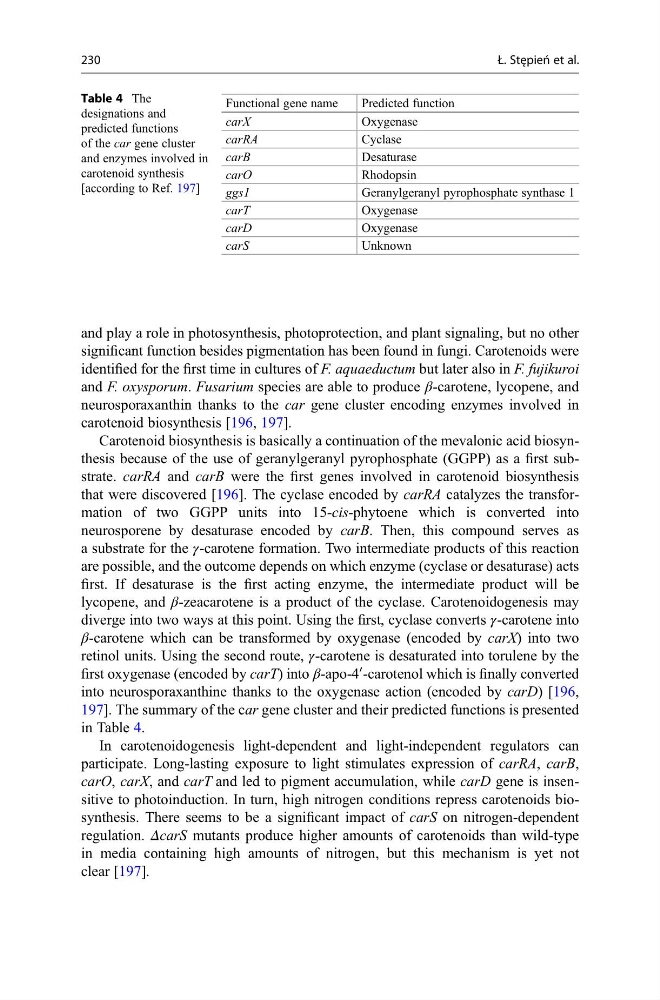
197]. The summary of the car gene cluster and their predicted functions is presented
in Table 4.
In carotenoidogenesis light-dependent and light-independent regulators can
participate. Long-lasting exposure to light stimulates expression of carRA, carB,
carO, carX, and carT and led to pigment accumulation, while carD gene is insensitive to photoinduction. In turn, high nitrogen conditions repress carotenoids biosynthesis. There seems to be a significant impact of carS on nitrogen-dependent
regulation. ΔcarS mutants produce higher amounts of carotenoids than wild-type
in media containing high amounts of nitrogen, but this mechanism is yet not
clear [197].
Table 4 The
designations and
predicted functions
of the car gene cluster
and enzymes involved in
carotenoid synthesis
[according to Ref. 197]
Functional gene name
Predicted function
carX
Oxygenase
carRA
Cyclase
carB
Desaturase
carO
Rhodopsin
ggs1
Geranylgeranyl pyrophosphate synthase 1
carT
Oxygenase
carD
Oxygenase
carS
Unknown
230
Ł. Stępień et al.
significant function besides pigmentation has been found in fungi. Carotenoids were
identified for the first time in cultures of F. aquaeductum but later also in F. fujikuroi
and F. oxysporum. Fusarium species are able to produce β-carotene, lycopene, and
neurosporaxanthin thanks to the car gene cluster encoding enzymes involved in
carotenoid biosynthesis [196, 197].
Carotenoid biosynthesis is basically a continuation of the mevalonic acid biosynthesis because of the use of geranylgeranyl pyrophosphate (GGPP) as a first substrate. carRA and carB were the first genes involved in carotenoid biosynthesis
that were discovered [196]. The cyclase encoded by carRA catalyzes the transformation of two GGPP units into 15-cis-phytoene which is converted into
neurosporene by desaturase encoded by carB. Then, this compound serves as
a substrate for the γ-carotene formation. Two intermediate products of this reaction
are possible, and the outcome depends on which enzyme (cyclase or desaturase) acts
first. If desaturase is the first acting enzyme, the intermediate product will be
lycopene, and β-zeacarotene is a product of the cyclase. Carotenoidogenesis may
diverge into two ways at this point. Using the first, cyclase converts γ-carotene into
β-carotene which can be transformed by oxygenase (encoded by carX) into two
retinol units. Using the second route, γ-carotene is desaturated into torulene by the
first oxygenase (encoded by carT) into β-apo-4
0 -carotenol which is finally converted
into neurosporaxanthine thanks to the oxygenase action (encoded by carD) [196,
197]. The summary of the car gene cluster and their predicted functions is presented
in Table 4.
In carotenoidogenesis light-dependent and light-independent regulators can
participate. Long-lasting exposure to light stimulates expression of carRA, carB,
carO, carX, and carT and led to pigment accumulation, while carD gene is insensitive to photoinduction. In turn, high nitrogen conditions repress carotenoids biosynthesis. There seems to be a significant impact of carS on nitrogen-dependent
regulation. ΔcarS mutants produce higher amounts of carotenoids than wild-type
in media containing high amounts of nitrogen, but this mechanism is yet not
clear [197].
Table 4 The
designations and
predicted functions
of the car gene cluster
and enzymes involved in
carotenoid synthesis
[according to Ref. 197]
Functional gene name
Predicted function
carX
Oxygenase
carRA
Cyclase
carB
Desaturase
carO
Rhodopsin
ggs1
Geranylgeranyl pyrophosphate synthase 1
carT
Oxygenase
carD
Oxygenase
carS
Unknown
230
Ł. Stępień et al.