

and MCF-7 was tested as potential anticancer activity of stictic acid. Results showed
strong potential of this compound as anticancer agent (IC 50 = 29,29 μg/mL). For
comparison was tested normal cell line MRC-5 with IC 50 = 2478.40 μg/mL [62].
Dibenzofurans
Dibenzofurans are heterocyclic aromatic organic compounds with two benzene rings
fused to a central furan ring. As secondary metabolites, the phenolic units are derived
by the orsellinic acid-type cyclization. The dibenzofurans appear to form by
carbon–carbon coupling and cyclodehydration of two such acetate–polymalonatederived phenolic acid units.
Usnic Acid
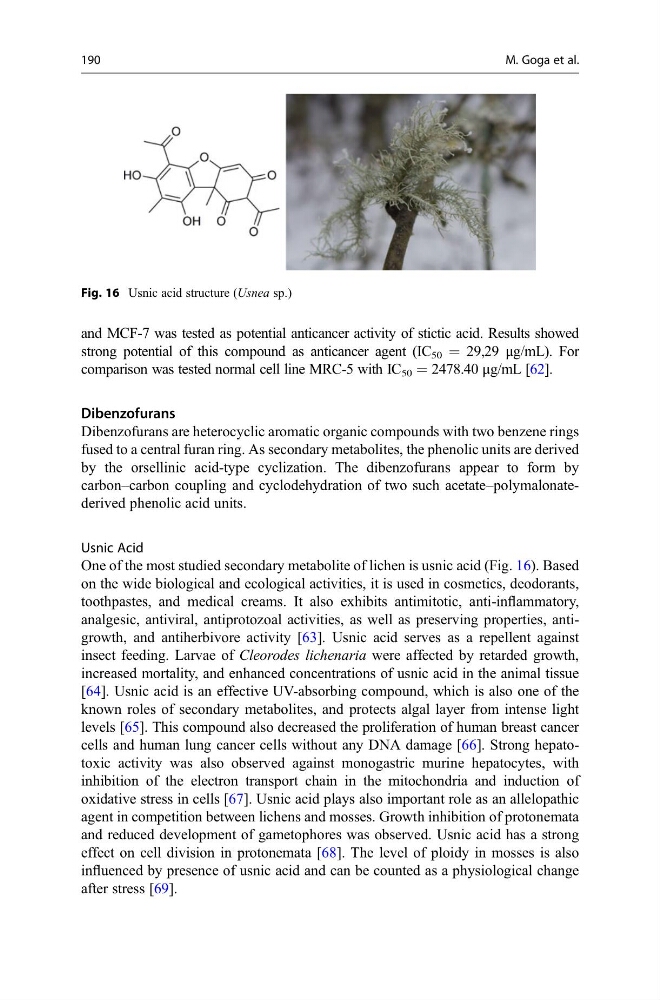
One of the most studied secondary metabolite of lichen is usnic acid (Fig. 16). Based
on the wide biological and ecological activities, it is used in cosmetics, deodorants,
toothpastes, and medical creams. It also exhibits antimitotic, anti-inflammatory,
analgesic, antiviral, antiprotozoal activities, as well as preserving properties, antigrowth, and antiherbivore activity [63]. Usnic acid serves as a repellent against
insect feeding. Larvae of Cleorodes lichenaria were affected by retarded growth,
increased mortality, and enhanced concentrations of usnic acid in the animal tissue
[64]. Usnic acid is an effective UV-absorbing compound, which is also one of the
known roles of secondary metabolites, and protects algal layer from intense light
levels [65]. This compound also decreased the proliferation of human breast cancer
cells and human lung cancer cells without any DNA damage [66]. Strong hepatotoxic activity was also observed against monogastric murine hepatocytes, with
inhibition of the electron transport chain in the mitochondria and induction of
oxidative stress in cells [67]. Usnic acid plays also important role as an allelopathic
agent in competition between lichens and mosses. Growth inhibition of protonemata
and reduced development of gametophores was observed. Usnic acid has a strong
effect on cell division in protonemata [68]. The level of ploidy in mosses is also
influenced by presence of usnic acid and can be counted as a physiological change
after stress [69].
Fig. 16 Usnic acid structure (Usnea sp.)
190
M. Goga et al.
strong potential of this compound as anticancer agent (IC 50 = 29,29 μg/mL). For
comparison was tested normal cell line MRC-5 with IC 50 = 2478.40 μg/mL [62].
Dibenzofurans
Dibenzofurans are heterocyclic aromatic organic compounds with two benzene rings
fused to a central furan ring. As secondary metabolites, the phenolic units are derived
by the orsellinic acid-type cyclization. The dibenzofurans appear to form by
carbon–carbon coupling and cyclodehydration of two such acetate–polymalonatederived phenolic acid units.
Usnic Acid
One of the most studied secondary metabolite of lichen is usnic acid (Fig. 16). Based
on the wide biological and ecological activities, it is used in cosmetics, deodorants,
toothpastes, and medical creams. It also exhibits antimitotic, anti-inflammatory,
analgesic, antiviral, antiprotozoal activities, as well as preserving properties, antigrowth, and antiherbivore activity [63]. Usnic acid serves as a repellent against
insect feeding. Larvae of Cleorodes lichenaria were affected by retarded growth,
increased mortality, and enhanced concentrations of usnic acid in the animal tissue
[64]. Usnic acid is an effective UV-absorbing compound, which is also one of the
known roles of secondary metabolites, and protects algal layer from intense light
levels [65]. This compound also decreased the proliferation of human breast cancer
cells and human lung cancer cells without any DNA damage [66]. Strong hepatotoxic activity was also observed against monogastric murine hepatocytes, with
inhibition of the electron transport chain in the mitochondria and induction of
oxidative stress in cells [67]. Usnic acid plays also important role as an allelopathic
agent in competition between lichens and mosses. Growth inhibition of protonemata
and reduced development of gametophores was observed. Usnic acid has a strong
effect on cell division in protonemata [68]. The level of ploidy in mosses is also
influenced by presence of usnic acid and can be counted as a physiological change
after stress [69].
Fig. 16 Usnic acid structure (Usnea sp.)
190
M. Goga et al.