

Physodic Acid
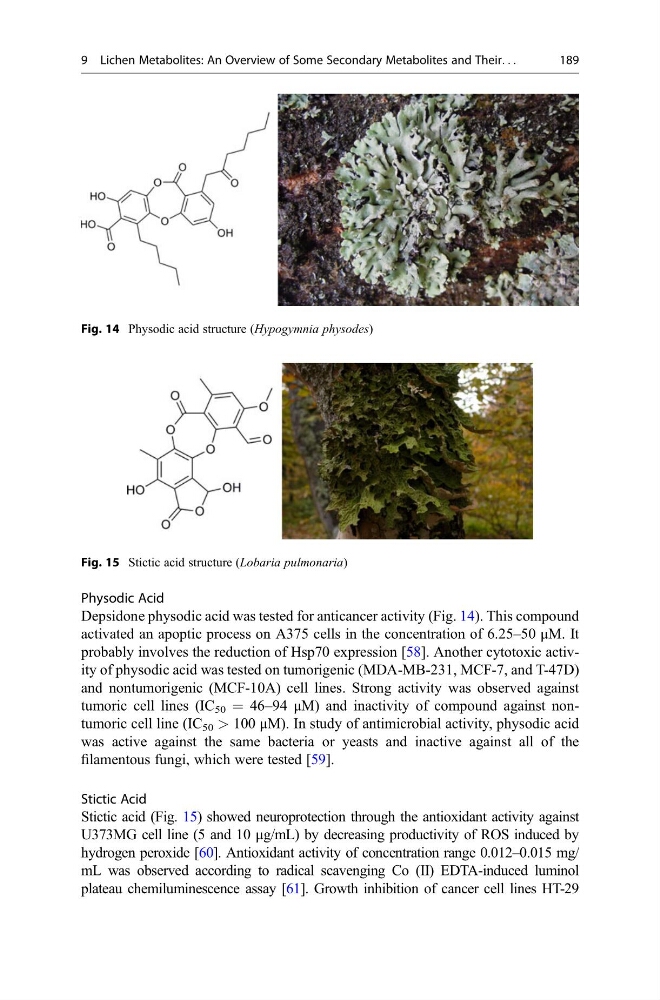
Depsidone physodic acid was tested for anticancer activity (Fig. 14). This compound
activated an apoptic process on A375 cells in the concentration of 6.25–50 μM. It
probably involves the reduction of Hsp70 expression [58]. Another cytotoxic activity of physodic acid was tested on tumorigenic (MDA-MB-231, MCF-7, and T-47D)
and nontumorigenic (MCF-10A) cell lines. Strong activity was observed against
tumoric cell lines (IC 50 = 46–94 μM) and inactivity of compound against nontumoric cell line (IC 50 > 100 μM). In study of antimicrobial activity, physodic acid
was active against the same bacteria or yeasts and inactive against all of the
filamentous fungi, which were tested [59].
Stictic Acid
Stictic acid (Fig. 15) showed neuroprotection through the antioxidant activity against
U373MG cell line (5 and 10 μg/mL) by decreasing productivity of ROS induced by
hydrogen peroxide [60]. Antioxidant activity of concentration range 0.012–0.015 mg/
mL was observed according to radical scavenging Co (II) EDTA-induced luminol
plateau chemiluminescence assay [61]. Growth inhibition of cancer cell lines HT-29
Fig. 14 Physodic acid structure (Hypogymnia physodes)
Fig. 15 Stictic acid structure (Lobaria pulmonaria)
9 Lichen Metabolites: An Overview of Some Secondary Metabolites and Their. . .
189
Depsidone physodic acid was tested for anticancer activity (Fig. 14). This compound
activated an apoptic process on A375 cells in the concentration of 6.25–50 μM. It
probably involves the reduction of Hsp70 expression [58]. Another cytotoxic activity of physodic acid was tested on tumorigenic (MDA-MB-231, MCF-7, and T-47D)
and nontumorigenic (MCF-10A) cell lines. Strong activity was observed against
tumoric cell lines (IC 50 = 46–94 μM) and inactivity of compound against nontumoric cell line (IC 50 > 100 μM). In study of antimicrobial activity, physodic acid
was active against the same bacteria or yeasts and inactive against all of the
filamentous fungi, which were tested [59].
Stictic Acid
Stictic acid (Fig. 15) showed neuroprotection through the antioxidant activity against
U373MG cell line (5 and 10 μg/mL) by decreasing productivity of ROS induced by
hydrogen peroxide [60]. Antioxidant activity of concentration range 0.012–0.015 mg/
mL was observed according to radical scavenging Co (II) EDTA-induced luminol
plateau chemiluminescence assay [61]. Growth inhibition of cancer cell lines HT-29
Fig. 14 Physodic acid structure (Hypogymnia physodes)
Fig. 15 Stictic acid structure (Lobaria pulmonaria)
9 Lichen Metabolites: An Overview of Some Secondary Metabolites and Their. . .
189