

Salmonella typhi (0.5 μg/mL) and significant antifungal effect against Tripthyton
rubrum (1 μg/1 mL) were reported. Protocetraric acid can be used as potential
antimicrobial drug against human pathogenic microbes [54]. Antitubercular activity
of several lichen substances was also tested. Protocetraric acid (MIC value 125 μg/
mL, 334 μM) showed moderate inhibitory activity [55]. Antiproliferative activity of
protocetraric acid against FemX (human melanoma) and LS174 (human colon
carcinoma) cell lines with IC 50 values from 35.67 to 60.18 μg/mL was confirmed.
Fumarprotocetraric Acid
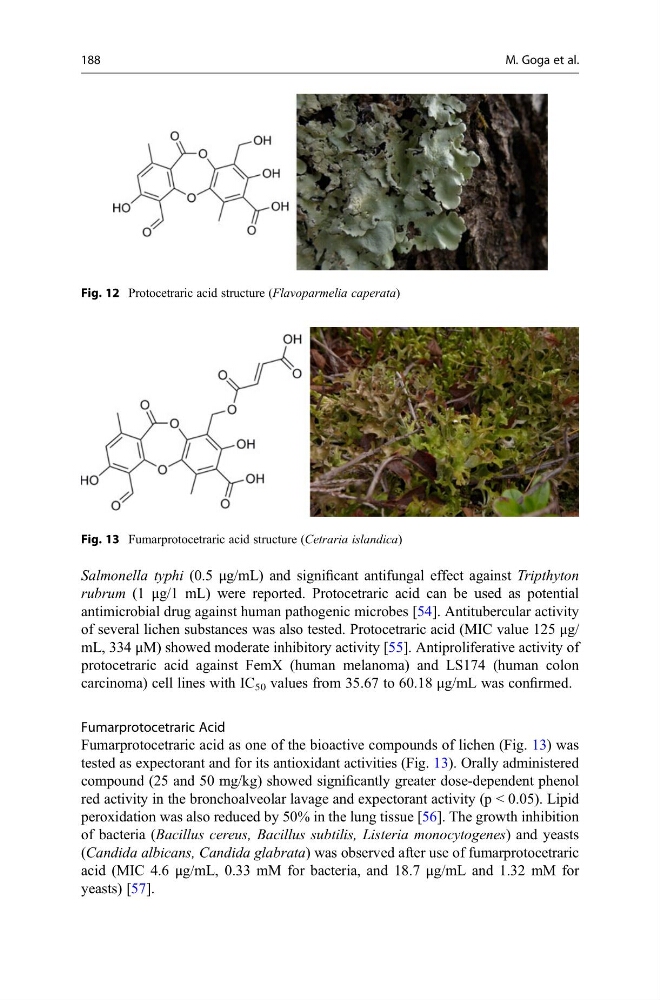
Fumarprotocetraric acid as one of the bioactive compounds of lichen (Fig. 13) was
tested as expectorant and for its antioxidant activities (Fig. 13). Orally administered
compound (25 and 50 mg/kg) showed significantly greater dose-dependent phenol
red activity in the bronchoalveolar lavage and expectorant activity (p ˂ 0.05). Lipid
peroxidation was also reduced by 50% in the lung tissue [56]. The growth inhibition
of bacteria (Bacillus cereus, Bacillus subtilis, Listeria monocytogenes) and yeasts
(Candida albicans, Candida glabrata) was observed after use of fumarprotocetraric
acid (MIC 4.6 μg/mL, 0.33 mM for bacteria, and 18.7 μg/mL and 1.32 mM for
yeasts) [57].
Fig. 12 Protocetraric acid structure (Flavoparmelia caperata)
Fig. 13 Fumarprotocetraric acid structure (Cetraria islandica)
188
M. Goga et al.
rubrum (1 μg/1 mL) were reported. Protocetraric acid can be used as potential
antimicrobial drug against human pathogenic microbes [54]. Antitubercular activity
of several lichen substances was also tested. Protocetraric acid (MIC value 125 μg/
mL, 334 μM) showed moderate inhibitory activity [55]. Antiproliferative activity of
protocetraric acid against FemX (human melanoma) and LS174 (human colon
carcinoma) cell lines with IC 50 values from 35.67 to 60.18 μg/mL was confirmed.
Fumarprotocetraric Acid
Fumarprotocetraric acid as one of the bioactive compounds of lichen (Fig. 13) was
tested as expectorant and for its antioxidant activities (Fig. 13). Orally administered
compound (25 and 50 mg/kg) showed significantly greater dose-dependent phenol
red activity in the bronchoalveolar lavage and expectorant activity (p ˂ 0.05). Lipid
peroxidation was also reduced by 50% in the lung tissue [56]. The growth inhibition
of bacteria (Bacillus cereus, Bacillus subtilis, Listeria monocytogenes) and yeasts
(Candida albicans, Candida glabrata) was observed after use of fumarprotocetraric
acid (MIC 4.6 μg/mL, 0.33 mM for bacteria, and 18.7 μg/mL and 1.32 mM for
yeasts) [57].
Fig. 12 Protocetraric acid structure (Flavoparmelia caperata)
Fig. 13 Fumarprotocetraric acid structure (Cetraria islandica)
188
M. Goga et al.