

Umbilicaric Acid
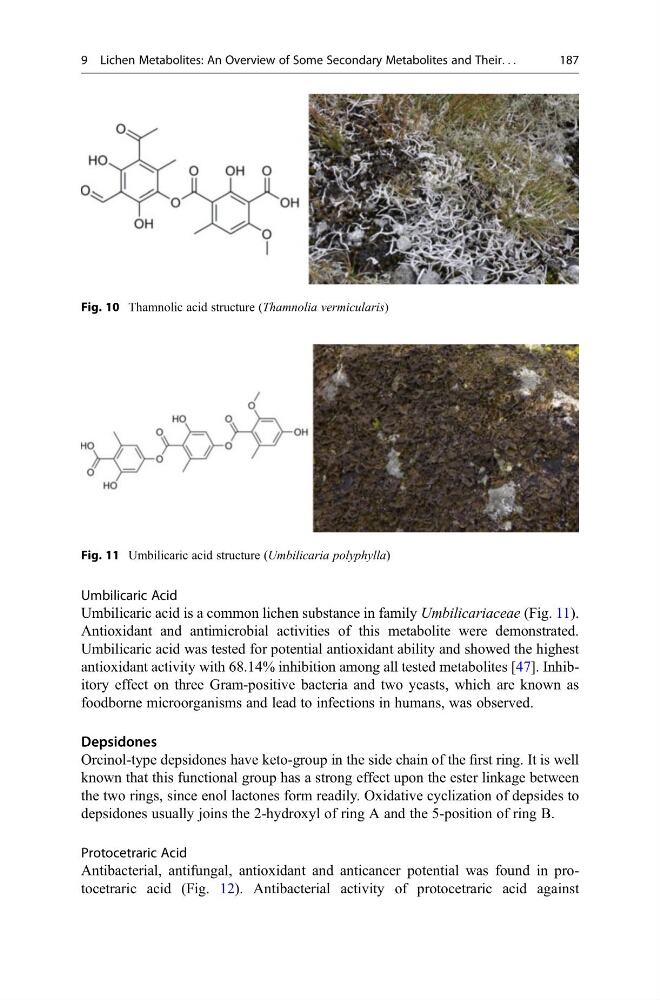
Umbilicaric acid is a common lichen substance in family Umbilicariaceae (Fig. 11).
Antioxidant and antimicrobial activities of this metabolite were demonstrated.
Umbilicaric acid was tested for potential antioxidant ability and showed the highest
antioxidant activity with 68.14% inhibition among all tested metabolites [47]. Inhibitory effect on three Gram-positive bacteria and two yeasts, which are known as
foodborne microorganisms and lead to infections in humans, was observed.
Depsidones
Orcinol-type depsidones have keto-group in the side chain of the first ring. It is well
known that this functional group has a strong effect upon the ester linkage between
the two rings, since enol lactones form readily. Oxidative cyclization of depsides to
depsidones usually joins the 2-hydroxyl of ring A and the 5-position of ring B.
Protocetraric Acid
Antibacterial, antifungal, antioxidant and anticancer potential was found in protocetraric acid (Fig. 12). Antibacterial activity of protocetraric acid against
Fig. 11 Umbilicaric acid structure (Umbilicaria polyphylla)
Fig. 10 Thamnolic acid structure (Thamnolia vermicularis)
9 Lichen Metabolites: An Overview of Some Secondary Metabolites and Their. . .
187
Umbilicaric acid is a common lichen substance in family Umbilicariaceae (Fig. 11).
Antioxidant and antimicrobial activities of this metabolite were demonstrated.
Umbilicaric acid was tested for potential antioxidant ability and showed the highest
antioxidant activity with 68.14% inhibition among all tested metabolites [47]. Inhibitory effect on three Gram-positive bacteria and two yeasts, which are known as
foodborne microorganisms and lead to infections in humans, was observed.
Depsidones
Orcinol-type depsidones have keto-group in the side chain of the first ring. It is well
known that this functional group has a strong effect upon the ester linkage between
the two rings, since enol lactones form readily. Oxidative cyclization of depsides to
depsidones usually joins the 2-hydroxyl of ring A and the 5-position of ring B.
Protocetraric Acid
Antibacterial, antifungal, antioxidant and anticancer potential was found in protocetraric acid (Fig. 12). Antibacterial activity of protocetraric acid against
Fig. 11 Umbilicaric acid structure (Umbilicaria polyphylla)
Fig. 10 Thamnolic acid structure (Thamnolia vermicularis)
9 Lichen Metabolites: An Overview of Some Secondary Metabolites and Their. . .
187