

Alectosarmentin
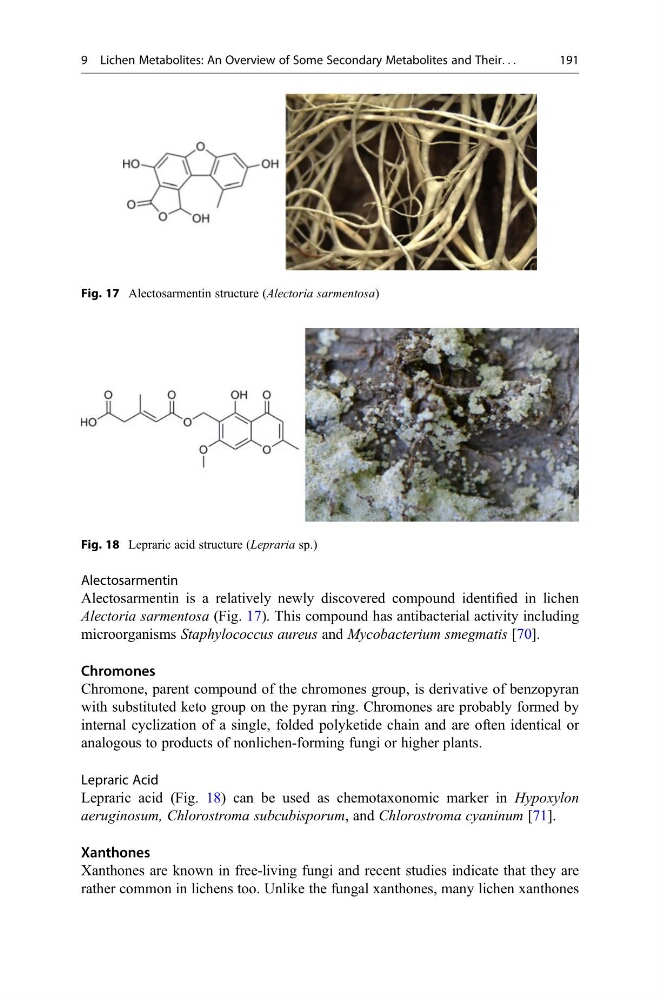
Alectosarmentin is a relatively newly discovered compound identified in lichen
Alectoria sarmentosa (Fig. 17). This compound has antibacterial activity including
microorganisms Staphylococcus aureus and Mycobacterium smegmatis [70].
Chromones
Chromone, parent compound of the chromones group, is derivative of benzopyran
with substituted keto group on the pyran ring. Chromones are probably formed by
internal cyclization of a single, folded polyketide chain and are often identical or
analogous to products of nonlichen-forming fungi or higher plants.
Lepraric Acid
Lepraric acid (Fig. 18) can be used as chemotaxonomic marker in Hypoxylon
aeruginosum, Chlorostroma subcubisporum, and Chlorostroma cyaninum [71].
Xanthones
Xanthones are known in free-living fungi and recent studies indicate that they are
rather common in lichens too. Unlike the fungal xanthones, many lichen xanthones
Fig. 17 Alectosarmentin structure (Alectoria sarmentosa)
Fig. 18 Lepraric acid structure (Lepraria sp.)
9 Lichen Metabolites: An Overview of Some Secondary Metabolites and Their. . .
191
Alectosarmentin is a relatively newly discovered compound identified in lichen
Alectoria sarmentosa (Fig. 17). This compound has antibacterial activity including
microorganisms Staphylococcus aureus and Mycobacterium smegmatis [70].
Chromones
Chromone, parent compound of the chromones group, is derivative of benzopyran
with substituted keto group on the pyran ring. Chromones are probably formed by
internal cyclization of a single, folded polyketide chain and are often identical or
analogous to products of nonlichen-forming fungi or higher plants.
Lepraric Acid
Lepraric acid (Fig. 18) can be used as chemotaxonomic marker in Hypoxylon
aeruginosum, Chlorostroma subcubisporum, and Chlorostroma cyaninum [71].
Xanthones
Xanthones are known in free-living fungi and recent studies indicate that they are
rather common in lichens too. Unlike the fungal xanthones, many lichen xanthones
Fig. 17 Alectosarmentin structure (Alectoria sarmentosa)
Fig. 18 Lepraric acid structure (Lepraria sp.)
9 Lichen Metabolites: An Overview of Some Secondary Metabolites and Their. . .
191