

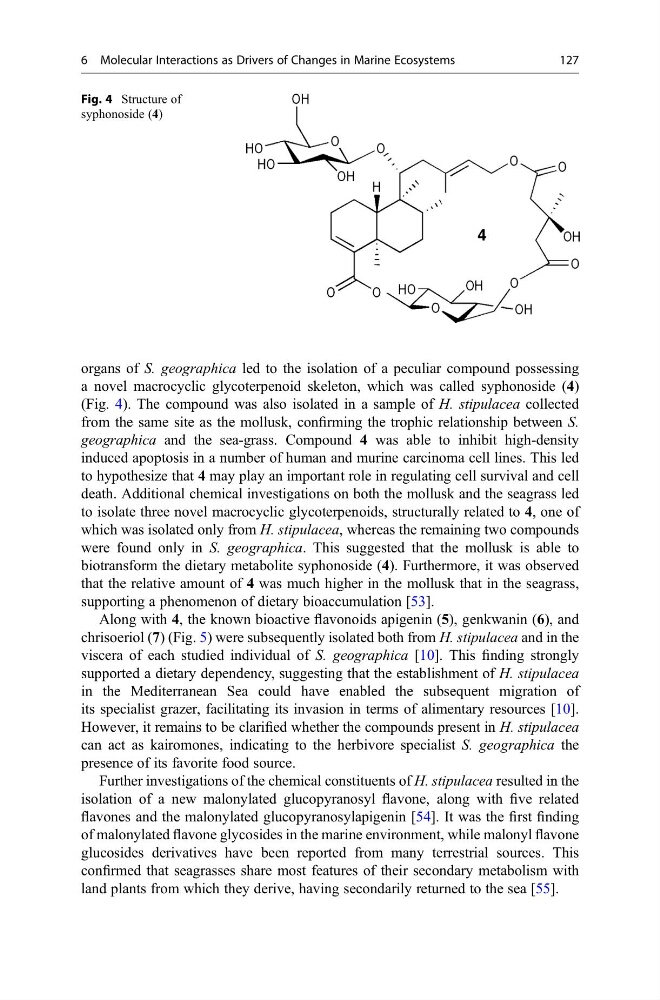
organs of S. geographica led to the isolation of a peculiar compound possessing
a novel macrocyclic glycoterpenoid skeleton, which was called syphonoside (4)
(Fig. 4). The compound was also isolated in a sample of H. stipulacea collected
from the same site as the mollusk, confirming the trophic relationship between S.
geographica and the sea-grass. Compound 4 was able to inhibit high-density
induced apoptosis in a number of human and murine carcinoma cell lines. This led
to hypothesize that 4 may play an important role in regulating cell survival and cell
death. Additional chemical investigations on both the mollusk and the seagrass led
to isolate three novel macrocyclic glycoterpenoids, structurally related to 4, one of
which was isolated only from H. stipulacea, whereas the remaining two compounds
were found only in S. geographica. This suggested that the mollusk is able to
biotransform the dietary metabolite syphonoside (4). Furthermore, it was observed
that the relative amount of 4 was much higher in the mollusk that in the seagrass,
supporting a phenomenon of dietary bioaccumulation [53].
Along with 4, the known bioactive flavonoids apigenin (5), genkwanin (6), and
chrisoeriol (7) (Fig. 5) were subsequently isolated both from H. stipulacea and in the
viscera of each studied individual of S. geographica [10]. This finding strongly
supported a dietary dependency, suggesting that the establishment of H. stipulacea
in the Mediterranean Sea could have enabled the subsequent migration of
its specialist grazer, facilitating its invasion in terms of alimentary resources [10].
However, it remains to be clarified whether the compounds present in H. stipulacea
can act as kairomones, indicating to the herbivore specialist S. geographica the
presence of its favorite food source.
Further investigations of the chemical constituents of H. stipulacea resulted in the
isolation of a new malonylated glucopyranosyl flavone, along with five related
flavones and the malonylated glucopyranosylapigenin [54]. It was the first finding
of malonylated flavone glycosides in the marine environment, while malonyl flavone
glucosides derivatives have been reported from many terrestrial sources. This
confirmed that seagrasses share most features of their secondary metabolism with
land plants from which they derive, having secondarily returned to the sea [55].
Fig. 4 Structure of
syphonoside (4)
6 Molecular Interactions as Drivers of Changes in Marine Ecosystems
127
a novel macrocyclic glycoterpenoid skeleton, which was called syphonoside (4)
(Fig. 4). The compound was also isolated in a sample of H. stipulacea collected
from the same site as the mollusk, confirming the trophic relationship between S.
geographica and the sea-grass. Compound 4 was able to inhibit high-density
induced apoptosis in a number of human and murine carcinoma cell lines. This led
to hypothesize that 4 may play an important role in regulating cell survival and cell
death. Additional chemical investigations on both the mollusk and the seagrass led
to isolate three novel macrocyclic glycoterpenoids, structurally related to 4, one of
which was isolated only from H. stipulacea, whereas the remaining two compounds
were found only in S. geographica. This suggested that the mollusk is able to
biotransform the dietary metabolite syphonoside (4). Furthermore, it was observed
that the relative amount of 4 was much higher in the mollusk that in the seagrass,
supporting a phenomenon of dietary bioaccumulation [53].
Along with 4, the known bioactive flavonoids apigenin (5), genkwanin (6), and
chrisoeriol (7) (Fig. 5) were subsequently isolated both from H. stipulacea and in the
viscera of each studied individual of S. geographica [10]. This finding strongly
supported a dietary dependency, suggesting that the establishment of H. stipulacea
in the Mediterranean Sea could have enabled the subsequent migration of
its specialist grazer, facilitating its invasion in terms of alimentary resources [10].
However, it remains to be clarified whether the compounds present in H. stipulacea
can act as kairomones, indicating to the herbivore specialist S. geographica the
presence of its favorite food source.
Further investigations of the chemical constituents of H. stipulacea resulted in the
isolation of a new malonylated glucopyranosyl flavone, along with five related
flavones and the malonylated glucopyranosylapigenin [54]. It was the first finding
of malonylated flavone glycosides in the marine environment, while malonyl flavone
glucosides derivatives have been reported from many terrestrial sources. This
confirmed that seagrasses share most features of their secondary metabolism with
land plants from which they derive, having secondarily returned to the sea [55].
Fig. 4 Structure of
syphonoside (4)
6 Molecular Interactions as Drivers of Changes in Marine Ecosystems
127