

by the finding of an increase of neuropeptide Y (NPY) transcriptional expression in
the central nervous system of D. sargus fed with CAU enriched food [50].
In order to characterize the molecular interactions between bioactive metabolites
from C. cylindracea that are responsible for the most relevant observed metabolic
and behavioral effects, an interdisciplinary study has been carried out starting from
in silico studies that led to predict the interaction of 2 with peroxisome proliferator
activated receptors (PPARs) [51]. These nuclear receptors play essential roles in the
regulation of metabolism and social behavior in vertebrates, mediating the effects of
several nutrients and drugs through transcriptional regulation of their target genes.
The prediction has been then validated by in vitro assays, coupled with in vivo, ex
vivo, and in vitro transcriptional analysis of PPARα downstream genes related to
fatty acid hepatic β-oxidation. Overall, the obtained results disclosed the unprecedented molecular interaction of 2 with PPARs, likely to exert cascade effects at all
levels of biological organization, down to sea-based economy, with implications of
interest for the development of functional foods for human nutrition and/or drugs for
treating human chronic diseases [51].
3
Bioactive Metabolites from the Invasive Seagrass
Halophila stipulacea
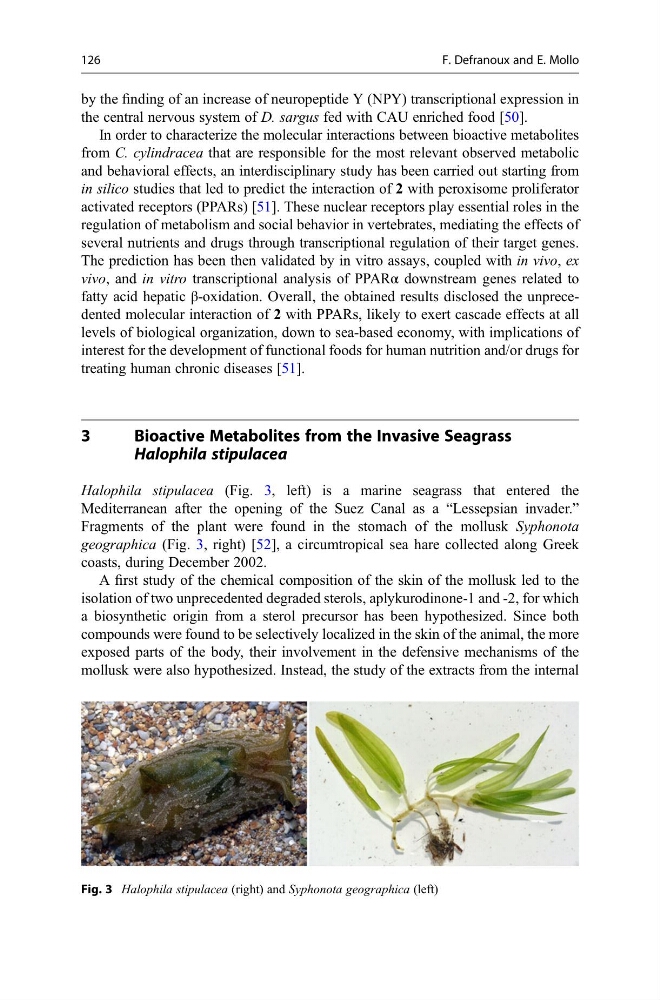
Halophila stipulacea (Fig. 3, left) is a marine seagrass that entered the
Mediterranean after the opening of the Suez Canal as a “Lessepsian invader.”
Fragments of the plant were found in the stomach of the mollusk Syphonota
geographica (Fig. 3, right) [52], a circumtropical sea hare collected along Greek
coasts, during December 2002.
A first study of the chemical composition of the skin of the mollusk led to the
isolation of two unprecedented degraded sterols, aplykurodinone-1 and -2, for which
a biosynthetic origin from a sterol precursor has been hypothesized. Since both
compounds were found to be selectively localized in the skin of the animal, the more
exposed parts of the body, their involvement in the defensive mechanisms of the
mollusk were also hypothesized. Instead, the study of the extracts from the internal
Fig. 3 Halophila stipulacea (right) and Syphonota geographica (left)
126
F. Defranoux and E. Mollo
the central nervous system of D. sargus fed with CAU enriched food [50].
In order to characterize the molecular interactions between bioactive metabolites
from C. cylindracea that are responsible for the most relevant observed metabolic
and behavioral effects, an interdisciplinary study has been carried out starting from
in silico studies that led to predict the interaction of 2 with peroxisome proliferator
activated receptors (PPARs) [51]. These nuclear receptors play essential roles in the
regulation of metabolism and social behavior in vertebrates, mediating the effects of
several nutrients and drugs through transcriptional regulation of their target genes.
The prediction has been then validated by in vitro assays, coupled with in vivo, ex
vivo, and in vitro transcriptional analysis of PPARα downstream genes related to
fatty acid hepatic β-oxidation. Overall, the obtained results disclosed the unprecedented molecular interaction of 2 with PPARs, likely to exert cascade effects at all
levels of biological organization, down to sea-based economy, with implications of
interest for the development of functional foods for human nutrition and/or drugs for
treating human chronic diseases [51].
3
Bioactive Metabolites from the Invasive Seagrass
Halophila stipulacea
Halophila stipulacea (Fig. 3, left) is a marine seagrass that entered the
Mediterranean after the opening of the Suez Canal as a “Lessepsian invader.”
Fragments of the plant were found in the stomach of the mollusk Syphonota
geographica (Fig. 3, right) [52], a circumtropical sea hare collected along Greek
coasts, during December 2002.
A first study of the chemical composition of the skin of the mollusk led to the
isolation of two unprecedented degraded sterols, aplykurodinone-1 and -2, for which
a biosynthetic origin from a sterol precursor has been hypothesized. Since both
compounds were found to be selectively localized in the skin of the animal, the more
exposed parts of the body, their involvement in the defensive mechanisms of the
mollusk were also hypothesized. Instead, the study of the extracts from the internal
Fig. 3 Halophila stipulacea (right) and Syphonota geographica (left)
126
F. Defranoux and E. Mollo