

It is worth to mention here that flavonoids showed important health functionality
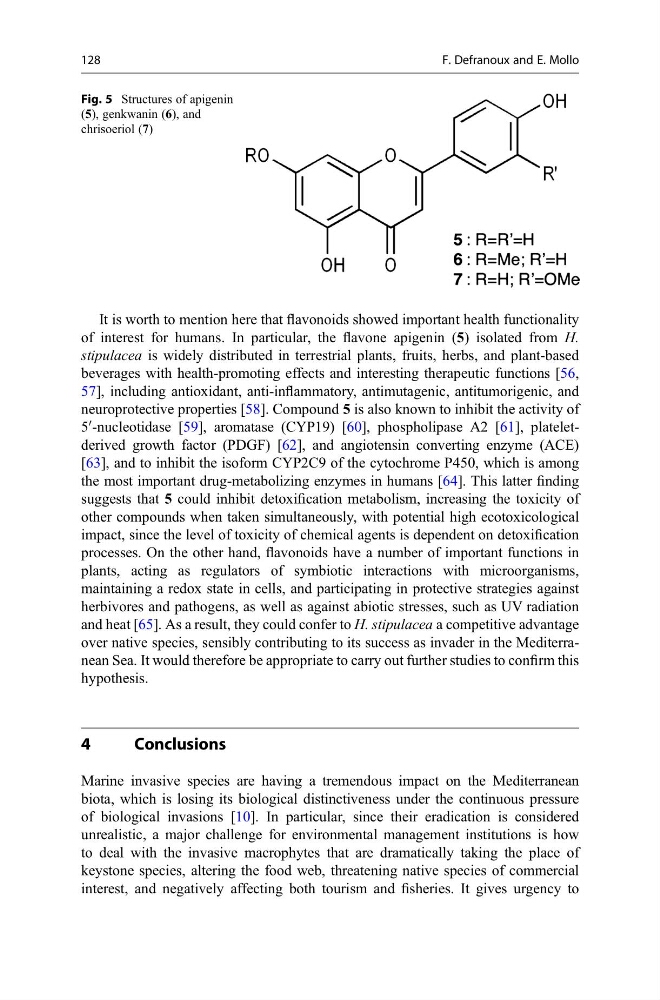
of interest for humans. In particular, the flavone apigenin (5) isolated from H.
stipulacea is widely distributed in terrestrial plants, fruits, herbs, and plant-based
beverages with health-promoting effects and interesting therapeutic functions [56,
57], including antioxidant, anti-inflammatory, antimutagenic, antitumorigenic, and
neuroprotective properties [58]. Compound 5 is also known to inhibit the activity of
5
0 -nucleotidase [59], aromatase (CYP19) [60], phospholipase A2 [61], plateletderived growth factor (PDGF) [62], and angiotensin converting enzyme (ACE)
[63], and to inhibit the isoform CYP2C9 of the cytochrome P450, which is among
the most important drug-metabolizing enzymes in humans [64]. This latter finding
suggests that 5 could inhibit detoxification metabolism, increasing the toxicity of
other compounds when taken simultaneously, with potential high ecotoxicological
impact, since the level of toxicity of chemical agents is dependent on detoxification
processes. On the other hand, flavonoids have a number of important functions in
plants, acting as regulators of symbiotic interactions with microorganisms,
maintaining a redox state in cells, and participating in protective strategies against
herbivores and pathogens, as well as against abiotic stresses, such as UV radiation
and heat [65]. As a result, they could confer to H. stipulacea a competitive advantage
over native species, sensibly contributing to its success as invader in the Mediterranean Sea. It would therefore be appropriate to carry out further studies to confirm this
hypothesis.
4
Conclusions
Marine invasive species are having a tremendous impact on the Mediterranean
biota, which is losing its biological distinctiveness under the continuous pressure
of biological invasions [10]. In particular, since their eradication is considered
unrealistic, a major challenge for environmental management institutions is how
to deal with the invasive macrophytes that are dramatically taking the place of
keystone species, altering the food web, threatening native species of commercial
interest, and negatively affecting both tourism and fisheries. It gives urgency to
Fig. 5 Structures of apigenin
(5), genkwanin (6), and
chrisoeriol (7)
128
F. Defranoux and E. Mollo
of interest for humans. In particular, the flavone apigenin (5) isolated from H.
stipulacea is widely distributed in terrestrial plants, fruits, herbs, and plant-based
beverages with health-promoting effects and interesting therapeutic functions [56,
57], including antioxidant, anti-inflammatory, antimutagenic, antitumorigenic, and
neuroprotective properties [58]. Compound 5 is also known to inhibit the activity of
5
0 -nucleotidase [59], aromatase (CYP19) [60], phospholipase A2 [61], plateletderived growth factor (PDGF) [62], and angiotensin converting enzyme (ACE)
[63], and to inhibit the isoform CYP2C9 of the cytochrome P450, which is among
the most important drug-metabolizing enzymes in humans [64]. This latter finding
suggests that 5 could inhibit detoxification metabolism, increasing the toxicity of
other compounds when taken simultaneously, with potential high ecotoxicological
impact, since the level of toxicity of chemical agents is dependent on detoxification
processes. On the other hand, flavonoids have a number of important functions in
plants, acting as regulators of symbiotic interactions with microorganisms,
maintaining a redox state in cells, and participating in protective strategies against
herbivores and pathogens, as well as against abiotic stresses, such as UV radiation
and heat [65]. As a result, they could confer to H. stipulacea a competitive advantage
over native species, sensibly contributing to its success as invader in the Mediterranean Sea. It would therefore be appropriate to carry out further studies to confirm this
hypothesis.
4
Conclusions
Marine invasive species are having a tremendous impact on the Mediterranean
biota, which is losing its biological distinctiveness under the continuous pressure
of biological invasions [10]. In particular, since their eradication is considered
unrealistic, a major challenge for environmental management institutions is how
to deal with the invasive macrophytes that are dramatically taking the place of
keystone species, altering the food web, threatening native species of commercial
interest, and negatively affecting both tourism and fisheries. It gives urgency to
Fig. 5 Structures of apigenin
(5), genkwanin (6), and
chrisoeriol (7)
128
F. Defranoux and E. Mollo