

absorption strength, as well as their impact on the conducting tissue of the host
[64]. Saric-Krsmanovic et al. [79, 95] examined the effect of field dodder on the
petiole of sugar beet, and the data for the measured parameters (tracheid diameter,
petiole hydraulic conductance, xylem surface, phloem cell diameter, and phloem
area) indicated that this parasitic flowering plant has a significant influence on all
measured parameters. In the infested sugar beet, field dodder significantly reduced
the area of conducting tissues, as well as the hydraulic conductance of the petiole,
compared to noninfested plants. Even though, the parasite is connected both with the
host xylem and phloem, Cuscuta spp. mostly assimilates through the phloem [50]. In
addition to the basic metabolic compounds, also some secondary products (such as
alkaloids, etc.) and xenobiotics are adopted by dodder plants mostly from the phloem
of the host [65]. But essential nutrients, which are deficient in the phloem, are
assimilated from the host xylem [50].
In general, field dodder exhausts the host plant, so that it becomes weak, its
lushness of growth declines, and fruit and seed maturation become significantly
reduced [90]. Also, host plants change their habit as their axillary buds sometimes
become suppressed [97], and the harm may result in total plant destruction (Picture 7).
5
Conclusions
Cuscuta, as a generalist type of holostemparasitic plants, interacts with various
hosts, causing different morphological, anatomical, and physiological changes.
Hosts are attacked non-specifically and sometimes even simultaneously, and one
crop species may serve as a host for several dodder species. Depending on the
infected plant species, Cuscuta infestation has more or less severe effects on the
growth and reproduction of its host. Rather than causing host death, Cuscuta
infestation seems to weaken host plants and to render them more susceptible to
secondary diseases such as infection by microbes or insect and nematode
infestation.
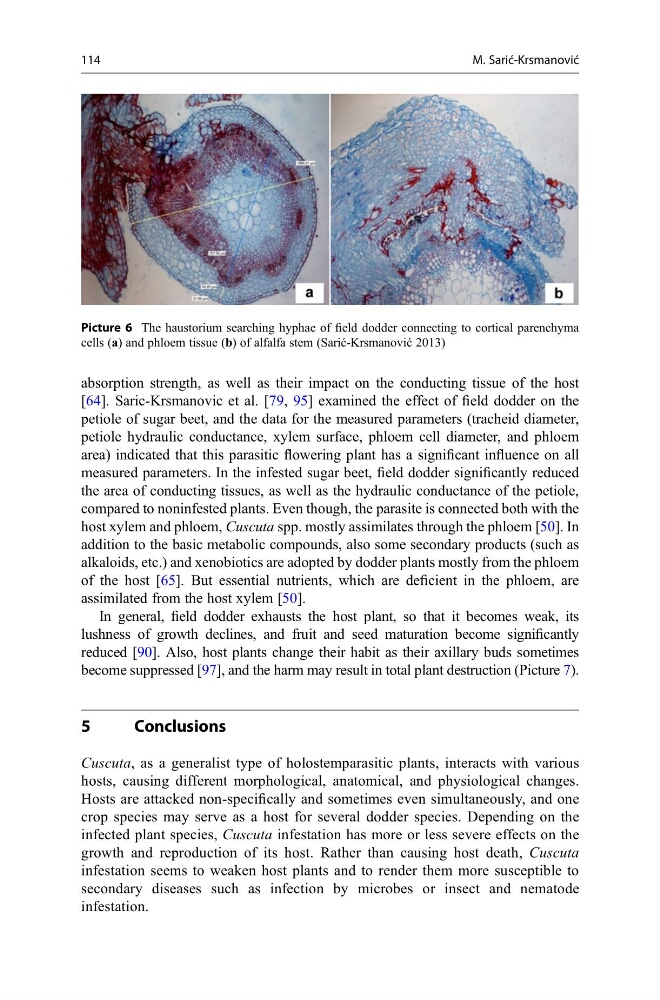
Picture 6 The haustorium searching hyphae of field dodder connecting to cortical parenchyma
cells (a) and phloem tissue (b) of alfalfa stem (Sarić-Krsmanović 2013)
114
M. Sarić-Krsmanović
[64]. Saric-Krsmanovic et al. [79, 95] examined the effect of field dodder on the
petiole of sugar beet, and the data for the measured parameters (tracheid diameter,
petiole hydraulic conductance, xylem surface, phloem cell diameter, and phloem
area) indicated that this parasitic flowering plant has a significant influence on all
measured parameters. In the infested sugar beet, field dodder significantly reduced
the area of conducting tissues, as well as the hydraulic conductance of the petiole,
compared to noninfested plants. Even though, the parasite is connected both with the
host xylem and phloem, Cuscuta spp. mostly assimilates through the phloem [50]. In
addition to the basic metabolic compounds, also some secondary products (such as
alkaloids, etc.) and xenobiotics are adopted by dodder plants mostly from the phloem
of the host [65]. But essential nutrients, which are deficient in the phloem, are
assimilated from the host xylem [50].
In general, field dodder exhausts the host plant, so that it becomes weak, its
lushness of growth declines, and fruit and seed maturation become significantly
reduced [90]. Also, host plants change their habit as their axillary buds sometimes
become suppressed [97], and the harm may result in total plant destruction (Picture 7).
5
Conclusions
Cuscuta, as a generalist type of holostemparasitic plants, interacts with various
hosts, causing different morphological, anatomical, and physiological changes.
Hosts are attacked non-specifically and sometimes even simultaneously, and one
crop species may serve as a host for several dodder species. Depending on the
infected plant species, Cuscuta infestation has more or less severe effects on the
growth and reproduction of its host. Rather than causing host death, Cuscuta
infestation seems to weaken host plants and to render them more susceptible to
secondary diseases such as infection by microbes or insect and nematode
infestation.
Picture 6 The haustorium searching hyphae of field dodder connecting to cortical parenchyma
cells (a) and phloem tissue (b) of alfalfa stem (Sarić-Krsmanović 2013)
114
M. Sarić-Krsmanović