

The parasitic process in Cuscuta begins in finding and attaching to a host plant
and then developing a haustorium. The process does not always require any
chemical signal but does require a light signal. A contact signal is also necessary
for haustorium induction. The direct connection between Cuscuta and its host
involves both the xylem and phloem, and mRNA and proteins can translocate.
Several features indicate that Cuscuta is a useful model plant for parasite plant
research as well as plant-plant interaction research. These include the simple
anatomical structure and seedling development, no chemical requirement for
haustorium induction, and the wide range of host plants. Their continuous growth
and ability to successively change hosts make the occurrence of coevolution
between Cuscuta and specific hosts unlikely. Different responses from host plants
to Cuscuta might be able to partially clarify some potential tendencies of plant
stress response between different plant taxa and may also suggest unknown stress
response mechanisms in host plants. More extensive research is required in order
to develop new means for parasitic weed control. It is important to learn more
about this pest, studying its life cycle, development, and parasitic-host
interactions.
Acknowledgment We acknowledge the funding of the Ministry of Education, Science and
Technology of the Republic of Serbia, Project III 46008.
References
1. Dawson JH, Musselman LJ, Wolswinkel P, Dörr I (1994) Biology and control of Cuscuta. Rev
Weed Sci 6:265–317
2. Press MC, Phoenix GK (2005) Impacts of parasitic plants on natural communities. New Phytol
166:737–751
3. Albert M, Belastegui-Macadam X, Bleischwitz M, Kaldenhoff R (2008) Cuscuta spp.: parasitic
plants in the spotlight of plant physiology, economy, and ecology. Prog Bot 69:267–277
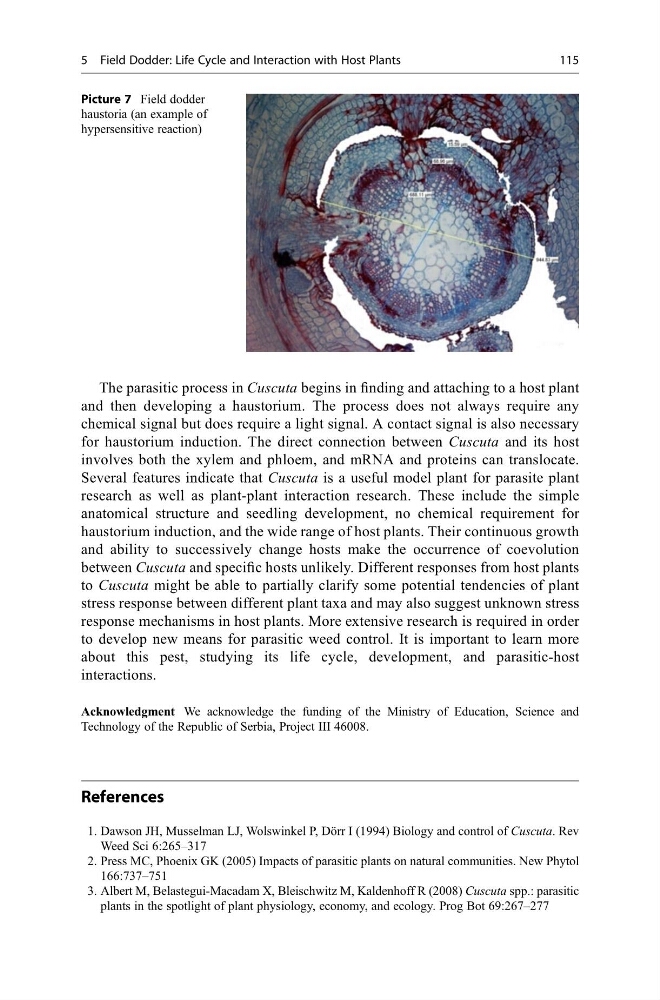
Picture 7 Field dodder
haustoria (an example of
hypersensitive reaction)
5 Field Dodder: Life Cycle and Interaction with Host Plants
115
and then developing a haustorium. The process does not always require any
chemical signal but does require a light signal. A contact signal is also necessary
for haustorium induction. The direct connection between Cuscuta and its host
involves both the xylem and phloem, and mRNA and proteins can translocate.
Several features indicate that Cuscuta is a useful model plant for parasite plant
research as well as plant-plant interaction research. These include the simple
anatomical structure and seedling development, no chemical requirement for
haustorium induction, and the wide range of host plants. Their continuous growth
and ability to successively change hosts make the occurrence of coevolution
between Cuscuta and specific hosts unlikely. Different responses from host plants
to Cuscuta might be able to partially clarify some potential tendencies of plant
stress response between different plant taxa and may also suggest unknown stress
response mechanisms in host plants. More extensive research is required in order
to develop new means for parasitic weed control. It is important to learn more
about this pest, studying its life cycle, development, and parasitic-host
interactions.
Acknowledgment We acknowledge the funding of the Ministry of Education, Science and
Technology of the Republic of Serbia, Project III 46008.
References
1. Dawson JH, Musselman LJ, Wolswinkel P, Dörr I (1994) Biology and control of Cuscuta. Rev
Weed Sci 6:265–317
2. Press MC, Phoenix GK (2005) Impacts of parasitic plants on natural communities. New Phytol
166:737–751
3. Albert M, Belastegui-Macadam X, Bleischwitz M, Kaldenhoff R (2008) Cuscuta spp.: parasitic
plants in the spotlight of plant physiology, economy, and ecology. Prog Bot 69:267–277
Picture 7 Field dodder
haustoria (an example of
hypersensitive reaction)
5 Field Dodder: Life Cycle and Interaction with Host Plants
115