

and mineral nutrients in noninfested and infested alfalfa and sugar beet plants may be
considered as a response reaction of the host to parasitism, which mostly leads to
accumulate nutrients because intensified metabolism creates a defense mechanism in
the host. The changes in nutrient contents and fresh biomass have a crucial effect on
the composition of plant communities and determine their invasiveness [93].
4.5
Impact on Host Anatomical Parameters
The effect of field dodder on the anatomy of cultivated host plants is still mostly an
uninvestigated area. Field dodders cause changes in stalk anatomy and leaves of host
plants (alfalfa and sugar beet) [79, 94, 95]. Regarding nearly all analyzed parameters
of alfalfa stem (epidermis, cortex, pith, diameter), significantly lower values were
recorded in infested than in noninfested plants 42 DAI (days after infestation)
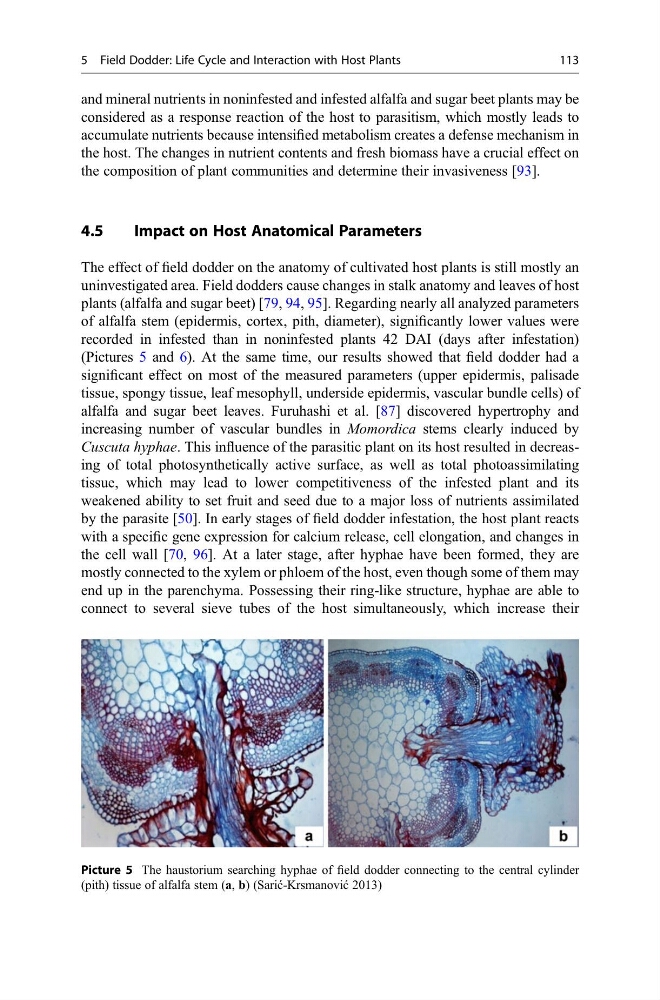
(Pictures 5 and 6). At the same time, our results showed that field dodder had a
significant effect on most of the measured parameters (upper epidermis, palisade
tissue, spongy tissue, leaf mesophyll, underside epidermis, vascular bundle cells) of
alfalfa and sugar beet leaves. Furuhashi et al. [87] discovered hypertrophy and
increasing number of vascular bundles in Momordica stems clearly induced by
Cuscuta hyphae. This influence of the parasitic plant on its host resulted in decreasing of total photosynthetically active surface, as well as total photoassimilating
tissue, which may lead to lower competitiveness of the infested plant and its
weakened ability to set fruit and seed due to a major loss of nutrients assimilated
by the parasite [50]. In early stages of field dodder infestation, the host plant reacts
with a specific gene expression for calcium release, cell elongation, and changes in
the cell wall [70, 96]. At a later stage, after hyphae have been formed, they are
mostly connected to the xylem or phloem of the host, even though some of them may
end up in the parenchyma. Possessing their ring-like structure, hyphae are able to
connect to several sieve tubes of the host simultaneously, which increase their
Picture 5 The haustorium searching hyphae of field dodder connecting to the central cylinder
(pith) tissue of alfalfa stem (a, b) (Sarić-Krsmanović 2013)
5 Field Dodder: Life Cycle and Interaction with Host Plants
113
considered as a response reaction of the host to parasitism, which mostly leads to
accumulate nutrients because intensified metabolism creates a defense mechanism in
the host. The changes in nutrient contents and fresh biomass have a crucial effect on
the composition of plant communities and determine their invasiveness [93].
4.5
Impact on Host Anatomical Parameters
The effect of field dodder on the anatomy of cultivated host plants is still mostly an
uninvestigated area. Field dodders cause changes in stalk anatomy and leaves of host
plants (alfalfa and sugar beet) [79, 94, 95]. Regarding nearly all analyzed parameters
of alfalfa stem (epidermis, cortex, pith, diameter), significantly lower values were
recorded in infested than in noninfested plants 42 DAI (days after infestation)
(Pictures 5 and 6). At the same time, our results showed that field dodder had a
significant effect on most of the measured parameters (upper epidermis, palisade
tissue, spongy tissue, leaf mesophyll, underside epidermis, vascular bundle cells) of
alfalfa and sugar beet leaves. Furuhashi et al. [87] discovered hypertrophy and
increasing number of vascular bundles in Momordica stems clearly induced by
Cuscuta hyphae. This influence of the parasitic plant on its host resulted in decreasing of total photosynthetically active surface, as well as total photoassimilating
tissue, which may lead to lower competitiveness of the infested plant and its
weakened ability to set fruit and seed due to a major loss of nutrients assimilated
by the parasite [50]. In early stages of field dodder infestation, the host plant reacts
with a specific gene expression for calcium release, cell elongation, and changes in
the cell wall [70, 96]. At a later stage, after hyphae have been formed, they are
mostly connected to the xylem or phloem of the host, even though some of them may
end up in the parenchyma. Possessing their ring-like structure, hyphae are able to
connect to several sieve tubes of the host simultaneously, which increase their
Picture 5 The haustorium searching hyphae of field dodder connecting to the central cylinder
(pith) tissue of alfalfa stem (a, b) (Sarić-Krsmanović 2013)
5 Field Dodder: Life Cycle and Interaction with Host Plants
113