

that chlorophyll fluorescence parameters reacted to stress at different speeds,
depending on a number of factors.
4.4
Impact on Host Mineral Nutrient Content
Parasitic plants restrain the growth and reproduction of their hosts by capturing
nutrients and disturbing resource balance [2]. The presence of the parasite strongly
reduces the biomass by acting as a competing sink for assimilate, but more importantly, by compromising the efficiency of mineral and organic nutrient assimilation.
The holoparasitic Cuscuta is known to constitute an overwhelming competitive sink
by diverting the major portion of the current photoassimilates of the host into its own
tissues [1, 3, 90]. Hibberd and Jeschke [50] observed that nitrogen uptake by a
parasite depends primarily on its availability and translocation through the
conducting tissue of its host plant. Also, Press et al. [91] showed that the extent of
parasites competing with hosts for carbon and other nutrients depends on their
relative sink strength and the degree of autotrophy of the parasite. Increasing of
nitrogen and potassium contents in Mikania micrantha was reported by Yu et al.
[92], while no impact on phosphorus content was detected in the early stages after
C. campestris infestation. Saric-Krsmanovic et al. [79] revealed increase of some
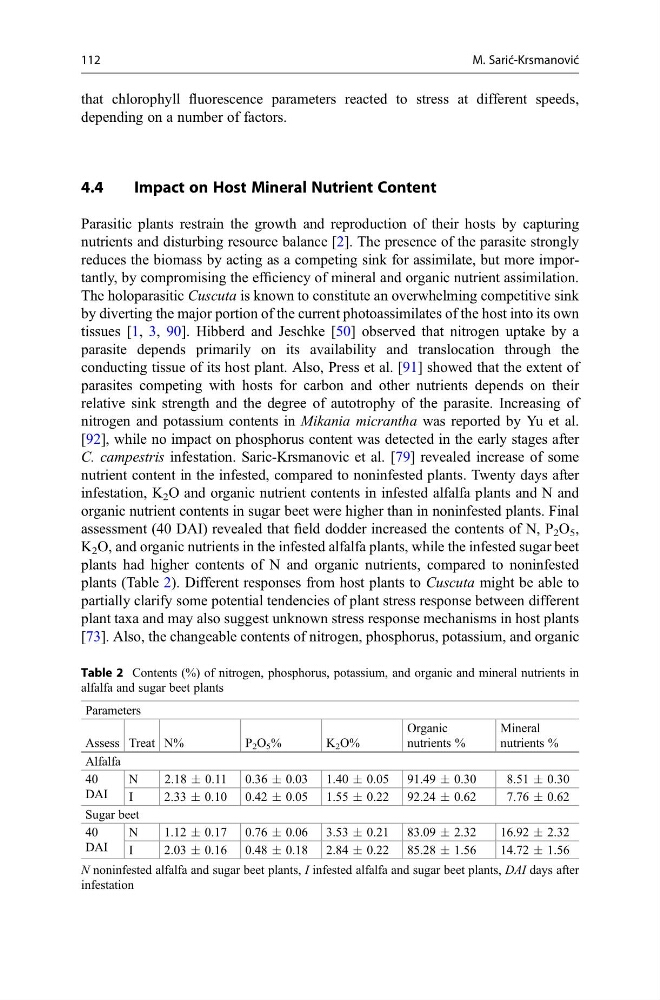
nutrient content in the infested, compared to noninfested plants. Twenty days after
infestation, K 2 O and organic nutrient contents in infested alfalfa plants and N and
organic nutrient contents in sugar beet were higher than in noninfested plants. Final
assessment (40 DAI) revealed that field dodder increased the contents of N, P 2 O 5 ,
K 2 O, and organic nutrients in the infested alfalfa plants, while the infested sugar beet
plants had higher contents of N and organic nutrients, compared to noninfested
plants (Table 2). Different responses from host plants to Cuscuta might be able to
partially clarify some potential tendencies of plant stress response between different
plant taxa and may also suggest unknown stress response mechanisms in host plants
[73]. Also, the changeable contents of nitrogen, phosphorus, potassium, and organic
Table 2 Contents (%) of nitrogen, phosphorus, potassium, and organic and mineral nutrients in
alfalfa and sugar beet plants
Parameters
Assess Treat N%
P 2 O 5 %
K 2 O%
Organic
nutrients %
Mineral
nutrients %
Alfalfa
40
DAI
N
2.18 Æ 0.11 0.36 Æ 0.03 1.40 Æ 0.05 91.49 Æ 0.30
8.51 Æ 0.30
I
2.33 Æ 0.10 0.42 Æ 0.05 1.55 Æ 0.22 92.24 Æ 0.62
7.76 Æ 0.62
Sugar beet
40
DAI
N
1.12 Æ 0.17 0.76 Æ 0.06 3.53 Æ 0.21 83.09 Æ 2.32
16.92 Æ 2.32
I
2.03 Æ 0.16 0.48 Æ 0.18 2.84 Æ 0.22 85.28 Æ 1.56
14.72 Æ 1.56
N noninfested alfalfa and sugar beet plants, I infested alfalfa and sugar beet plants, DAI days after
infestation
112
M. Sarić-Krsmanović
depending on a number of factors.
4.4
Impact on Host Mineral Nutrient Content
Parasitic plants restrain the growth and reproduction of their hosts by capturing
nutrients and disturbing resource balance [2]. The presence of the parasite strongly
reduces the biomass by acting as a competing sink for assimilate, but more importantly, by compromising the efficiency of mineral and organic nutrient assimilation.
The holoparasitic Cuscuta is known to constitute an overwhelming competitive sink
by diverting the major portion of the current photoassimilates of the host into its own
tissues [1, 3, 90]. Hibberd and Jeschke [50] observed that nitrogen uptake by a
parasite depends primarily on its availability and translocation through the
conducting tissue of its host plant. Also, Press et al. [91] showed that the extent of
parasites competing with hosts for carbon and other nutrients depends on their
relative sink strength and the degree of autotrophy of the parasite. Increasing of
nitrogen and potassium contents in Mikania micrantha was reported by Yu et al.
[92], while no impact on phosphorus content was detected in the early stages after
C. campestris infestation. Saric-Krsmanovic et al. [79] revealed increase of some
nutrient content in the infested, compared to noninfested plants. Twenty days after
infestation, K 2 O and organic nutrient contents in infested alfalfa plants and N and
organic nutrient contents in sugar beet were higher than in noninfested plants. Final
assessment (40 DAI) revealed that field dodder increased the contents of N, P 2 O 5 ,
K 2 O, and organic nutrients in the infested alfalfa plants, while the infested sugar beet
plants had higher contents of N and organic nutrients, compared to noninfested
plants (Table 2). Different responses from host plants to Cuscuta might be able to
partially clarify some potential tendencies of plant stress response between different
plant taxa and may also suggest unknown stress response mechanisms in host plants
[73]. Also, the changeable contents of nitrogen, phosphorus, potassium, and organic
Table 2 Contents (%) of nitrogen, phosphorus, potassium, and organic and mineral nutrients in
alfalfa and sugar beet plants
Parameters
Assess Treat N%
P 2 O 5 %
K 2 O%
Organic
nutrients %
Mineral
nutrients %
Alfalfa
40
DAI
N
2.18 Æ 0.11 0.36 Æ 0.03 1.40 Æ 0.05 91.49 Æ 0.30
8.51 Æ 0.30
I
2.33 Æ 0.10 0.42 Æ 0.05 1.55 Æ 0.22 92.24 Æ 0.62
7.76 Æ 0.62
Sugar beet
40
DAI
N
1.12 Æ 0.17 0.76 Æ 0.06 3.53 Æ 0.21 83.09 Æ 2.32
16.92 Æ 2.32
I
2.03 Æ 0.16 0.48 Æ 0.18 2.84 Æ 0.22 85.28 Æ 1.56
14.72 Æ 1.56
N noninfested alfalfa and sugar beet plants, I infested alfalfa and sugar beet plants, DAI days after
infestation
112
M. Sarić-Krsmanović