

primarily focused on the response of insect herbivores to host plant defences and
nutrient content. There are also other plant traits such as growth-form, architecture,
distribution, or abundance, which significantly affect insect herbivores [124, 125]. In
some cases, these traits may modulate or drive responses of insect herbivores to host
plant defences, often being tightly linked to them. In addition, insect herbivores
strongly respond to host phylogeny, usually because of its covariation with host
traits. The relative importance of host plant phylogeny and defensive traits is highly
dependent on the phylogenetic scale and identity of the traits one considers [126].
For example, secondary metabolites often exhibit a weak phylogenetic signal among
congeneric plant species, as outlined above, but the major differences in secondary
metabolite presence or absence may be generally conserved when comparing hosts
at the family level [7, 113, 114, 127]. The composition of herbivore communities,
therefore, usually arises from the interplay between host phylogeny and functional
traits, both with differential effects on insects with various levels of specialization
and life histories [7, 13, 126].
Acknowledgments I acknowledge funding by Alexander von Humboldt Foundation and the
Federal Ministry for Education and Research. I thank the New Guinea Binatang Research Center
for providing photos of New Guinean Lepidoptera, Tereza Holicová for help with preparing the
illustrations for this chapter, and Conor Redmond, Carlo L. Seifert, and Tereza Holicová for
providing valuable comments on the manuscript.
0
5
10
15
20
25
30
35
40
45
0
0.5
1
1.5
2
2.5
3
Lepidoptera species
Chemical diversity (Shanon)
Triterpenes
Polyphenols
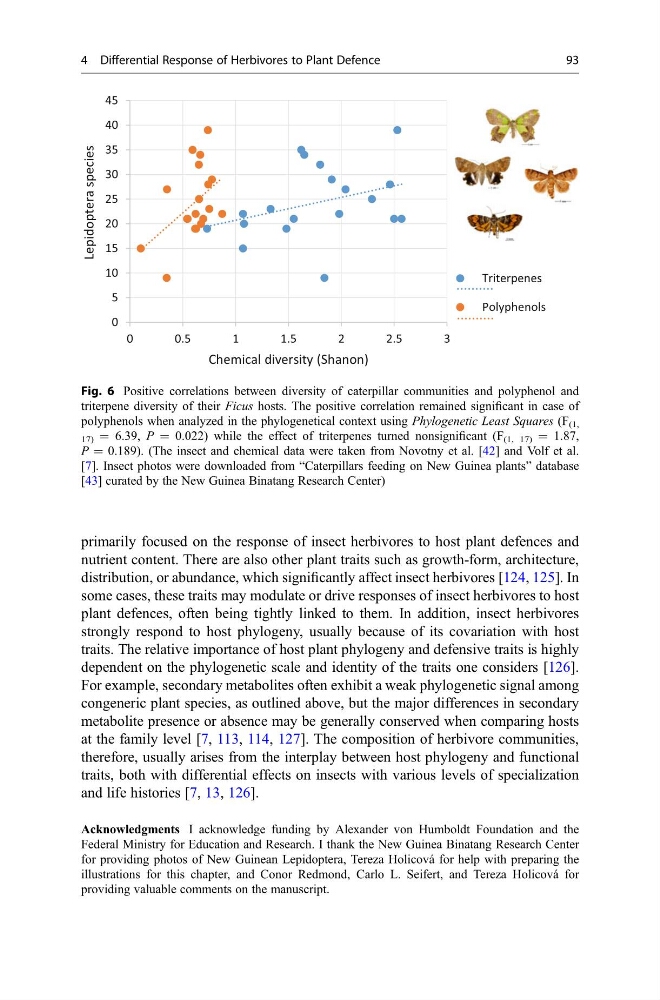
Fig. 6 Positive correlations between diversity of caterpillar communities and polyphenol and
triterpene diversity of their Ficus hosts. The positive correlation remained significant in case of
polyphenols when analyzed in the phylogenetical context using Phylogenetic Least Squares (F (1,
17) = 6.39, P = 0.022) while the effect of triterpenes turned nonsignificant (F (1, 17) = 1.87,
P = 0.189). (The insect and chemical data were taken from Novotny et al. [42] and Volf et al.
[7]. Insect photos were downloaded from “Caterpillars feeding on New Guinea plants” database
[43] curated by the New Guinea Binatang Research Center)
4 Differential Response of Herbivores to Plant Defence
93
nutrient content. There are also other plant traits such as growth-form, architecture,
distribution, or abundance, which significantly affect insect herbivores [124, 125]. In
some cases, these traits may modulate or drive responses of insect herbivores to host
plant defences, often being tightly linked to them. In addition, insect herbivores
strongly respond to host phylogeny, usually because of its covariation with host
traits. The relative importance of host plant phylogeny and defensive traits is highly
dependent on the phylogenetic scale and identity of the traits one considers [126].
For example, secondary metabolites often exhibit a weak phylogenetic signal among
congeneric plant species, as outlined above, but the major differences in secondary
metabolite presence or absence may be generally conserved when comparing hosts
at the family level [7, 113, 114, 127]. The composition of herbivore communities,
therefore, usually arises from the interplay between host phylogeny and functional
traits, both with differential effects on insects with various levels of specialization
and life histories [7, 13, 126].
Acknowledgments I acknowledge funding by Alexander von Humboldt Foundation and the
Federal Ministry for Education and Research. I thank the New Guinea Binatang Research Center
for providing photos of New Guinean Lepidoptera, Tereza Holicová for help with preparing the
illustrations for this chapter, and Conor Redmond, Carlo L. Seifert, and Tereza Holicová for
providing valuable comments on the manuscript.
0
5
10
15
20
25
30
35
40
45
0
0.5
1
1.5
2
2.5
3
Lepidoptera species
Chemical diversity (Shanon)
Triterpenes
Polyphenols
Fig. 6 Positive correlations between diversity of caterpillar communities and polyphenol and
triterpene diversity of their Ficus hosts. The positive correlation remained significant in case of
polyphenols when analyzed in the phylogenetical context using Phylogenetic Least Squares (F (1,
17) = 6.39, P = 0.022) while the effect of triterpenes turned nonsignificant (F (1, 17) = 1.87,
P = 0.189). (The insect and chemical data were taken from Novotny et al. [42] and Volf et al.
[7]. Insect photos were downloaded from “Caterpillars feeding on New Guinea plants” database
[43] curated by the New Guinea Binatang Research Center)
4 Differential Response of Herbivores to Plant Defence
93