

8
Conclusions
Here I have tried to illustrate that the differential response of insect herbivores to
plant defences is one of the mechanisms promoting high specificity of insect-plant
interactions. The resulting specificity of interactions gives rise to diversification of
host defences as no single trait can provide an efficient defence against diverse
communities of insects. The diversification of host defences then seems to be one of
the key factors promoting the diversity of insects in a reciprocal way. This chapter
0.00 0.20 0.0
1.0
0.0 0.4 0.8
0 4 8
0.0 1.5
0 100 250
F. virens
F. pungens
F. aurantiacafolia
F. hahliana
F. hispidioides
F. conges
F. pachyrrhachis
F. botryocarpa
F. septica
F. nodosa
F. variegata
F. dammaropsis
F. mollior
F. rubrives
F. subtrinervia
F. conocepholia
F. phaeosyce
F. copiosa
F. wassa
F. gul
F. trachypison
ta
timenta
Protease
activity
Alkaloid
diversity
Polyphenol
diversity
Oxidative
activity
Triterpene
diversity
Trichome
density
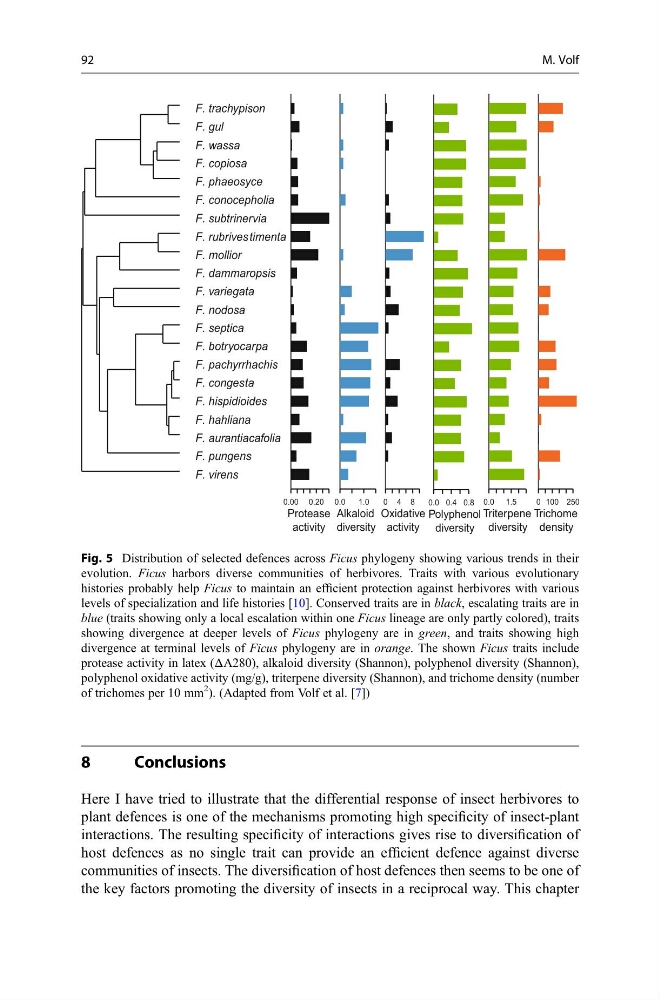
Fig. 5 Distribution of selected defences across Ficus phylogeny showing various trends in their
evolution. Ficus harbors diverse communities of herbivores. Traits with various evolutionary
histories probably help Ficus to maintain an efficient protection against herbivores with various
levels of specialization and life histories [10]. Conserved traits are in black, escalating traits are in
blue (traits showing only a local escalation within one Ficus lineage are only partly colored), traits
showing divergence at deeper levels of Ficus phylogeny are in green, and traits showing high
divergence at terminal levels of Ficus phylogeny are in orange. The shown Ficus traits include
protease activity in latex (ΔA280), alkaloid diversity (Shannon), polyphenol diversity (Shannon),
polyphenol oxidative activity (mg/g), triterpene diversity (Shannon), and trichome density (number
of trichomes per 10 mm
2
). (Adapted from Volf et al. [7])
92
M. Volf
Conclusions
Here I have tried to illustrate that the differential response of insect herbivores to
plant defences is one of the mechanisms promoting high specificity of insect-plant
interactions. The resulting specificity of interactions gives rise to diversification of
host defences as no single trait can provide an efficient defence against diverse
communities of insects. The diversification of host defences then seems to be one of
the key factors promoting the diversity of insects in a reciprocal way. This chapter
0.00 0.20 0.0
1.0
0.0 0.4 0.8
0 4 8
0.0 1.5
0 100 250
F. virens
F. pungens
F. aurantiacafolia
F. hahliana
F. hispidioides
F. conges
F. pachyrrhachis
F. botryocarpa
F. septica
F. nodosa
F. variegata
F. dammaropsis
F. mollior
F. rubrives
F. subtrinervia
F. conocepholia
F. phaeosyce
F. copiosa
F. wassa
F. gul
F. trachypison
ta
timenta
Protease
activity
Alkaloid
diversity
Polyphenol
diversity
Oxidative
activity
Triterpene
diversity
Trichome
density
Fig. 5 Distribution of selected defences across Ficus phylogeny showing various trends in their
evolution. Ficus harbors diverse communities of herbivores. Traits with various evolutionary
histories probably help Ficus to maintain an efficient protection against herbivores with various
levels of specialization and life histories [10]. Conserved traits are in black, escalating traits are in
blue (traits showing only a local escalation within one Ficus lineage are only partly colored), traits
showing divergence at deeper levels of Ficus phylogeny are in green, and traits showing high
divergence at terminal levels of Ficus phylogeny are in orange. The shown Ficus traits include
protease activity in latex (ΔA280), alkaloid diversity (Shannon), polyphenol diversity (Shannon),
polyphenol oxidative activity (mg/g), triterpene diversity (Shannon), and trichome density (number
of trichomes per 10 mm
2
). (Adapted from Volf et al. [7])
92
M. Volf