

388
R. Ku´ smierek-Tomaszewska and J. ˙
Zarski
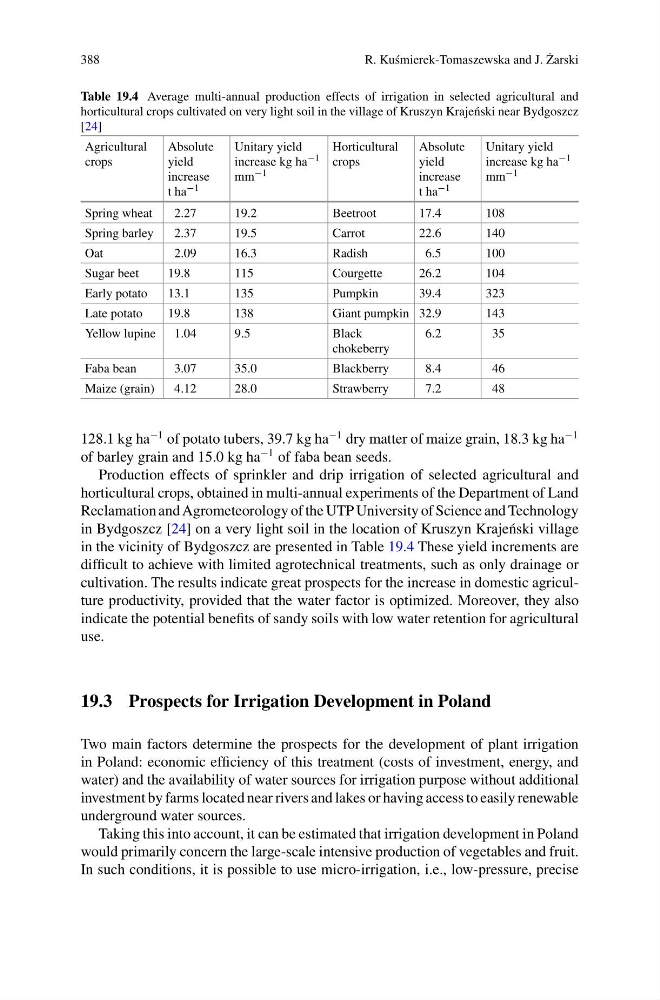
Table 19.4 Average multi-annual production effects of irrigation in selected agricultural and
horticultural crops cultivated on very light soil in the village of Kruszyn Kraje´ nski near Bydgoszcz
[24]
Agricultural
crops
Absolute
yield
increase
t ha −1
Unitary yield
increase kg ha −1
mm −1
Horticultural
crops
Absolute
yield
increase
t ha −1
Unitary yield
increase kg ha −1
mm −1
Spring wheat
2.27
19.2
Beetroot
17.4
108
Spring barley
2.37
19.5
Carrot
22.6
140
Oat
2.09
16.3
Radish
6.5
100
Sugar beet
19.8
115
Courgette
26.2
104
Early potato
13.1
135
Pumpkin
39.4
323
Late potato
19.8
138
Giant pumpkin 32.9
143
Yellow lupine 1.04
9.5
Black
chokeberry
6.2
35
Faba bean
3.07
35.0
Blackberry
8.4
46
Maize (grain)
4.12
28.0
Strawberry
7.2
48
128.1 kg ha
−1 of potato tubers, 39.7 kg ha
−1 dry matter of maize grain, 18.3 kg ha
−1
of barley grain and 15.0 kg ha
−1 of faba bean seeds.
Production effects of sprinkler and drip irrigation of selected agricultural and
horticultural crops, obtained in multi-annual experiments of the Department of Land
Reclamation and Agrometeorology of the UTP University of Science and Technology
in Bydgoszcz [24] on a very light soil in the location of Kruszyn Kraje´ nski village
in the vicinity of Bydgoszcz are presented in Table 19.4 These yield increments are
difficult to achieve with limited agrotechnical treatments, such as only drainage or
cultivation. The results indicate great prospects for the increase in domestic agriculture productivity, provided that the water factor is optimized. Moreover, they also
indicate the potential benefits of sandy soils with low water retention for agricultural
use.
19.3 Prospects for Irrigation Development in Poland
Two main factors determine the prospects for the development of plant irrigation
in Poland: economic efficiency of this treatment (costs of investment, energy, and
water) and the availability of water sources for irrigation purpose without additional
investment by farms located near rivers and lakes or having access to easily renewable
underground water sources.
Taking this into account, it can be estimated that irrigation development in Poland
would primarily concern the large-scale intensive production of vegetables and fruit.
In such conditions, it is possible to use micro-irrigation, i.e., low-pressure, precise
R. Ku´ smierek-Tomaszewska and J. ˙
Zarski
Table 19.4 Average multi-annual production effects of irrigation in selected agricultural and
horticultural crops cultivated on very light soil in the village of Kruszyn Kraje´ nski near Bydgoszcz
[24]
Agricultural
crops
Absolute
yield
increase
t ha −1
Unitary yield
increase kg ha −1
mm −1
Horticultural
crops
Absolute
yield
increase
t ha −1
Unitary yield
increase kg ha −1
mm −1
Spring wheat
2.27
19.2
Beetroot
17.4
108
Spring barley
2.37
19.5
Carrot
22.6
140
Oat
2.09
16.3
Radish
6.5
100
Sugar beet
19.8
115
Courgette
26.2
104
Early potato
13.1
135
Pumpkin
39.4
323
Late potato
19.8
138
Giant pumpkin 32.9
143
Yellow lupine 1.04
9.5
Black
chokeberry
6.2
35
Faba bean
3.07
35.0
Blackberry
8.4
46
Maize (grain)
4.12
28.0
Strawberry
7.2
48
128.1 kg ha
−1 of potato tubers, 39.7 kg ha
−1 dry matter of maize grain, 18.3 kg ha
−1
of barley grain and 15.0 kg ha
−1 of faba bean seeds.
Production effects of sprinkler and drip irrigation of selected agricultural and
horticultural crops, obtained in multi-annual experiments of the Department of Land
Reclamation and Agrometeorology of the UTP University of Science and Technology
in Bydgoszcz [24] on a very light soil in the location of Kruszyn Kraje´ nski village
in the vicinity of Bydgoszcz are presented in Table 19.4 These yield increments are
difficult to achieve with limited agrotechnical treatments, such as only drainage or
cultivation. The results indicate great prospects for the increase in domestic agriculture productivity, provided that the water factor is optimized. Moreover, they also
indicate the potential benefits of sandy soils with low water retention for agricultural
use.
19.3 Prospects for Irrigation Development in Poland
Two main factors determine the prospects for the development of plant irrigation
in Poland: economic efficiency of this treatment (costs of investment, energy, and
water) and the availability of water sources for irrigation purpose without additional
investment by farms located near rivers and lakes or having access to easily renewable
underground water sources.
Taking this into account, it can be estimated that irrigation development in Poland
would primarily concern the large-scale intensive production of vegetables and fruit.
In such conditions, it is possible to use micro-irrigation, i.e., low-pressure, precise