

19 The Effects of Plant Irrigation in Poland
389
Table 19.5 Indicators of
economic and financial
efficiency of crops production
under irrigation [26]
Crop
Profitability indicator
Winter wheat
35–81
Potato
121–217
Sugar beet
153–170
Headed cabbage
241
Onion
364–394
Carrot
419–529
Strawberry
447
irrigation techniques that supply water with drops or streams to the vicinity of plants
or directly to the root zone. According to data presented by ICID [1], micro-irrigation
is used in 14.4 million hectares throughout the world. This type of system enables
fertigation as well as advanced automation based on perpetual monitoring of atmospheric conditions that allows determination of the water needs of the plants [25]. An
important advantage of this type of system is that it ensures the economic management of water at the farm scale since there is no need to irrigate the whole field
surface, but only precisely chosen parts of the plantation. This argument is particularly important because water resources that can be gained for irrigation purposes
should be utilized in Poland in an especially rational manner.
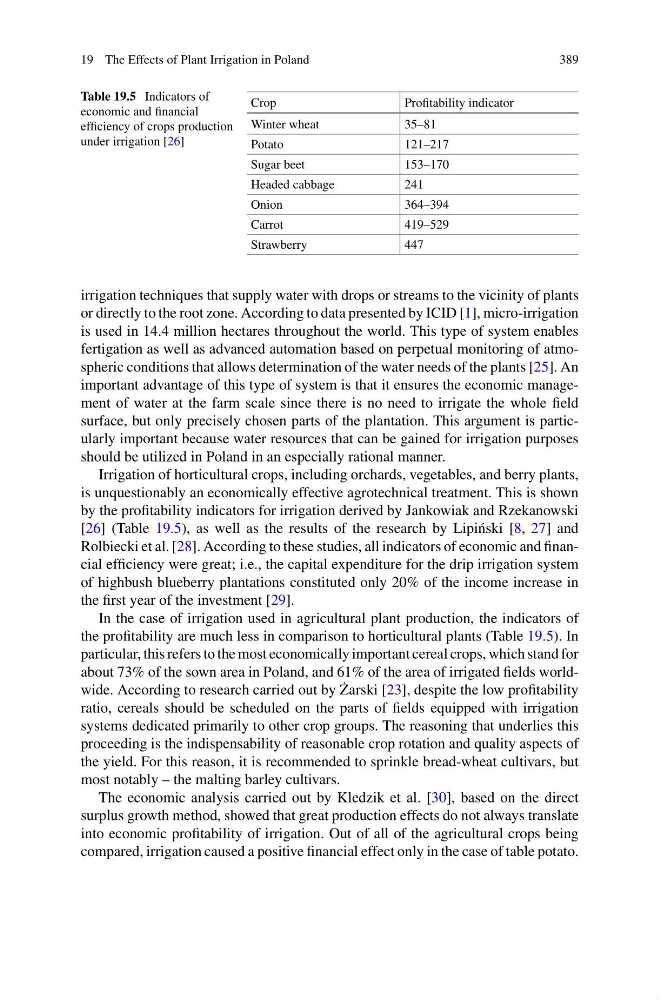
Irrigation of horticultural crops, including orchards, vegetables, and berry plants,
is unquestionably an economically effective agrotechnical treatment. This is shown
by the profitability indicators for irrigation derived by Jankowiak and Rzekanowski
[26] (Table 19.5), as well as the results of the research by Lipi´ nski [8, 27] and
Rolbiecki et al. [28]. According to these studies, all indicators of economic and financial efficiency were great; i.e., the capital expenditure for the drip irrigation system
of highbush blueberry plantations constituted only 20% of the income increase in
the first year of the investment [29].
In the case of irrigation used in agricultural plant production, the indicators of
the profitability are much less in comparison to horticultural plants (Table 19.5). In
particular, this refers to the most economically important cereal crops, which stand for
about 73% of the sown area in Poland, and 61% of the area of irrigated fields worldwide. According to research carried out by ˙
Zarski [23], despite the low profitability
ratio, cereals should be scheduled on the parts of fields equipped with irrigation
systems dedicated primarily to other crop groups. The reasoning that underlies this
proceeding is the indispensability of reasonable crop rotation and quality aspects of
the yield. For this reason, it is recommended to sprinkle bread-wheat cultivars, but
most notably – the malting barley cultivars.
The economic analysis carried out by Kledzik et al. [30], based on the direct
surplus growth method, showed that great production effects do not always translate
into economic profitability of irrigation. Out of all of the agricultural crops being
compared, irrigation caused a positive financial effect only in the case of table potato.
389
Table 19.5 Indicators of
economic and financial
efficiency of crops production
under irrigation [26]
Crop
Profitability indicator
Winter wheat
35–81
Potato
121–217
Sugar beet
153–170
Headed cabbage
241
Onion
364–394
Carrot
419–529
Strawberry
447
irrigation techniques that supply water with drops or streams to the vicinity of plants
or directly to the root zone. According to data presented by ICID [1], micro-irrigation
is used in 14.4 million hectares throughout the world. This type of system enables
fertigation as well as advanced automation based on perpetual monitoring of atmospheric conditions that allows determination of the water needs of the plants [25]. An
important advantage of this type of system is that it ensures the economic management of water at the farm scale since there is no need to irrigate the whole field
surface, but only precisely chosen parts of the plantation. This argument is particularly important because water resources that can be gained for irrigation purposes
should be utilized in Poland in an especially rational manner.
Irrigation of horticultural crops, including orchards, vegetables, and berry plants,
is unquestionably an economically effective agrotechnical treatment. This is shown
by the profitability indicators for irrigation derived by Jankowiak and Rzekanowski
[26] (Table 19.5), as well as the results of the research by Lipi´ nski [8, 27] and
Rolbiecki et al. [28]. According to these studies, all indicators of economic and financial efficiency were great; i.e., the capital expenditure for the drip irrigation system
of highbush blueberry plantations constituted only 20% of the income increase in
the first year of the investment [29].
In the case of irrigation used in agricultural plant production, the indicators of
the profitability are much less in comparison to horticultural plants (Table 19.5). In
particular, this refers to the most economically important cereal crops, which stand for
about 73% of the sown area in Poland, and 61% of the area of irrigated fields worldwide. According to research carried out by ˙
Zarski [23], despite the low profitability
ratio, cereals should be scheduled on the parts of fields equipped with irrigation
systems dedicated primarily to other crop groups. The reasoning that underlies this
proceeding is the indispensability of reasonable crop rotation and quality aspects of
the yield. For this reason, it is recommended to sprinkle bread-wheat cultivars, but
most notably – the malting barley cultivars.
The economic analysis carried out by Kledzik et al. [30], based on the direct
surplus growth method, showed that great production effects do not always translate
into economic profitability of irrigation. Out of all of the agricultural crops being
compared, irrigation caused a positive financial effect only in the case of table potato.