

19 The Effects of Plant Irrigation in Poland
387
stages, as well as the type and the way of yield forming and the yield moisture content
are also important.
Comparison of the effectiveness of irrigation in various plants requires the elimination of other impact factors, especially meteorological and soil factors. Experiments should be carried out under the same growing seasons and soil conditions
while providing similar agrotechnical systems and ensuring a similar cover of plant
water needs by irrigation systems. One of a few experiments that meets the requirements of such comparability of results was carried out in the years 2006–2012 on
light soil with compacted subsoil, in the region of Bydgoszcz [21]. The seven-year
study of four crop species consisted of growing seasons with different rainfall conditions, which provided considerable data for the average increased yield outputs. The
comparison of the results shows that the increased yield outputs were similar in all
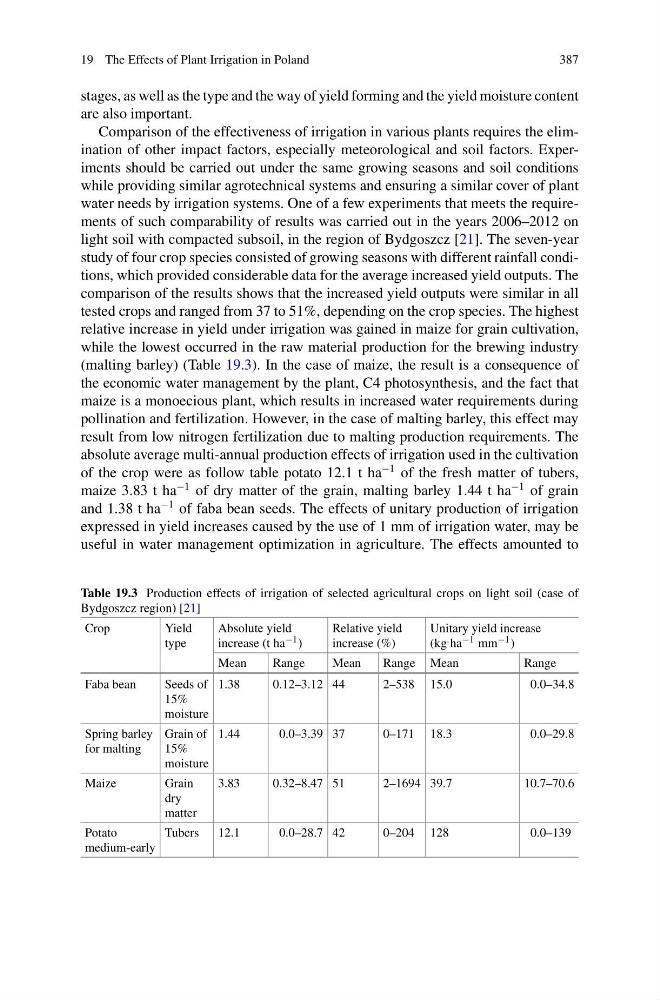
tested crops and ranged from 37 to 51%, depending on the crop species. The highest
relative increase in yield under irrigation was gained in maize for grain cultivation,
while the lowest occurred in the raw material production for the brewing industry
(malting barley) (Table 19.3). In the case of maize, the result is a consequence of
the economic water management by the plant, C4 photosynthesis, and the fact that
maize is a monoecious plant, which results in increased water requirements during
pollination and fertilization. However, in the case of malting barley, this effect may
result from low nitrogen fertilization due to malting production requirements. The
absolute average multi-annual production effects of irrigation used in the cultivation
of the crop were as follow table potato 12.1 t ha
−1 of the fresh matter of tubers,
maize 3.83 t ha
−1 of dry matter of the grain, malting barley 1.44 t ha
−1 of grain
and 1.38 t ha
−1 of faba bean seeds. The effects of unitary production of irrigation
expressed in yield increases caused by the use of 1 mm of irrigation water, may be
useful in water management optimization in agriculture. The effects amounted to
Table 19.3 Production effects of irrigation of selected agricultural crops on light soil (case of
Bydgoszcz region) [21]
Crop
Yield
type
Absolute yield
increase (t ha −1 )
Relative yield
increase (%)
Unitary yield increase
(kg . ha −1 mm −1 )
Mean
Range
Mean
Range Mean
Range
Faba bean
Seeds of
15%
moisture
1.38
0.12–3.12 44
2–538 15.0
0.0–34.8
Spring barley
for malting
Grain of
15%
moisture
1.44
0.0–3.39 37
0–171 18.3
0.0–29.8
Maize
Grain
dry
matter
3.83
0.32–8.47 51
2–1694 39.7
10.7–70.6
Potato
medium-early
Tubers
12.1
0.0–28.7 42
0–204 128
0.0–139
387
stages, as well as the type and the way of yield forming and the yield moisture content
are also important.
Comparison of the effectiveness of irrigation in various plants requires the elimination of other impact factors, especially meteorological and soil factors. Experiments should be carried out under the same growing seasons and soil conditions
while providing similar agrotechnical systems and ensuring a similar cover of plant
water needs by irrigation systems. One of a few experiments that meets the requirements of such comparability of results was carried out in the years 2006–2012 on
light soil with compacted subsoil, in the region of Bydgoszcz [21]. The seven-year
study of four crop species consisted of growing seasons with different rainfall conditions, which provided considerable data for the average increased yield outputs. The
comparison of the results shows that the increased yield outputs were similar in all
tested crops and ranged from 37 to 51%, depending on the crop species. The highest
relative increase in yield under irrigation was gained in maize for grain cultivation,
while the lowest occurred in the raw material production for the brewing industry
(malting barley) (Table 19.3). In the case of maize, the result is a consequence of
the economic water management by the plant, C4 photosynthesis, and the fact that
maize is a monoecious plant, which results in increased water requirements during
pollination and fertilization. However, in the case of malting barley, this effect may
result from low nitrogen fertilization due to malting production requirements. The
absolute average multi-annual production effects of irrigation used in the cultivation
of the crop were as follow table potato 12.1 t ha
−1 of the fresh matter of tubers,
maize 3.83 t ha
−1 of dry matter of the grain, malting barley 1.44 t ha
−1 of grain
and 1.38 t ha
−1 of faba bean seeds. The effects of unitary production of irrigation
expressed in yield increases caused by the use of 1 mm of irrigation water, may be
useful in water management optimization in agriculture. The effects amounted to
Table 19.3 Production effects of irrigation of selected agricultural crops on light soil (case of
Bydgoszcz region) [21]
Crop
Yield
type
Absolute yield
increase (t ha −1 )
Relative yield
increase (%)
Unitary yield increase
(kg . ha −1 mm −1 )
Mean
Range
Mean
Range Mean
Range
Faba bean
Seeds of
15%
moisture
1.38
0.12–3.12 44
2–538 15.0
0.0–34.8
Spring barley
for malting
Grain of
15%
moisture
1.44
0.0–3.39 37
0–171 18.3
0.0–29.8
Maize
Grain
dry
matter
3.83
0.32–8.47 51
2–1694 39.7
10.7–70.6
Potato
medium-early
Tubers
12.1
0.0–28.7 42
0–204 128
0.0–139