

386
R. Ku´ smierek-Tomaszewska and J. ˙
Zarski
0
1
2
3
4
5
6
7
8
Heavy soil
Medium soil
Light soil
Very light soil
Yield (t·ha -1
)
Type of soil
No irrigation
Irrigation
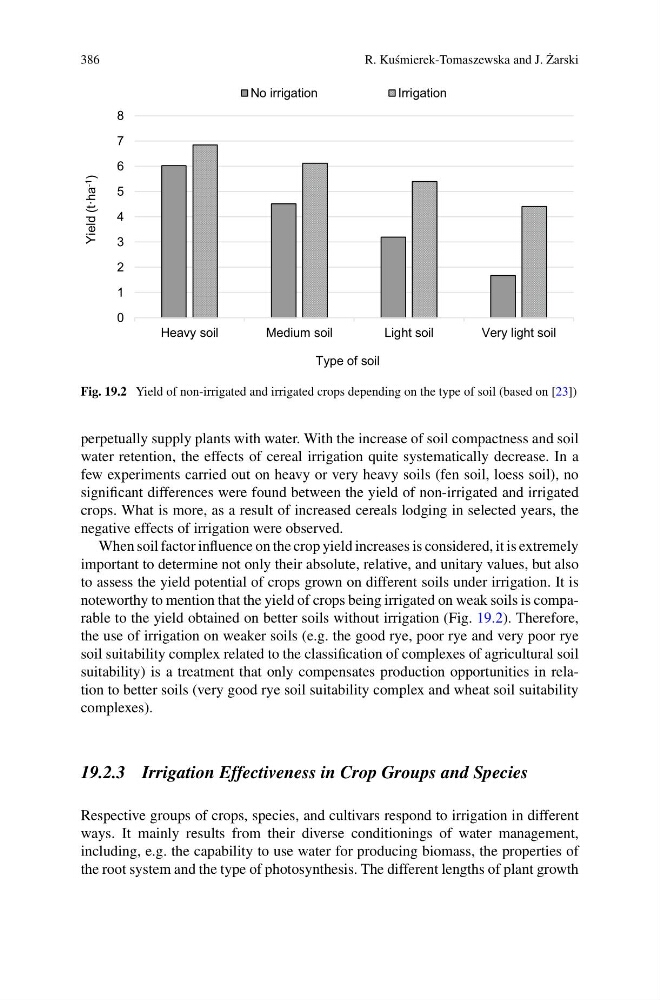
Fig. 19.2 Yield of non-irrigated and irrigated crops depending on the type of soil (based on [23])
perpetually supply plants with water. With the increase of soil compactness and soil
water retention, the effects of cereal irrigation quite systematically decrease. In a
few experiments carried out on heavy or very heavy soils (fen soil, loess soil), no
significant differences were found between the yield of non-irrigated and irrigated
crops. What is more, as a result of increased cereals lodging in selected years, the
negative effects of irrigation were observed.
When soil factor influence on the crop yield increases is considered, it is extremely
important to determine not only their absolute, relative, and unitary values, but also
to assess the yield potential of crops grown on different soils under irrigation. It is
noteworthy to mention that the yield of crops being irrigated on weak soils is comparable to the yield obtained on better soils without irrigation (Fig. 19.2). Therefore,
the use of irrigation on weaker soils (e.g. the good rye, poor rye and very poor rye
soil suitability complex related to the classification of complexes of agricultural soil
suitability) is a treatment that only compensates production opportunities in relation to better soils (very good rye soil suitability complex and wheat soil suitability
complexes).
19.2.3 Irrigation Effectiveness in Crop Groups and Species
Respective groups of crops, species, and cultivars respond to irrigation in different
ways. It mainly results from their diverse conditionings of water management,
including, e.g. the capability to use water for producing biomass, the properties of
the root system and the type of photosynthesis. The different lengths of plant growth
R. Ku´ smierek-Tomaszewska and J. ˙
Zarski
0
1
2
3
4
5
6
7
8
Heavy soil
Medium soil
Light soil
Very light soil
Yield (t·ha -1
)
Type of soil
No irrigation
Irrigation
Fig. 19.2 Yield of non-irrigated and irrigated crops depending on the type of soil (based on [23])
perpetually supply plants with water. With the increase of soil compactness and soil
water retention, the effects of cereal irrigation quite systematically decrease. In a
few experiments carried out on heavy or very heavy soils (fen soil, loess soil), no
significant differences were found between the yield of non-irrigated and irrigated
crops. What is more, as a result of increased cereals lodging in selected years, the
negative effects of irrigation were observed.
When soil factor influence on the crop yield increases is considered, it is extremely
important to determine not only their absolute, relative, and unitary values, but also
to assess the yield potential of crops grown on different soils under irrigation. It is
noteworthy to mention that the yield of crops being irrigated on weak soils is comparable to the yield obtained on better soils without irrigation (Fig. 19.2). Therefore,
the use of irrigation on weaker soils (e.g. the good rye, poor rye and very poor rye
soil suitability complex related to the classification of complexes of agricultural soil
suitability) is a treatment that only compensates production opportunities in relation to better soils (very good rye soil suitability complex and wheat soil suitability
complexes).
19.2.3 Irrigation Effectiveness in Crop Groups and Species
Respective groups of crops, species, and cultivars respond to irrigation in different
ways. It mainly results from their diverse conditionings of water management,
including, e.g. the capability to use water for producing biomass, the properties of
the root system and the type of photosynthesis. The different lengths of plant growth