

368
M. Gor˛ aczko and K. Kubiak-Wójcicka
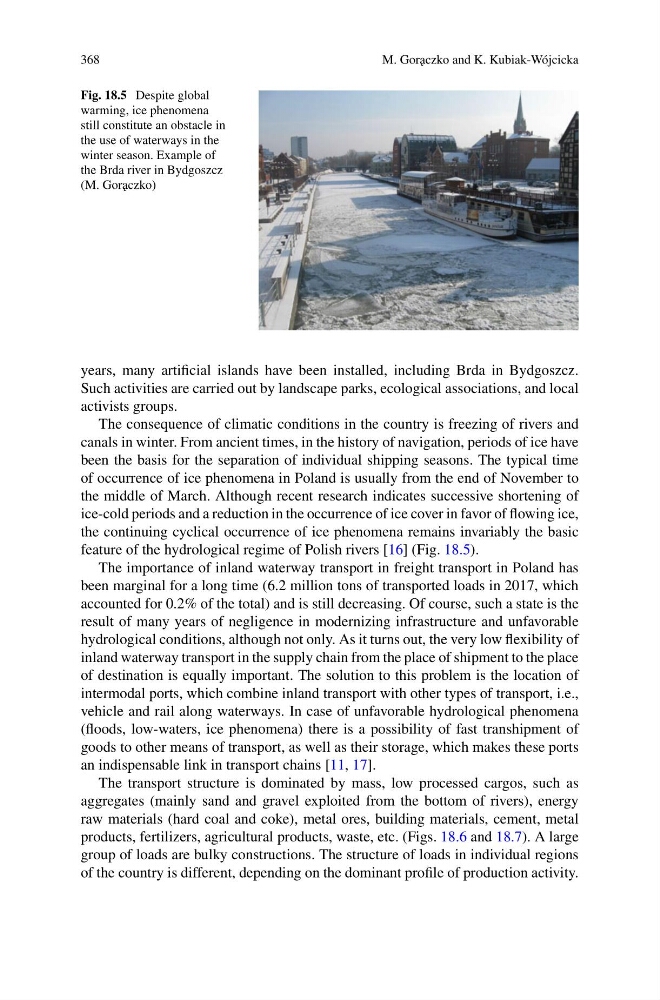
Fig. 18.5 Despite global
warming, ice phenomena
still constitute an obstacle in
the use of waterways in the
winter season. Example of
the Brda river in Bydgoszcz
(M. Gor˛ aczko)
years, many artificial islands have been installed, including Brda in Bydgoszcz.
Such activities are carried out by landscape parks, ecological associations, and local
activists groups.
The consequence of climatic conditions in the country is freezing of rivers and
canals in winter. From ancient times, in the history of navigation, periods of ice have
been the basis for the separation of individual shipping seasons. The typical time
of occurrence of ice phenomena in Poland is usually from the end of November to
the middle of March. Although recent research indicates successive shortening of
ice-cold periods and a reduction in the occurrence of ice cover in favor of flowing ice,
the continuing cyclical occurrence of ice phenomena remains invariably the basic
feature of the hydrological regime of Polish rivers [16] (Fig. 18.5).
The importance of inland waterway transport in freight transport in Poland has
been marginal for a long time (6.2 million tons of transported loads in 2017, which
accounted for 0.2% of the total) and is still decreasing. Of course, such a state is the
result of many years of negligence in modernizing infrastructure and unfavorable
hydrological conditions, although not only. As it turns out, the very low flexibility of
inland waterway transport in the supply chain from the place of shipment to the place
of destination is equally important. The solution to this problem is the location of
intermodal ports, which combine inland transport with other types of transport, i.e.,
vehicle and rail along waterways. In case of unfavorable hydrological phenomena
(floods, low-waters, ice phenomena) there is a possibility of fast transhipment of
goods to other means of transport, as well as their storage, which makes these ports
an indispensable link in transport chains [11, 17].
The transport structure is dominated by mass, low processed cargos, such as
aggregates (mainly sand and gravel exploited from the bottom of rivers), energy
raw materials (hard coal and coke), metal ores, building materials, cement, metal
products, fertilizers, agricultural products, waste, etc. (Figs. 18.6 and 18.7). A large
group of loads are bulky constructions. The structure of loads in individual regions
of the country is different, depending on the dominant profile of production activity.
M. Gor˛ aczko and K. Kubiak-Wójcicka
Fig. 18.5 Despite global
warming, ice phenomena
still constitute an obstacle in
the use of waterways in the
winter season. Example of
the Brda river in Bydgoszcz
(M. Gor˛ aczko)
years, many artificial islands have been installed, including Brda in Bydgoszcz.
Such activities are carried out by landscape parks, ecological associations, and local
activists groups.
The consequence of climatic conditions in the country is freezing of rivers and
canals in winter. From ancient times, in the history of navigation, periods of ice have
been the basis for the separation of individual shipping seasons. The typical time
of occurrence of ice phenomena in Poland is usually from the end of November to
the middle of March. Although recent research indicates successive shortening of
ice-cold periods and a reduction in the occurrence of ice cover in favor of flowing ice,
the continuing cyclical occurrence of ice phenomena remains invariably the basic
feature of the hydrological regime of Polish rivers [16] (Fig. 18.5).
The importance of inland waterway transport in freight transport in Poland has
been marginal for a long time (6.2 million tons of transported loads in 2017, which
accounted for 0.2% of the total) and is still decreasing. Of course, such a state is the
result of many years of negligence in modernizing infrastructure and unfavorable
hydrological conditions, although not only. As it turns out, the very low flexibility of
inland waterway transport in the supply chain from the place of shipment to the place
of destination is equally important. The solution to this problem is the location of
intermodal ports, which combine inland transport with other types of transport, i.e.,
vehicle and rail along waterways. In case of unfavorable hydrological phenomena
(floods, low-waters, ice phenomena) there is a possibility of fast transhipment of
goods to other means of transport, as well as their storage, which makes these ports
an indispensable link in transport chains [11, 17].
The transport structure is dominated by mass, low processed cargos, such as
aggregates (mainly sand and gravel exploited from the bottom of rivers), energy
raw materials (hard coal and coke), metal ores, building materials, cement, metal
products, fertilizers, agricultural products, waste, etc. (Figs. 18.6 and 18.7). A large
group of loads are bulky constructions. The structure of loads in individual regions
of the country is different, depending on the dominant profile of production activity.