

18 Waterways in Poland – The History, Present State and Future
367
depth of the route. These restrictions apply in a lesser extent to tourist traffic, e.g.,
kayaks, motorboats or other vessels with a small draft.
An ad hoc method of temporarily improving the navigation conditions used on
partially canalized rivers in low-water periods is intervention water discharges on
dams, calculated for a short-term increase of a waterway’s depth. For example, on
the lower Vistula river, on the night of 25/26 May 2018, the discharge in Włocławek
Dam was increased by 400 m
3 s
−1 . The wave produced in this way allowed for
delivery of a tanker’s hull (over 100 m long) from the river shipyard in Płock to
Gda´ nsk. This case, however, aroused great controversy among naturalists, because
the discharge resulting in sinking of river islands, was made during the breeding
period of the birds, annihilating their large number, including protected species.
Habel [15] analyzed the so-called artificial flood waves on the Włocławek Dam in
the years 1986–2015, with particular emphasis on the breeding season, from April
1 to September 30. Surfaces of river bars in the highest frontal part of them are
raised above the water level when water level on the Fordon gauge equals to 240 cm
(water flow 985 m
3 s
−1 ). Artificial floods have a record in the data recorded at water
gauges. In the analyzed period, as many as 40 artificial flood waves were recorded
in summer months, with intensified events from 2000. It should be noted that in
the decade 1986–1995, breeding success was potentially possible almost every year.
After 1996, up to now, conditions have deteriorated in this respect, and breeding
success was potentially achieved on average once every three years. Interventional
discharges have a negative impact on the living conditions and reproduction of water
fauna, mainly on the plover birds nesting in the Vistula river bed.
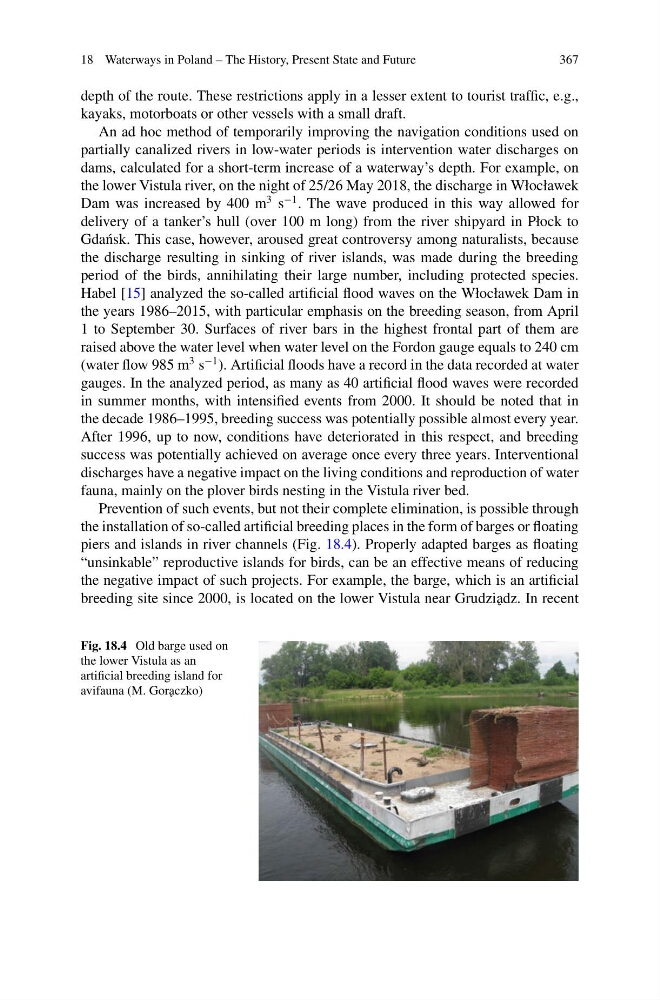
Prevention of such events, but not their complete elimination, is possible through
the installation of so-called artificial breeding places in the form of barges or floating
piers and islands in river channels (Fig. 18.4). Properly adapted barges as floating
“unsinkable” reproductive islands for birds, can be an effective means of reducing
the negative impact of such projects. For example, the barge, which is an artificial
breeding site since 2000, is located on the lower Vistula near Grudzi˛ adz. In recent
Fig. 18.4 Old barge used on
the lower Vistula as an
artificial breeding island for
avifauna (M. Gor˛ aczko)
367
depth of the route. These restrictions apply in a lesser extent to tourist traffic, e.g.,
kayaks, motorboats or other vessels with a small draft.
An ad hoc method of temporarily improving the navigation conditions used on
partially canalized rivers in low-water periods is intervention water discharges on
dams, calculated for a short-term increase of a waterway’s depth. For example, on
the lower Vistula river, on the night of 25/26 May 2018, the discharge in Włocławek
Dam was increased by 400 m
3 s
−1 . The wave produced in this way allowed for
delivery of a tanker’s hull (over 100 m long) from the river shipyard in Płock to
Gda´ nsk. This case, however, aroused great controversy among naturalists, because
the discharge resulting in sinking of river islands, was made during the breeding
period of the birds, annihilating their large number, including protected species.
Habel [15] analyzed the so-called artificial flood waves on the Włocławek Dam in
the years 1986–2015, with particular emphasis on the breeding season, from April
1 to September 30. Surfaces of river bars in the highest frontal part of them are
raised above the water level when water level on the Fordon gauge equals to 240 cm
(water flow 985 m
3 s
−1 ). Artificial floods have a record in the data recorded at water
gauges. In the analyzed period, as many as 40 artificial flood waves were recorded
in summer months, with intensified events from 2000. It should be noted that in
the decade 1986–1995, breeding success was potentially possible almost every year.
After 1996, up to now, conditions have deteriorated in this respect, and breeding
success was potentially achieved on average once every three years. Interventional
discharges have a negative impact on the living conditions and reproduction of water
fauna, mainly on the plover birds nesting in the Vistula river bed.
Prevention of such events, but not their complete elimination, is possible through
the installation of so-called artificial breeding places in the form of barges or floating
piers and islands in river channels (Fig. 18.4). Properly adapted barges as floating
“unsinkable” reproductive islands for birds, can be an effective means of reducing
the negative impact of such projects. For example, the barge, which is an artificial
breeding site since 2000, is located on the lower Vistula near Grudzi˛ adz. In recent
Fig. 18.4 Old barge used on
the lower Vistula as an
artificial breeding island for
avifauna (M. Gor˛ aczko)