

18 Waterways in Poland – The History, Present State and Future
369
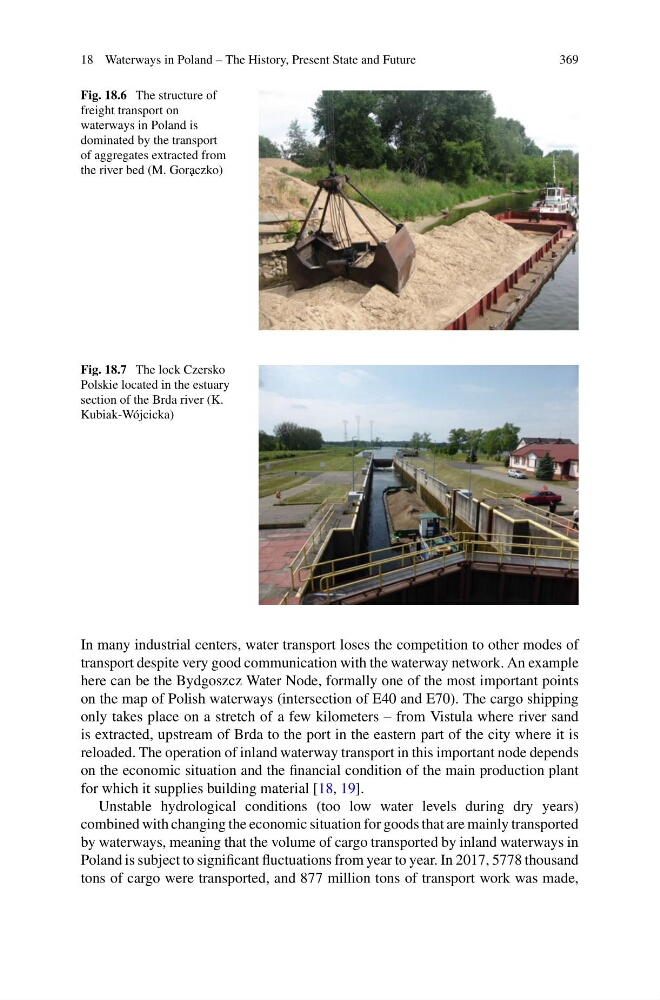
Fig. 18.6 The structure of
freight transport on
waterways in Poland is
dominated by the transport
of aggregates extracted from
the river bed (M. Gor˛ aczko)
Fig. 18.7 The lock Czersko
Polskie located in the estuary
section of the Brda river (K.
Kubiak-Wójcicka)
In many industrial centers, water transport loses the competition to other modes of
transport despite very good communication with the waterway network. An example
here can be the Bydgoszcz Water Node, formally one of the most important points
on the map of Polish waterways (intersection of E40 and E70). The cargo shipping
only takes place on a stretch of a few kilometers – from Vistula where river sand
is extracted, upstream of Brda to the port in the eastern part of the city where it is
reloaded. The operation of inland waterway transport in this important node depends
on the economic situation and the financial condition of the main production plant
for which it supplies building material [18, 19].
Unstable hydrological conditions (too low water levels during dry years)
combined with changing the economic situation for goods that are mainly transported
by waterways, meaning that the volume of cargo transported by inland waterways in
Poland is subject to significant fluctuations from year to year. In 2017, 5778 thousand
tons of cargo were transported, and 877 million tons of transport work was made,
369
Fig. 18.6 The structure of
freight transport on
waterways in Poland is
dominated by the transport
of aggregates extracted from
the river bed (M. Gor˛ aczko)
Fig. 18.7 The lock Czersko
Polskie located in the estuary
section of the Brda river (K.
Kubiak-Wójcicka)
In many industrial centers, water transport loses the competition to other modes of
transport despite very good communication with the waterway network. An example
here can be the Bydgoszcz Water Node, formally one of the most important points
on the map of Polish waterways (intersection of E40 and E70). The cargo shipping
only takes place on a stretch of a few kilometers – from Vistula where river sand
is extracted, upstream of Brda to the port in the eastern part of the city where it is
reloaded. The operation of inland waterway transport in this important node depends
on the economic situation and the financial condition of the main production plant
for which it supplies building material [18, 19].
Unstable hydrological conditions (too low water levels during dry years)
combined with changing the economic situation for goods that are mainly transported
by waterways, meaning that the volume of cargo transported by inland waterways in
Poland is subject to significant fluctuations from year to year. In 2017, 5778 thousand
tons of cargo were transported, and 877 million tons of transport work was made,