

11 Low-Flows in Polish Rivers
215
11.4 Duration and Dynamics of Low-Flow Episodes
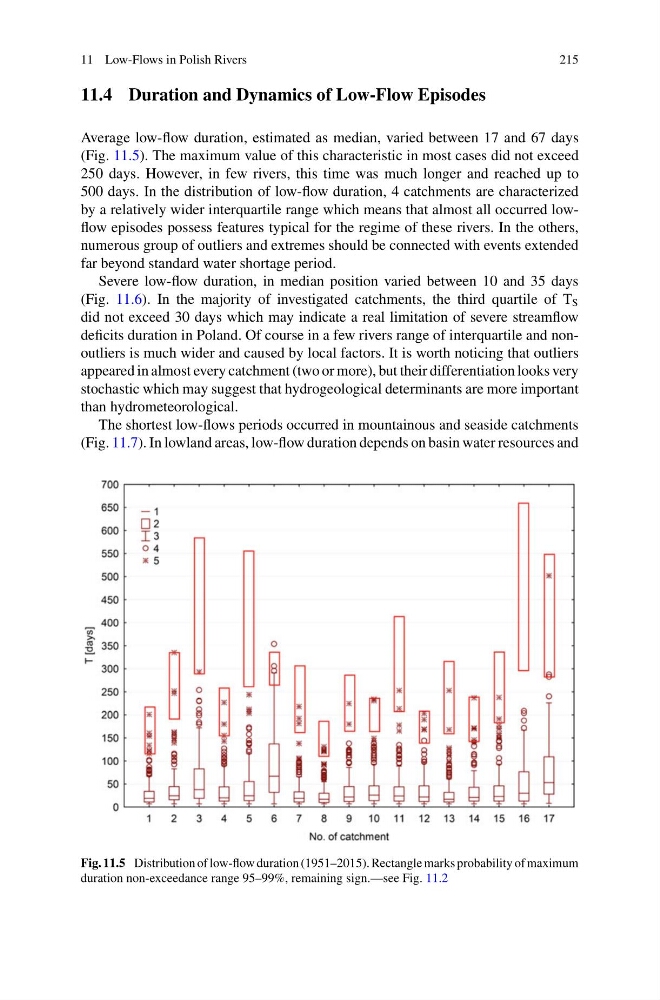
Average low-flow duration, estimated as median, varied between 17 and 67 days
(Fig. 11.5). The maximum value of this characteristic in most cases did not exceed
250 days. However, in few rivers, this time was much longer and reached up to
500 days. In the distribution of low-flow duration, 4 catchments are characterized
by a relatively wider interquartile range which means that almost all occurred lowflow episodes possess features typical for the regime of these rivers. In the others,
numerous group of outliers and extremes should be connected with events extended
far beyond standard water shortage period.
Severe low-flow duration, in median position varied between 10 and 35 days
(Fig. 11.6). In the majority of investigated catchments, the third quartile of T S
did not exceed 30 days which may indicate a real limitation of severe streamflow
deficits duration in Poland. Of course in a few rivers range of interquartile and nonoutliers is much wider and caused by local factors. It is worth noticing that outliers
appeared in almost every catchment (two or more), but their differentiation looks very
stochastic which may suggest that hydrogeological determinants are more important
than hydrometeorological.
The shortest low-flows periods occurred in mountainous and seaside catchments
(Fig. 11.7). In lowland areas, low-flow duration depends on basin water resources and
Fig. 11.5 Distribution of low-flow duration (1951–2015). Rectangle marks probability of maximum
duration non-exceedance range 95–99%, remaining sign.—see Fig. 11.2
215
11.4 Duration and Dynamics of Low-Flow Episodes
Average low-flow duration, estimated as median, varied between 17 and 67 days
(Fig. 11.5). The maximum value of this characteristic in most cases did not exceed
250 days. However, in few rivers, this time was much longer and reached up to
500 days. In the distribution of low-flow duration, 4 catchments are characterized
by a relatively wider interquartile range which means that almost all occurred lowflow episodes possess features typical for the regime of these rivers. In the others,
numerous group of outliers and extremes should be connected with events extended
far beyond standard water shortage period.
Severe low-flow duration, in median position varied between 10 and 35 days
(Fig. 11.6). In the majority of investigated catchments, the third quartile of T S
did not exceed 30 days which may indicate a real limitation of severe streamflow
deficits duration in Poland. Of course in a few rivers range of interquartile and nonoutliers is much wider and caused by local factors. It is worth noticing that outliers
appeared in almost every catchment (two or more), but their differentiation looks very
stochastic which may suggest that hydrogeological determinants are more important
than hydrometeorological.
The shortest low-flows periods occurred in mountainous and seaside catchments
(Fig. 11.7). In lowland areas, low-flow duration depends on basin water resources and
Fig. 11.5 Distribution of low-flow duration (1951–2015). Rectangle marks probability of maximum
duration non-exceedance range 95–99%, remaining sign.—see Fig. 11.2