

214
E. Tomaszewski and K. Kubiak-Wójcicka
of GMO index was estimated on the base of variation coefficient (Fig. 11.3). In
general, there is a proportional relationship between low flow seasonality and its
variability. Therefore in rivers with high GMO such as Dunajec, San, Nysa Kłodzka,
Narew or Note´ c serious seasonal perturbations of water resources managing may
be expected. This conclusion does not have to concern natural hydrological systems
because very often they have resistance mechanisms let them survive seasonal water
shortage periods.
In the analysis of the long-term variability of low flow, the existence of a linear
trend at the significance level of α = 0.05 was tested. The studies on systematic
components in the investigated time series of Lq led to the identification of linear
trends, statistically crucial for the majority of the catchments. Significance was verified using the Student’s t-test and the Mann-Kendall trend test [46, 47]. Lack of
statistically crucial trends was observed in the west part of the country, along the
whole course of the Oder River and its tributary—Nysa Kłodzka river (Fig. 11.3,
Table 11.1). Such a spatial pattern may suggest the influence of climate continentalism. However, the Oder channel is much more improved then Vistula which may
have an important impact as well. Exceptions are Pilica and Drw˛ eca river where
huge water resources stored in lake basins or aquifers make low flow regime resistant to multiannual systematic changes. The other investigated gauging cross-sections
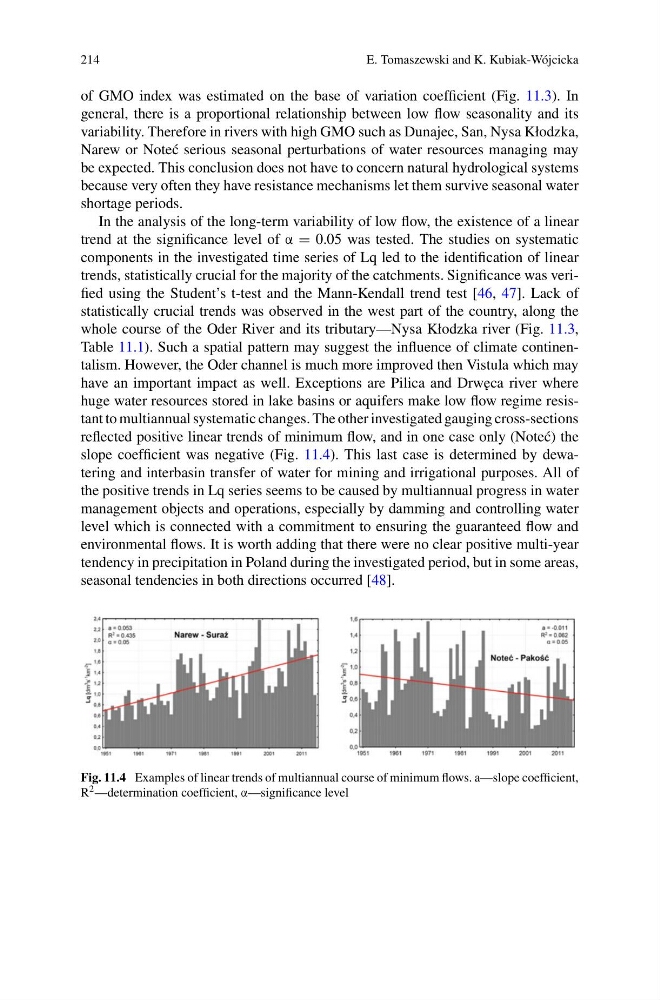
reflected positive linear trends of minimum flow, and in one case only (Note´ c) the
slope coefficient was negative (Fig. 11.4). This last case is determined by dewatering and interbasin transfer of water for mining and irrigational purposes. All of
the positive trends in Lq series seems to be caused by multiannual progress in water
management objects and operations, especially by damming and controlling water
level which is connected with a commitment to ensuring the guaranteed flow and
environmental flows. It is worth adding that there were no clear positive multi-year
tendency in precipitation in Poland during the investigated period, but in some areas,
seasonal tendencies in both directions occurred [48].
Fig. 11.4 Examples of linear trends of multiannual course of minimum flows. a—slope coefficient,
R 2 —determination coefficient, α—significance level
E. Tomaszewski and K. Kubiak-Wójcicka
of GMO index was estimated on the base of variation coefficient (Fig. 11.3). In
general, there is a proportional relationship between low flow seasonality and its
variability. Therefore in rivers with high GMO such as Dunajec, San, Nysa Kłodzka,
Narew or Note´ c serious seasonal perturbations of water resources managing may
be expected. This conclusion does not have to concern natural hydrological systems
because very often they have resistance mechanisms let them survive seasonal water
shortage periods.
In the analysis of the long-term variability of low flow, the existence of a linear
trend at the significance level of α = 0.05 was tested. The studies on systematic
components in the investigated time series of Lq led to the identification of linear
trends, statistically crucial for the majority of the catchments. Significance was verified using the Student’s t-test and the Mann-Kendall trend test [46, 47]. Lack of
statistically crucial trends was observed in the west part of the country, along the
whole course of the Oder River and its tributary—Nysa Kłodzka river (Fig. 11.3,
Table 11.1). Such a spatial pattern may suggest the influence of climate continentalism. However, the Oder channel is much more improved then Vistula which may
have an important impact as well. Exceptions are Pilica and Drw˛ eca river where
huge water resources stored in lake basins or aquifers make low flow regime resistant to multiannual systematic changes. The other investigated gauging cross-sections
reflected positive linear trends of minimum flow, and in one case only (Note´ c) the
slope coefficient was negative (Fig. 11.4). This last case is determined by dewatering and interbasin transfer of water for mining and irrigational purposes. All of
the positive trends in Lq series seems to be caused by multiannual progress in water
management objects and operations, especially by damming and controlling water
level which is connected with a commitment to ensuring the guaranteed flow and
environmental flows. It is worth adding that there were no clear positive multi-year
tendency in precipitation in Poland during the investigated period, but in some areas,
seasonal tendencies in both directions occurred [48].
Fig. 11.4 Examples of linear trends of multiannual course of minimum flows. a—slope coefficient,
R 2 —determination coefficient, α—significance level