

11 Low-Flows in Polish Rivers
213
conditions and also transit reach of Vistula river where water resources are discharged
downstream on a high level of inertia making water shortage periods less arduous
for water management. In rivers with the contribution of LLq below 30%, such as
San river, Nysa Kłodzka river or upper Vistula river, severe hydrological droughts
may be a considerable threat to basic water resources and proper structure of water
balance. The variation coefficient of an annual minimum specific flow, calculated for
the whole multi-year period, increases in inverse proportion to the LLq contribution,
presented above (Fig. 11.3). It proves in multiannual scale, the relation between low
flow dynamics and susceptibility to severe drought streamflow deficit occurrence.
In the hydrological system, deficit periods, similarly to any other phenomena, are
forming dynamically. Already D˛ ebski [43] noticed that particularly oppressive lowflows occur when water deficits happen in typical resource-feed periods. As a result,
low flow analysis should refer to those features of the flow regime which will facilitate the identification and valorisation of periods with significant disturbances in the
water balance structure. Large irregularities in the occurrence of low-flows crucially
impede the seasonal analysis based on time series in a monthly step. The solution of
this problem may be the characteristic describing the seasonal variability comprehensively. Level of low flows seasonality may by estimated by application a complex
index used by Olivier [44] to seasonal precipitation concentration analysis. This characteristic was successfully adopted to total river flow analysis in Carpathian rivers
by Soja [34]. After transformation the formula to low flow purposes, the modified
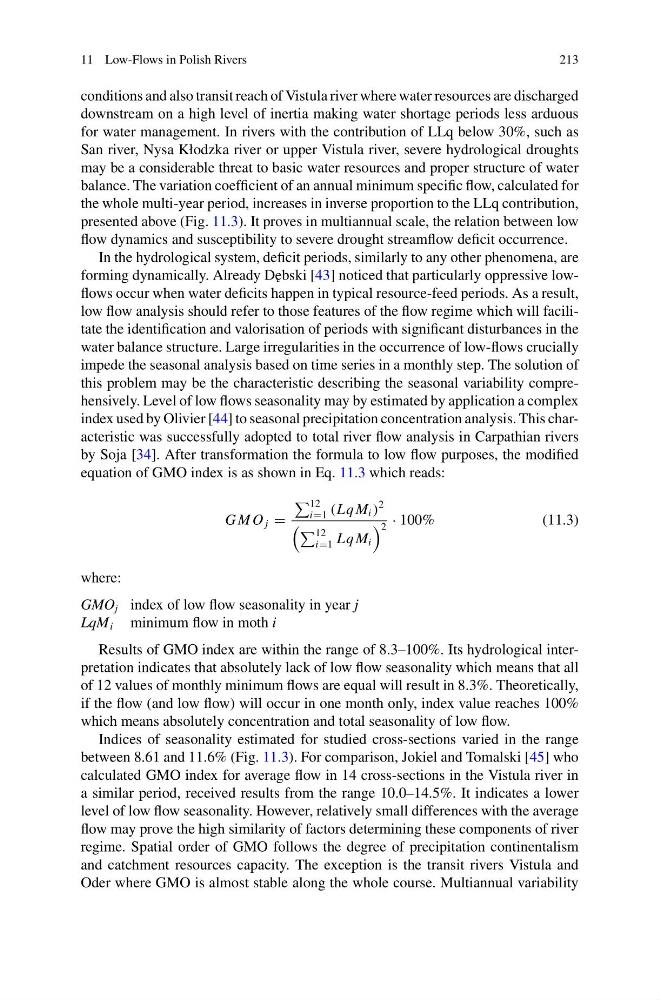
equation of GMO index is as shown in Eq. 11.3 which reads:
G M O j =
12
i=1 (Lq M i )
2
12
i=1 Lq M i
2 · 100%
(11.3)
where:
GMO j index of low flow seasonality in year j
LqM i minimum flow in moth i
Results of GMO index are within the range of 8.3–100%. Its hydrological interpretation indicates that absolutely lack of low flow seasonality which means that all
of 12 values of monthly minimum flows are equal will result in 8.3%. Theoretically,
if the flow (and low flow) will occur in one month only, index value reaches 100%
which means absolutely concentration and total seasonality of low flow.
Indices of seasonality estimated for studied cross-sections varied in the range
between 8.61 and 11.6% (Fig. 11.3). For comparison, Jokiel and Tomalski [45] who
calculated GMO index for average flow in 14 cross-sections in the Vistula river in
a similar period, received results from the range 10.0–14.5%. It indicates a lower
level of low flow seasonality. However, relatively small differences with the average
flow may prove the high similarity of factors determining these components of river
regime. Spatial order of GMO follows the degree of precipitation continentalism
and catchment resources capacity. The exception is the transit rivers Vistula and
Oder where GMO is almost stable along the whole course. Multiannual variability
213
conditions and also transit reach of Vistula river where water resources are discharged
downstream on a high level of inertia making water shortage periods less arduous
for water management. In rivers with the contribution of LLq below 30%, such as
San river, Nysa Kłodzka river or upper Vistula river, severe hydrological droughts
may be a considerable threat to basic water resources and proper structure of water
balance. The variation coefficient of an annual minimum specific flow, calculated for
the whole multi-year period, increases in inverse proportion to the LLq contribution,
presented above (Fig. 11.3). It proves in multiannual scale, the relation between low
flow dynamics and susceptibility to severe drought streamflow deficit occurrence.
In the hydrological system, deficit periods, similarly to any other phenomena, are
forming dynamically. Already D˛ ebski [43] noticed that particularly oppressive lowflows occur when water deficits happen in typical resource-feed periods. As a result,
low flow analysis should refer to those features of the flow regime which will facilitate the identification and valorisation of periods with significant disturbances in the
water balance structure. Large irregularities in the occurrence of low-flows crucially
impede the seasonal analysis based on time series in a monthly step. The solution of
this problem may be the characteristic describing the seasonal variability comprehensively. Level of low flows seasonality may by estimated by application a complex
index used by Olivier [44] to seasonal precipitation concentration analysis. This characteristic was successfully adopted to total river flow analysis in Carpathian rivers
by Soja [34]. After transformation the formula to low flow purposes, the modified
equation of GMO index is as shown in Eq. 11.3 which reads:
G M O j =
12
i=1 (Lq M i )
2
12
i=1 Lq M i
2 · 100%
(11.3)
where:
GMO j index of low flow seasonality in year j
LqM i minimum flow in moth i
Results of GMO index are within the range of 8.3–100%. Its hydrological interpretation indicates that absolutely lack of low flow seasonality which means that all
of 12 values of monthly minimum flows are equal will result in 8.3%. Theoretically,
if the flow (and low flow) will occur in one month only, index value reaches 100%
which means absolutely concentration and total seasonality of low flow.
Indices of seasonality estimated for studied cross-sections varied in the range
between 8.61 and 11.6% (Fig. 11.3). For comparison, Jokiel and Tomalski [45] who
calculated GMO index for average flow in 14 cross-sections in the Vistula river in
a similar period, received results from the range 10.0–14.5%. It indicates a lower
level of low flow seasonality. However, relatively small differences with the average
flow may prove the high similarity of factors determining these components of river
regime. Spatial order of GMO follows the degree of precipitation continentalism
and catchment resources capacity. The exception is the transit rivers Vistula and
Oder where GMO is almost stable along the whole course. Multiannual variability