

188
P. Jokiel and P. Tomalski
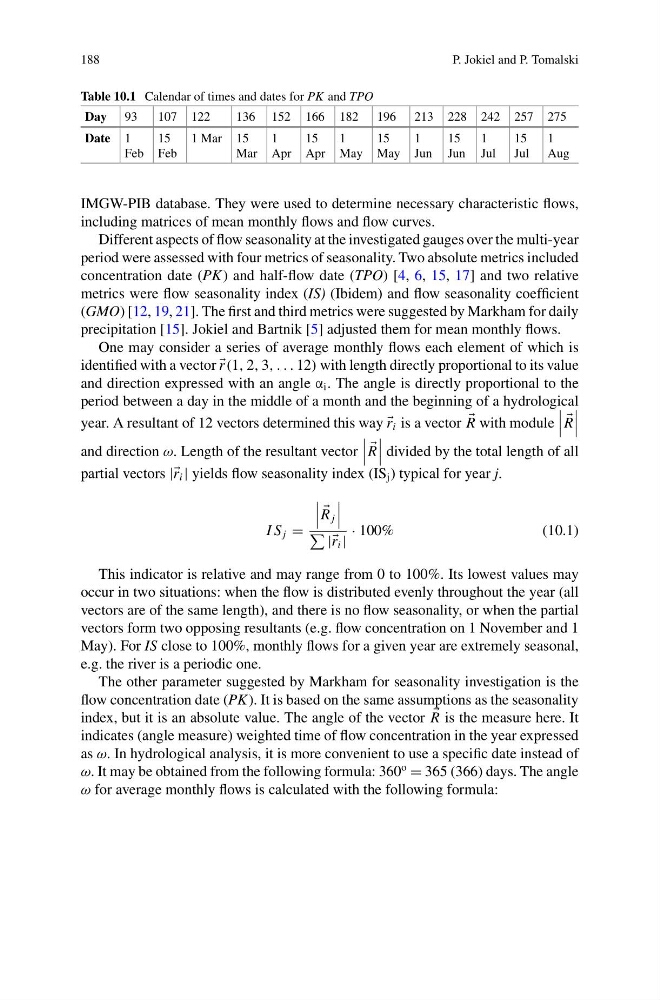
Table 10.1 Calendar of times and dates for PK and TPO
Day 93
107 122
136 152 166 182 196 213 228 242 257 275
Date 1
Feb
15
Feb
1 Mar 15
Mar
1
Apr
15
Apr
1
May
15
May
1
Jun
15
Jun
1
Jul
15
Jul
1
Aug
IMGW-PIB database. They were used to determine necessary characteristic flows,
including matrices of mean monthly flows and flow curves.
Different aspects of flow seasonality at the investigated gauges over the multi-year
period were assessed with four metrics of seasonality. Two absolute metrics included
concentration date (PK) and half-flow date (TPO) [4, 6, 15, 17] and two relative
metrics were flow seasonality index (IS) (Ibidem) and flow seasonality coefficient
(GMO) [12, 19, 21]. The first and third metrics were suggested by Markham for daily
precipitation [15]. Jokiel and Bartnik [5] adjusted them for mean monthly flows.
One may consider a series of average monthly flows each element of which is
identified with a vector
r (1, 2, 3, . . . 12) with length directly proportional to its value
and direction expressed with an angle α i . The angle is directly proportional to the
period between a day in the middle of a month and the beginning of a hydrological
year. A resultant of 12 vectors determined this way
r i is a vector
R with module
R
and direction ω. Length of the resultant vector
R
divided by the total length of all
partial vectors | r i | yields flow seasonality index (IS j ) typical for year j.
I S j =
R j
| r i |
· 100%
(10.1)
This indicator is relative and may range from 0 to 100%. Its lowest values may
occur in two situations: when the flow is distributed evenly throughout the year (all
vectors are of the same length), and there is no flow seasonality, or when the partial
vectors form two opposing resultants (e.g. flow concentration on 1 November and 1
May). For IS close to 100%, monthly flows for a given year are extremely seasonal,
e.g. the river is a periodic one.
The other parameter suggested by Markham for seasonality investigation is the
flow concentration date (PK). It is based on the same assumptions as the seasonality
index, but it is an absolute value. The angle of the vector
R is the measure here. It
indicates (angle measure) weighted time of flow concentration in the year expressed
as ω. In hydrological analysis, it is more convenient to use a specific date instead of
ω. It may be obtained from the following formula: 360
o
= 365 (366) days. The angle
ω for average monthly flows is calculated with the following formula:
P. Jokiel and P. Tomalski
Table 10.1 Calendar of times and dates for PK and TPO
Day 93
107 122
136 152 166 182 196 213 228 242 257 275
Date 1
Feb
15
Feb
1 Mar 15
Mar
1
Apr
15
Apr
1
May
15
May
1
Jun
15
Jun
1
Jul
15
Jul
1
Aug
IMGW-PIB database. They were used to determine necessary characteristic flows,
including matrices of mean monthly flows and flow curves.
Different aspects of flow seasonality at the investigated gauges over the multi-year
period were assessed with four metrics of seasonality. Two absolute metrics included
concentration date (PK) and half-flow date (TPO) [4, 6, 15, 17] and two relative
metrics were flow seasonality index (IS) (Ibidem) and flow seasonality coefficient
(GMO) [12, 19, 21]. The first and third metrics were suggested by Markham for daily
precipitation [15]. Jokiel and Bartnik [5] adjusted them for mean monthly flows.
One may consider a series of average monthly flows each element of which is
identified with a vector
r (1, 2, 3, . . . 12) with length directly proportional to its value
and direction expressed with an angle α i . The angle is directly proportional to the
period between a day in the middle of a month and the beginning of a hydrological
year. A resultant of 12 vectors determined this way
r i is a vector
R with module
R
and direction ω. Length of the resultant vector
R
divided by the total length of all
partial vectors | r i | yields flow seasonality index (IS j ) typical for year j.
I S j =
R j
| r i |
· 100%
(10.1)
This indicator is relative and may range from 0 to 100%. Its lowest values may
occur in two situations: when the flow is distributed evenly throughout the year (all
vectors are of the same length), and there is no flow seasonality, or when the partial
vectors form two opposing resultants (e.g. flow concentration on 1 November and 1
May). For IS close to 100%, monthly flows for a given year are extremely seasonal,
e.g. the river is a periodic one.
The other parameter suggested by Markham for seasonality investigation is the
flow concentration date (PK). It is based on the same assumptions as the seasonality
index, but it is an absolute value. The angle of the vector
R is the measure here. It
indicates (angle measure) weighted time of flow concentration in the year expressed
as ω. In hydrological analysis, it is more convenient to use a specific date instead of
ω. It may be obtained from the following formula: 360
o
= 365 (366) days. The angle
ω for average monthly flows is calculated with the following formula: