

10 Flow Seasonality in Two Big Polish Rivers – The Vistula …
189
ω = arctg
⎛
⎜
⎜
⎜
⎝
12
i=1
| r i | cos α i
12
i=1
| r i | sin α i
⎞
⎟
⎟
⎟
⎠
(10.2)
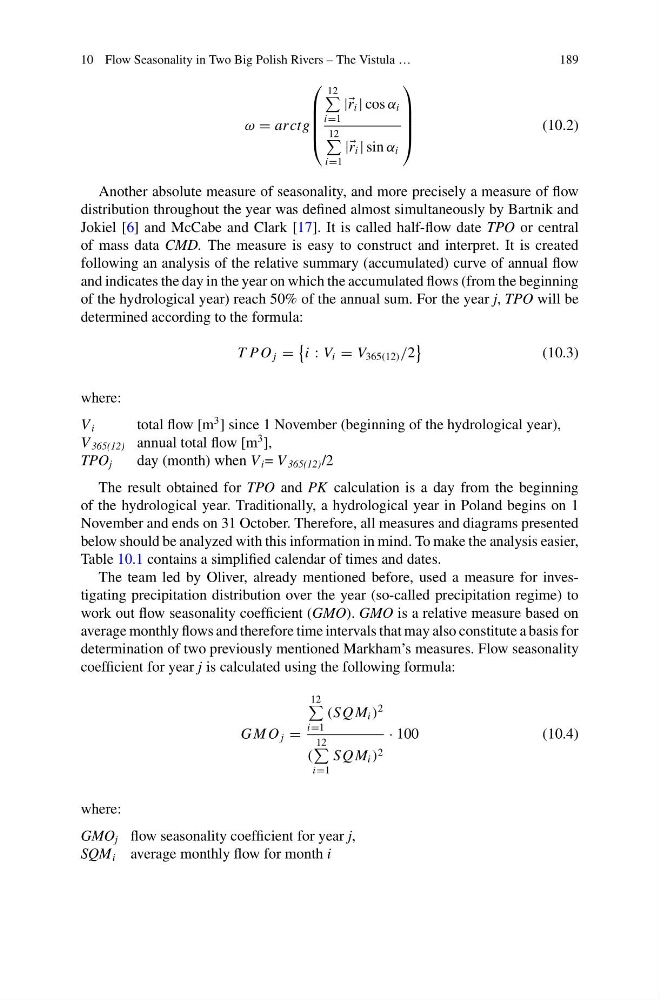
Another absolute measure of seasonality, and more precisely a measure of flow
distribution throughout the year was defined almost simultaneously by Bartnik and
Jokiel [6] and McCabe and Clark [17]. It is called half-flow date TPO or central
of mass data CMD. The measure is easy to construct and interpret. It is created
following an analysis of the relative summary (accumulated) curve of annual flow
and indicates the day in the year on which the accumulated flows (from the beginning
of the hydrological year) reach 50% of the annual sum. For the year j, TPO will be
determined according to the formula:
T P O j =
i : V i = V 365(12) /2
(10.3)
where:
V i
total flow [m
3 ] since 1 November (beginning of the hydrological year),
V 365(12) annual total flow [m
3 ],
TPO j
day (month) when V i = V 365(12) /2
The result obtained for TPO and PK calculation is a day from the beginning
of the hydrological year. Traditionally, a hydrological year in Poland begins on 1
November and ends on 31 October. Therefore, all measures and diagrams presented
below should be analyzed with this information in mind. To make the analysis easier,
Table 10.1 contains a simplified calendar of times and dates.
The team led by Oliver, already mentioned before, used a measure for investigating precipitation distribution over the year (so-called precipitation regime) to
work out flow seasonality coefficient (GMO). GMO is a relative measure based on
average monthly flows and therefore time intervals that may also constitute a basis for
determination of two previously mentioned Markham’s measures. Flow seasonality
coefficient for year j is calculated using the following formula:
G M O j =
12
i=1
(S Q M i )
2
(
12
i=1
S Q M i ) 2
· 100
(10.4)
where:
GMO j flow seasonality coefficient for year j,
SQM i average monthly flow for month i
189
ω = arctg
⎛
⎜
⎜
⎜
⎝
12
i=1
| r i | cos α i
12
i=1
| r i | sin α i
⎞
⎟
⎟
⎟
⎠
(10.2)
Another absolute measure of seasonality, and more precisely a measure of flow
distribution throughout the year was defined almost simultaneously by Bartnik and
Jokiel [6] and McCabe and Clark [17]. It is called half-flow date TPO or central
of mass data CMD. The measure is easy to construct and interpret. It is created
following an analysis of the relative summary (accumulated) curve of annual flow
and indicates the day in the year on which the accumulated flows (from the beginning
of the hydrological year) reach 50% of the annual sum. For the year j, TPO will be
determined according to the formula:
T P O j =
i : V i = V 365(12) /2
(10.3)
where:
V i
total flow [m
3 ] since 1 November (beginning of the hydrological year),
V 365(12) annual total flow [m
3 ],
TPO j
day (month) when V i = V 365(12) /2
The result obtained for TPO and PK calculation is a day from the beginning
of the hydrological year. Traditionally, a hydrological year in Poland begins on 1
November and ends on 31 October. Therefore, all measures and diagrams presented
below should be analyzed with this information in mind. To make the analysis easier,
Table 10.1 contains a simplified calendar of times and dates.
The team led by Oliver, already mentioned before, used a measure for investigating precipitation distribution over the year (so-called precipitation regime) to
work out flow seasonality coefficient (GMO). GMO is a relative measure based on
average monthly flows and therefore time intervals that may also constitute a basis for
determination of two previously mentioned Markham’s measures. Flow seasonality
coefficient for year j is calculated using the following formula:
G M O j =
12
i=1
(S Q M i )
2
(
12
i=1
S Q M i ) 2
· 100
(10.4)
where:
GMO j flow seasonality coefficient for year j,
SQM i average monthly flow for month i